

Enjoy the benefits of a premium membership!
Upgrade Account
-
TalkBass has been independent since 1998. Add your voice.
Create a free account to reply to discussions, view embedded media, and browse with fewer display ads.
Join free Log in
Want zero display ads or expanded classifieds tools? Compare plans.
You are using an out of date browser. It may not display this or other websites correctly.
You should upgrade or use an alternative browser.
You should upgrade or use an alternative browser.
More options
Who Replied?
I believe whatever neck option is on your L2K could be selected for an SB-2 -- just a matter of figuring out what neck profile you have and want to match
[Invalid or Expired Link Removed]
I'm rather partial to the #10, the only offering for a 5 string. Makes it easier to know what you're getting if you buy used when there's only the one.
Very likely. G&L offers 6 different neck shape options (for 4-string). With 3 different nut widths and 2 board radiuses, and all necks are 21 frets. I cannot imagine there is a specific neck pocket size required for each of these necks...
Mine's got a #7 according to that chart, 12" radius with a 1.75" nut width (4-string). I love this neck. Given the quality portrayed from my Indonesian L2K Tribute, I don't think I can justify the cost difference by going USA-made.. Maybe I'll just have to start saving my pennies for an SB-2..
...
Wait a sec.. We don't have pennies anymore!


Just added a homemade ramp to my L2500.
It's in between the neck and neck pickup, about 1/2" high. Went to Lowes with measurements, they gave me some scrap wood for free and cut into specs. I sanded and wrapped in gaff tape. Used double sided tape to keep it in place. I purposely made it way longer than the pickup, so that even on really far flamenco style strums on the G string my fingers are still above the ramp.
Will uploaded pics later.
It's in between the neck and neck pickup, about 1/2" high. Went to Lowes with measurements, they gave me some scrap wood for free and cut into specs. I sanded and wrapped in gaff tape. Used double sided tape to keep it in place. I purposely made it way longer than the pickup, so that even on really far flamenco style strums on the G string my fingers are still above the ramp.
Will uploaded pics later.
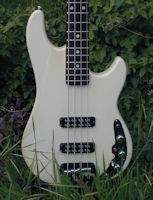
Very likely. G&L offers 6 different neck shape options (for 4-string). With 3 different nut widths and 2 board radiuses, and all necks are 21 frets. I cannot imagine there is a specific neck pocket size required for each of these necks...
Almost. The JB has 20 frets and is 4 bolt. As to fitment, if the neck to be installed is from roughly the same build time as the target body and both are modern G&L, it should go. "Should" being the operative word here. There is still a little hand adjusting done during final assembly.
Ken...
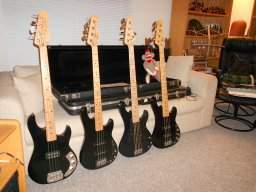

Here's the bass ramp I added. The covering is gaff tape, and I decided to be creative with it hence the stripes. As it wears down, I can always add more tape, and even add tape to increase the overall height if I'm not happy. The core of the ramp is some weird cardboard/lightweight wood material. Stuck on bass with double sided tape. Complete game changer with technique.


The more I see/read about ramps, the more I want to try one out.
I don't play with my fingers often due.to.sever carpal tunnel syndrome, however, I've been trying to "play through the pain" and I think one would help me with.my right-hand technic.
Now that I have really nice gear, I can focus more on skill. I'm thinkin' between the pickups on my L2K, definitely home-made.. I've got a long weekend coming up so maybe I'll experiment with one.
I don't play with my fingers often due.to.sever carpal tunnel syndrome, however, I've been trying to "play through the pain" and I think one would help me with.my right-hand technic.
Now that I have really nice gear, I can focus more on skill. I'm thinkin' between the pickups on my L2K, definitely home-made.. I've got a long weekend coming up so maybe I'll experiment with one.
The more I see/read about ramps, the more I want to try one out.
I don't play with my fingers often due.to.sever carpal tunnel syndrome, however, I've been trying to "play through the pain" and I think one would help me with.my right-hand technic.
Now that I have really nice gear, I can focus more on skill. I'm thinkin' between the pickups on my L2K, definitely home-made.. I've got a long weekend coming up so maybe I'll experiment with one.
I'm genuinely blown away by the difference in playability, for both finger style, slap, and other extended techniques. I wasn't doing it due to pain, but I can completely see the health benefits of using a ramp for that reason. The plus of the tape is that it has a fabric quality to it, so it is incredibly soft on the fingers.
Total, the most expensive part was the tape. ~$7 for that, some scrap wood which was cut and sanded, and spare tape I had around the house. About 30 minutes of work.

There may be situations where playing through pain can do no further damage.
In my experience carpal tunnel is not one of those situations.
It's an issue of inflammation and nerves and it's rather startling how physical problems can escalate when nerves are involved.
Playing through the pain is not a workable strategy.
In my experience carpal tunnel is not one of those situations.
It's an issue of inflammation and nerves and it's rather startling how physical problems can escalate when nerves are involved.
Playing through the pain is not a workable strategy.
My wife has carpal tunnel. Definitely have a doctor look at it and make suggestions. You can make it worse.
There may be situations where playing through pain can do no further damage.
In my experience carpal tunnel is not one of those situations.
It's an issue of inflammation and nerves and it's rather startling how physical problems can escalate when nerves are involved.
Playing through the pain is not a workable strategy.
My wife has carpal tunnel. Definitely have a doctor look at it and make suggestions. You can make it worse.
Let me re-phrase that.. I'm trying to, or would at least try to play finger-style more often than with a pick, especially when playing with other people where a pick is not suitable, but my stamina is gone out the window.. I'm talking minutes, if that. Nerve problems are terrible and extremely painful/debilitating. I've had CTS issues since I was a young teenager, and pretty sure I'm developing more nerve problems in my left hand (my research leading to Ulnar nerve problems).
I've already had the testing done, diagnosed with severe CTS, and my left wrist was fixed a few years ago, just hard to make the time to get the other one fixed when I'm the only income in my family. I do have a 2-week paid vacation this summer, so I might take advantage of that and get it done then. I was back to work within a week/week-and-a-half when I had the left one fixed. I work in an industrial environment operating extruding machines, and some of the work is very repetitive, but it's nothing I'd be able to not do with a brace on my hand. I was working in a paper mill doing similar operational work which was very hands-on and managed when the left wrist was done, so yeah. For me, it's just a matter of finding the right time to get the other one fixed.
I can tell you, the Carpal Tunnel Release procedure they do to fix it, really helped my left hand. I was amazed at how more responsive and how much more my left hand "listened" when I told it to do things, like chording an acoustic guitar for example.

That is a very strange coincidence seeing this discussion coming up right now! I just have had a CTS threat this last night with my left hand. I think I had practiced too much on SO WHAT these last days, catching the Eb with my pinky on the 11th fret. I went to an osteopath today and she said I cannot know what's really going on before a few days, after she manipulated everything between my hand and my neck... Let's see tomorrow and during the coming weeks. I need to keep quiet: no bass, no horse, my two main activities.
I was aware of the risk with a potentially wrong hand position, after reading about it in Ed Friedland's books ("4 fingers - 4 frets"). I'm scared about having to sell all my basses some day!!!
I was aware of the risk with a potentially wrong hand position, after reading about it in Ed Friedland's books ("4 fingers - 4 frets"). I'm scared about having to sell all my basses some day!!!
Last edited:
That is a very strange coincidence seeing this discussion coming up right now! I just have had a CTS threat since last night with my left hand. I think I had practiced too much on SO WHAT these last days, catching the Eb on the 11th fret. I went to an osteopath today and she said I cannot know what's really going on before a few days, after she manipulated everything between my hand and my neck... Let's see tomorrow and during the coming weeks. I need to keep quiet: no bass, no horse, my two main activities.
I was aware of the risk with a potentially wrong hand position, after reading about it in Ed Friedland's books ("4 fingers - 4 frets"). I'm scared about having to sell all my basses some day!!!
Not to de-rail this thread further, but you're tested for CTS by a specialist performing an Electromyogram, which is essentially a series of electrical shocks on various parts of your hands/elbows to determine how fast and well your nerves respond to these electrical shocks. It doesn't hurt, you will twitch, and it feels more or less like a static shock. The severity is based on the results of this test. I had it done a few years ago, and apparently was the worst case that particular doctor had seen in some one my age (I was 26 at the time).
I can tell you right now, I lose sleep and ability over it. Simple tasks like writing, feels like a rubber band is being snapped inside my wrist, ontop of the chronic numbness, burning, tingling, and overall aching pains that come with it. It's not something you should brush off. The CT Release procedure only took about 20 minutes to be completed under a local anesthetic (freezing). It's mostly painful during the first week of recovery, nothing a little Advil/Tylenol can't help.
The Dr. who performed it actually encouraged me to play bass more to rehabilitate my hand back into normal function. Said that it was probably one of the best forms of physiotherapy for this procedure, given the way the hands/wrist move when playing bass/guitar.
Not sure what your health care is like in France, but I didn't have to pay for it. My family Dr. referred me to a specialist who performed the test, who sent me to a local surgeon who performs the operation. Fortunately for me (in Canada), it's covered by my provincial health care plan.
I was fully functional after about a solid 2 months, where the recovery pain was completely gone, and my hand/wrist was no longer stiff. It only leaves a scar about 1 5/8" long from the wrist going into the palm of the hand.
Lowendtech
Happily trending in my own peculiar direction.
Best advice I got from a Doctor was "LISTEN TO YOUR BODY".
If something you're doing doesn't feel right and you want to keep doing it, then you have to figure out a different path to get there. I think playing through pain in a complex joint like the wrist is not the same as pushing a muscle hard to increase strength/endurance.
If something you're doing doesn't feel right and you want to keep doing it, then you have to figure out a different path to get there. I think playing through pain in a complex joint like the wrist is not the same as pushing a muscle hard to increase strength/endurance.
Carol Kaye describes her approach on one of her bass instruction videos. She had to develop her left had style to be able to cope with the sometimes 10+ hours a day of session work. She uses mostly her index and middle fingers along with the pinky; the ring finger doesn't get much action. She claims this saved her from CTS. Could be worth looking at before you give up the bass. You can get details from Carol. She has a web site and she responds to emails very quickly.... no bass, no horse, my two main activities.
I was aware of the risk with a potentially wrong hand position, after reading about it in Ed Friedland's books ("4 fingers - 4 frets"). I'm scared about having to sell all my basses some day!!!
Thank you to the three of you. The next steps will be: see a doctor, have some physiotherapy, try infiltrations, have electromyogram, end with surgery if needed. Let's see how all this develops... I was lucky to get within hours a one hour appointment with an osteopath today. She was very helpful for the pain and the tingling.
Last edited:

Here's one more encouragement for the CT release surgery, assuming the nerve response tests mentioned above indicate the procedure. I needed it in both hands - did each one year apart. It's quick, not too painful, and I was gigging within a month. Best of all, recovery has been 100%. ...really ...totally.
Last edited:
That's very good news that you are completely recovered! Did you change your approach to playing at all? Or perhaps, your CTS was not due to playing the bass but something else?Here's one more encouragement for the CT release surgery, assuming the nerve response tests mentioned above indicate the procedure. I needed it in both hands - did each one year apart. It's quick, not too painful, and I was gigging within a month. Best of all, recovery has been 100%. ...really ...totally.
That's very good news that you are completely recovered! Did you change your approach to playing at all? Or perhaps, your CTS was not due to playing the bass but something else?
I'm not sure how much CTS was caused by playing. I work on computers a lot and actually bike riding seemed to aggravate the condition the most. But it certainly affected bass playing. Whole nights were tough, and I had to stretch and relax my arm a lot. I never switched technique at all.
There have been a few other threads on this topic over time if anyone wants to dig into it. There's some very good and thorough advice (some of it conflicting, of course) on CTS on this site. I think we've taken this thread sideways
 .
.
Mine was caused by a lot of time at the computer -- during a period when we were under the gun to migrate a very large project from one language/OS to another and then to burn off stress I was mountain biking long rides with a handlebar setup that really only allowed one hand/wrist position.
My osteopath explained to me that what happens many times is that we're asking our muscles to do two things at once -- move and not move -- as in working a mouse -- if you tend to hover with the mouse there is tension in the arm wrist shoulder that releases a little but not all the way, so we're in a position of maintaining a ready to move, but not moving position. Somewhat similar with bike riding, but added pounding and stress. So as a result, there are lots of micro tears in the muscle leading to inflammation and the nerves get involved.
So as a practice you have to consciously allow those muscles to relax rather than hover. Very similar playing an instrument like bass, guitar or piano. Unnecessary tension is a technique killer.
fwiw
My osteopath explained to me that what happens many times is that we're asking our muscles to do two things at once -- move and not move -- as in working a mouse -- if you tend to hover with the mouse there is tension in the arm wrist shoulder that releases a little but not all the way, so we're in a position of maintaining a ready to move, but not moving position. Somewhat similar with bike riding, but added pounding and stress. So as a result, there are lots of micro tears in the muscle leading to inflammation and the nerves get involved.
So as a practice you have to consciously allow those muscles to relax rather than hover. Very similar playing an instrument like bass, guitar or piano. Unnecessary tension is a technique killer.
fwiw


