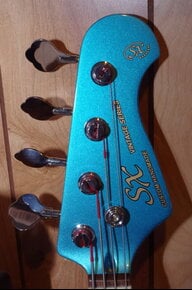
That was an option but never seen one with Bass written
Yeah, I think you're both right about that.I've seen just the G&L name alone nothing else.

TalkBass has been independent since 1998. Add your voice.
Create a free account to reply to discussions, view embedded media, and browse with fewer display ads.
Join free Log in
Want zero display ads or expanded classifieds tools? Compare plans.
That was an option but never seen one with Bass written
Yeah, I think you're both right about that.I've seen just the G&L name alone nothing else.

Educate a bassist that should know how to identify a quartersawn neck and why it's important. I think I used to know, but I don't anymore!
Educate a bassist that should know how to identify a quartersawn neck and why it's important. I think I used to know, but I don't anymore!

That BTO and CS option is (wasYeah, I think you're both right about that.
 ) named "Logo Delete" or "Model Logo Delete"
The 3-bolt LB-100s said "LB-100 Bass" and the 6-bolts just said "LB-100." So yeah, makes sense that it's not a LB-100 neck.View attachment 7402585
Looks like they scraped off the "L-2000" part of the label.

small sample size, but here goesI wonder if there were more cases of early L series basses having ski jumps with dark wood fingerboards vs maple 1pc units. My '81 L2K with ebony had a very thin wiggly neck and ski jump whereas this '81 L1K maple seems rock solid and true.
I'm sure it has more to do with the fatness, hardness, and structure of the neck rather than the fingerboard material, but being 1pc probably doesn't hurt.
My '80 L-1000 (pictured above) with an ebony board was very thin front to back. It did require some truss rod adjustments in its early years, but has been stable for the last 40 or so. It never had a hint of ski jump. I've owned 8 G&L basses over those years (I only have the L1K today). I never had a ski jump issue, or a "wiggly" neck except as noted. I did have an '06 SB-2 that had a " buried" truss rod end and required some painful surgery to gain access, but otherwise their necks have behaved very well. Of course my newest one was that '06, so a lot of things may have changed since then.I wonder if there were more cases of early L series basses having ski jumps with dark wood fingerboards vs maple 1pc units. My '81 L2K with ebony had a very thin wiggly neck and ski jump whereas this '81 L1K maple seems rock solid and true.
I'm sure it has more to do with the fatness, hardness, and structure of the neck rather than the fingerboard material, but being 1pc probably doesn't hurt.

My 40th Anniversary SB-1 came with such a 'model logo delete':That BTO and CS option is (was
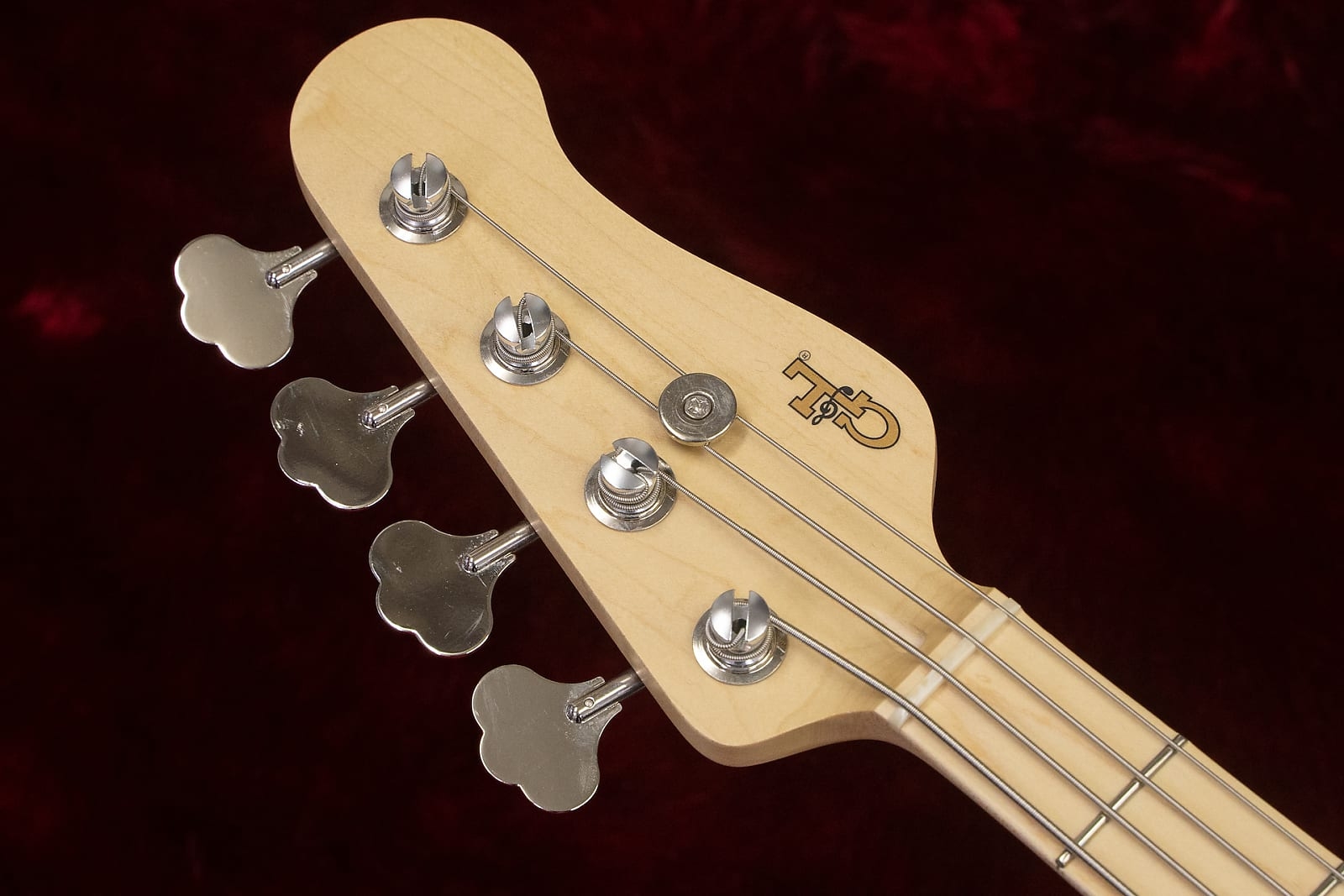

I used a stack pot on my SB-2 to stack the two individual pickup volumes and then added a master volume so I could preset the relative volume of the pickups with the stacked pot and control the overall volume with the master. It has worked great.
Kim
If I recall correctly, I used an Alpha stacked pot that I got on Amazon. It fit perfectly in my SB-2 (Tribute).
Kim


Yes, this is that one.@Ricky Rioli - looking good! Is this by chance the one you had all the neck/truss issues with?
I don't have the whole story of what G&L was using for bass strings that first year of business when I bought my L-1000, but mine came with generic round wounds - couldn't say what brand. I think I recall no silks. I was playing 6 nights a week back then so whatever they were likely got changed pretty quickly.All - what strings did G&L use in the early days when Leo was at the helm? I know GHS Brite Flats were stock for Leo era Music Man, and Fender used Squier flats until late '70s/early '80s (yes I'm aware he sold to CBS in mid-'60s).
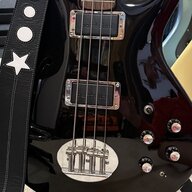
I have a Tribute M2000 and kept it over a similar L2500. I just felt it was easier to dial in what I wanted tonally. Fortunately enough G&L product has been built that they will continue to show up on the used market but maybe in fewer numbers now that new ones can no longer be had. It is a loss at least as far as the basses are concerned.I broke out my tribute M-2500. Haven't seen it for about 6 months. Never played it much when I got it. I got 2 other Fullerton M-2500s kinda at the same time. So the tribute got a setup and put away.
Smitten to say the least. First time hearing it through some amplification.
Extreme clarity. So surprised by the on-board electronics all the way to the pickups. These Basses are active. 100% of the time. And you would think there would be some similarity in tone. And there is but, each one has a sound. Hard to explain.
I also have a (usa) Fullerton L-2500.
Great Bass. It's much "tamer" sounding. And the neck doesn't seem as fast.
Just throwing smack at the wall and see what explodes.
With the loss of a great manufacture such as G&L the low end will suffer.
Well, the point of the post was how awesome my M-2500's are.. The L series seem to get the most love. I definitely dig the M series.

SB-1 has a more slender (at the waist) body shape and an MFD split coil P-type pickup. The LB100 is more of a Fenderish P-bass with a garden variety split pickup.I have a 1990 SB1 and it looks a lot like a LB100. Can some tell me the difference? I've been playing G&Lsince 1986 counting the 3 G&L s I have now I've had 6 but can't tell the difference between your lb and my about
Thanks