• TalkBass has been independent since 1998. Add your voice.
    Create a free account to reply to discussions, view embedded media, and browse with fewer display ads.
    Join freeLog in
    Want zero display ads or expanded classifieds tools? Compare plans.

Genz Benz testing issues and general rig advise needed

Lets get this straight right out of the box. There is no such thing ever as a flat sounding bass rig. No one on the planet can build a flat response (manageable) speaker cab period. So hence there is no flat sounding amp if you hook it to a cab.

Chunger, you should try the 9.0 into two Neox 112 Cabs.

For tubes I run a 1955 Mullard Long Plate ECC83 in my Shuttle 9.0.
 
What improvement does that make for you?

And how did you date the tube?

It is nice, warm, round, subtle but definitely add character.

On date, I dated it by the date code. :eek:

Oh and I brought her flowers.:D

I purchased 6 of these NOS NIB from Vacuum Tube Valley a couple years ago. They were not cheap but they were well worth it. I have a picture of them somewhere, I'll dig it up.
 
Cheers for that mate, I was wondering what you would call a larger cabinet? I'm guessing youd advise against having the switch in on the 9 with either a bergantino ae210 (what about with two?) or a barefaced midget t?

Depends. If you are going to drive the amp hard, I would hesitate to recommend using the low frequency extension on most (8 ohm) 210 cabinets and all 4 ohm 210 cabinets because they will exceed their extreme low frequency mechanical power handling capabilities at 500+ watts, but if you are even somewhat conservative there shouldn't be a problem. Conservative and common sense are the key concepts here.

My biggest caution to all of the users of the SUB-compact cabinets like out STL series (and similar products by other manufacturers) is that trying to get extended low frequency response at high levels on these cabinets just isn't going to happen and will leave you with a mechanically damaged driver. I certainly don't want to see anybody do this without understanding the risks.
 
It is nice, warm, round, subtle but definitely add character.

On date, I dated it by the date code. :eek:

Oh and I brought her flowers.:D

I purchased 6 of these NOS NIB from Vacuum Tube Valley a couple years ago. They were not cheap but they were well worth it. I have a picture of them somewhere, I'll dig it up.

Thanks, just after I posted that question I educated myself regarding tube date codes with a few searches.
 
Depends. If you are going to drive the amp hard, I would hesitate to recommend using the low frequency extension on most (8 ohm) 210 cabinets and all 4 ohm 210 cabinets because they will exceed their extreme low frequency mechanical power handling capabilities at 500+ watts, but if you are even somewhat conservative there shouldn't be a problem. Conservative and common sense are the key concepts here.

My biggest caution to all of the users of the SUB-compact cabinets like out STL series (and similar products by other manufacturers) is that trying to get extended low frequency response at high levels on these cabinets just isn't going to happen and will leave you with a mechanically damaged driver. I certainly don't want to see anybody do this without understanding the risks.

Yes, I often run my 8 ohm 400 watt 2x10 with my Shuttle 9.0 but I never turn the master past half way though I do use the LF Boost to get more out of it.
 
Depends. If you are going to drive the amp hard, I would hesitate to recommend using the low frequency extension on most (8 ohm) 210 cabinets and all 4 ohm 210 cabinets because they will exceed their extreme low frequency mechanical power handling capabilities at 500+ watts, but if you are even somewhat conservative there shouldn't be a problem. Conservative and common sense are the key concepts here.

My biggest caution to all of the users of the SUB-compact cabinets like out STL series (and similar products by other manufacturers) is that trying to get extended low frequency response at high levels on these cabinets just isn't going to happen and will leave you with a mechanically damaged driver. I certainly don't want to see anybody do this without understanding the risks.

A-Horse...I've had a 6.0 for a few weeks now and am luvin it but still feeling out it's limits. With my SR5HH, the LF extend really adds happiness to my bottom. :p I got a Avatar B210neo last week and will try it out live this weekend for the first time.

I realize my ears will be the final common sense judge but whats your opinion on pushing it with the following setup?
GK neo212 600watts 36Hz +/-5dB and Avatar 210neo 500watts. Avatars have custom deltalites with extended Xmax(5.2mm?) Both 8ohm cabs would be getting 300 watts with EQ fairly flat and LF extend engauged.

Outdoor gig with unknown PA support so I'm hoping for a decent kick from the amp.
 
No problem with either cabinet IMO. I suspect you will like the 212 for what you are trying to achieve, but try both.
 
how different is a 6.0 with low extend engaged vs a 9.0 vs a 9.0 with low extend engaged
(with or without any necessary dialback of the low eq)

does the low end button extend relative to the starting point or does it put them back on even footing with the disclaimer that you should now be minding your headroom.
 
The difference is quite small, 4 or 5 Hz or so, but when coupled with the additional power it's noticeable.

The extend is reasonably (not exactly) proportional between the 6 and 9. Starting and ending a shade lower on the 9.0.
 
I did a few more tests recently with the shuttle 9.0. It has been performing adequately in all settings I've played in. I did a test by plugging an alembic f-1x into the effects loop return to bypass the onboard preamp to hear more directly how the ice module sounds. Granted I don't know how much filtering still happens before the fx return hits the power amp but it was a really big difference in breadth and depth of tone. Just massive gooey, saucey bass with rich harmonics up top.

Very different voiced preamps but both single 12ax7 deals. In my opinion the f-1x is a bit more robust of a pre design. Very voiced but good at what it does. Good enough imo as a serious studio tool. The ice module still sounds a. Little bit veiled but given the size and power I give it a lot of slack.

So after that test I went ahead and traded the alembic for a markbass f1 just to try another flavor. I think at this point I will have to recommend the markbass line for general duty. I feel even though the f1 does not have as much saucey tube drive flavor, it delivers a very nice detailed 3 dimentional tone with enough power to drive most reasonable rigs.

The f1 just seems to work better for me all around and even though I feel it also exhibits a bit less bottom end.

Well, those are first impressions anyways.
 
I did a few more tests recently with the shuttle 9.0. It has been performing adequately in all settings I've played in. I did a test by plugging an alembic f-1x into the effects loop return to bypass the onboard preamp to hear more directly how the ice module sounds. Granted I don't know how much filtering still happens before the fx return hits the power amp but it was a really big difference in breadth and depth of tone. Just massive gooey, saucey bass with rich harmonics up top.

Very different voiced preamps but both single 12ax7 deals. In my opinion the f-1x is a bit more robust of a pre design. Very voiced but good at what it does. Good enough imo as a serious studio tool. The ice module still sounds a. Little bit veiled but given the size and power I give it a lot of slack.

So after that test I went ahead and traded the alembic for a markbass f1 just to try another flavor. I think at this point I will have to recommend the markbass line for general duty. I feel even though the f1 does not have as much saucey tube drive flavor, it delivers a very nice detailed 3 dimentional tone with enough power to drive most reasonable rigs.

The f1 just seems to work better for me all around and even though I feel it also exhibits a bit less bottom end.

Well, those are first impressions anyways.

That's kind of where I ended up after trying lots of stuff. You might want to check out the F500 (my main gigging head now), which is identical to the F1, but with a few added features that are very nice... two bands of semi-parametric mids (nice to be able to roll down the frequency center on the low mids with some cabs), a push/pull mute switch on the master volume (not a perfect design, but it works well and typically does not result in master volume changes), and most importantly, a more fully featured DI with pre/post switch and level control.

The bad news is, since there is very little room on the front panel, the tone controls are all small concentrics which are a bit hard to use on the fly.

The F1 is great. I have literally hundreds of gigs on the F1 and F500, and like you found, I feel there is a very even voicing that is very 'gig friendly'... not a huge low end, but a 'good low end', and into a relatively high SPL 4ohm cab, I've never run out of headroom, even when slapping in a loud setting.

Wonderful product IMO, and voiced so there is no messing with knobs to 'get a good tone' for most. And, in small amounts, the variable filters are also much more usable than the extreme 'all or nothing' Genz voicing buttons on the smaller Shuttles. And the input clip light actually means something! Set the input gain just below clip, and there you go... play the gig!
 
OK. . . some additional thoughts as well as . . . well gratuitous photographs. :D

p165860241-4.jpg


In their very different ways, the Alembic F-1X and Thunderfunk TB550 seemed to be voiced in a specific way that is very pleasant and easy on the ears. . . maybe something to do with smoothing or phase phenomina on the top end. They are both certainly high quality and have detail, depth, and nice round tone. They both sortof give a nice, friendly sheen and make you feel good about whatever bass you have plugged in.

The Markbass f1 feels to me (in the bass world) a lot like I the Bryston 4B does in studio monitoring or hifi. Everything is a bit flatter, and right up front. Subsequently, it is much less forgiving. While it has a nice depth and bounce to the tone, it is not nearly as tolerant of to errors in technique or deficiencies in the sonic character of the instrument. Problems are more revealed than masked. All the elements of what I consider a great amp are there as the quality of the sound coming out is great, but it is very analytical and showcases the differences between instruments to a greater extent than the other setups mentioned above which tend to impose their own "friendly" sonic footprint on whatever is plugged in. Alembic f-1x, Thunderfunk, and Markbass f1. . . very differently voiced amps that I feel all exhibit the characteristics I look for in "great" bass amp.

Unfortunately for me, the Genz Benz Shuttle series preamp did not give me what I was looking for generally and I find myself wrestling with it in an attempt to achieve a baseline sound most of the time whereas the other options I tried easily provided me a good foundation right off the bat and gave some shaping options in addition to that.

I will retain the f1 for its "analytical" nature. In a bass and pickup development capacity, it has a tendency to reveal problems that need to be addressed and allows me to hear those more readily. A big plus for me especially when tweaking on minute pickup spec changes.
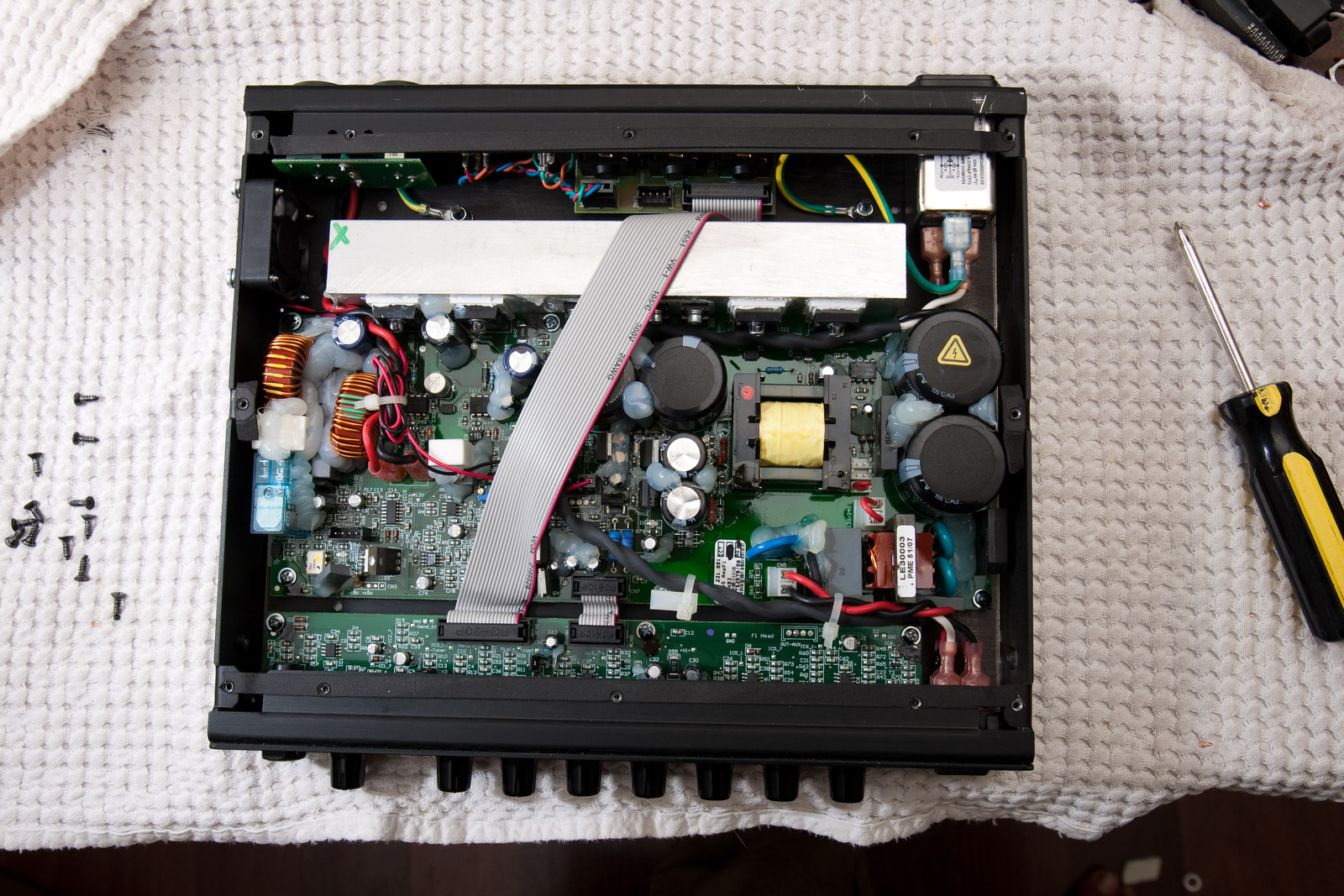
p307506469.jpg


p493436680-6.jpg


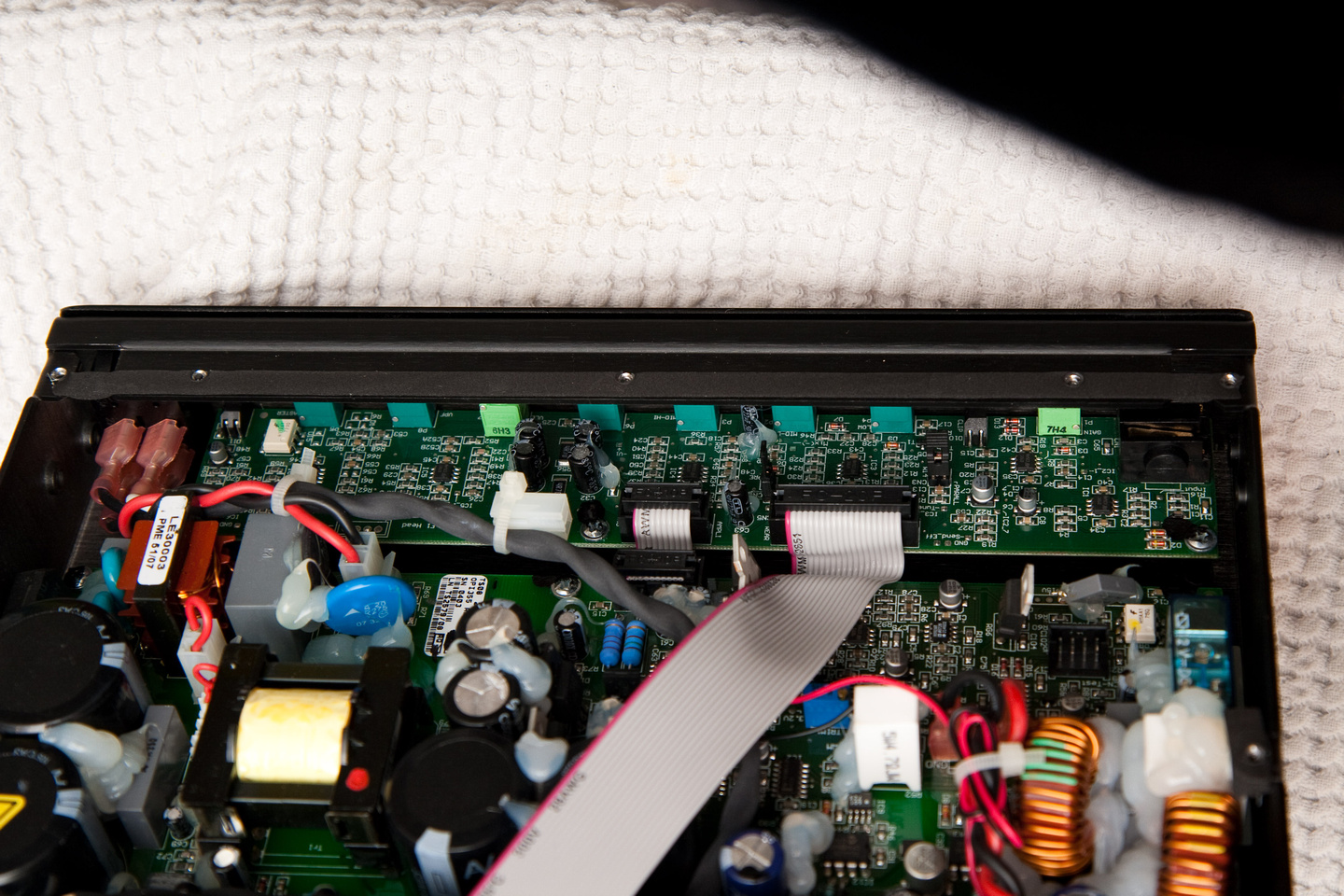
Take the following with a big grain of salt because I know just about zero about electronics. It seems part of the reason the Markbass stuff is priced better than the other offerings is the way the boards are produced. . . mostly surface mounted components that may be a bit harder to service, but easier to automate in the manufacturing process. I'm not sure if they are using a off-the-shelf oem power amp module. . . I'll have to dig and see if "OPI355" has any significance (markings i found on the board). The preamp just seems to be a straight forward IC type unit that sounds well designed and looks straight forward to make. I think the Genz has a sexier, lighter aluminum case with more display bling (LED indicators). The preamp also seems a bit more user serviceable as it uses standard mount components.


p109584198-5.jpg
 
OH! one last tidbit that was curious to me on the f1. . .

there appears to be a provision for a pre-post switch on either the line output or FX loop that is not utilized. I wonder if this functionality can actually be tapped into on the f1. . . perhaps as easy as mounting a switch?

p373571992-5.jpg
 
That's kind of where I ended up after trying lots of stuff. You might want to check out the F500 (my main gigging head now), which is identical to the F1, but with a few added features that are very nice... two bands of semi-parametric mids (nice to be able to roll down the frequency center on the low mids with some cabs), a push/pull mute switch on the master volume (not a perfect design, but it works well and typically does not result in master volume changes), and most importantly, a more fully featured DI with pre/post switch and level control.

The f1 already has a built-in push/pull mute switch. . . I pull the input cable 1/2 way out of the head before I unplug the instrument :hiding:

As for semi-parametric EQ's, I'm not sure it is a function that I necessarily need to have. The 4 band execution on the f1 from the looks of it covers my needs fairly well. I find a little VLE and a little cut in the upper mids and maybe just the slightest of boosts in bass EQ gets me close most of the time. . . unless I'm dealing with an wild-child prototype jazz pickup (bass #9) that is throwing up loads of treble, and the f1 is just absolutely PINGing my brains out :eek:

This head will be VERY good for ongoing pickup development. I feel like it's telling me the truth when I play it.
 
OH! one last tidbit that was curious to me on the f1. . .

there appears to be a provision for a pre-post switch on either the line output or FX loop that is not utilized. I wonder if this functionality can actually be tapped into on the f1. . . perhaps as easy as mounting a switch?

p373571992-5.jpg

+1 There is a simple jumper that changes the LMII and F1's DI from pre to post. This has been changed to a more typical rear panel switch on the updated models (F500 and the LMIII series of amps).
 
The f1 already has a built-in push/pull mute switch. . . I pull the input cable 1/2 way out of the head before I unplug the instrument :hiding:

As for semi-parametric EQ's, I'm not sure it is a function that I necessarily need to have. The 4 band execution on the f1 from the looks of it covers my needs fairly well. I find a little VLE and a little cut in the upper mids and maybe just the slightest of boosts in bass EQ gets me close most of the time. . . unless I'm dealing with an wild-child prototype jazz pickup (bass #9) that is throwing up loads of treble, and the f1 is just absolutely PINGing my brains out :eek:

This head will be VERY good for ongoing pickup development. I feel like it's telling me the truth when I play it.

+1 I rarely use a mute myself. Mostly handy if you use the tuner out so that you can tune and mute without having to plug in and unplug a tuner. Some find this a very important feature though.

I also find that I rarely use the EQ on the MB amps at all. The good news is, the upper mid control fixed at 800hz of the F1 is in pretty much the perfect place to remove that upper mid gank from some cabs. Perfect. However, the 380hz low mid control is useless IMO, and with some cabs that are a bit lacking in low mid punch, being able to dial down that low mid control to a more typical frequency for low mid 'meat' (i.e., 100 ot 200hz) can really be nice.

And, per the above, the pre/post EQ DI switch is a nice upgrade.

They both sound identical flat though, so not a huge difference if you don't have the need to switch between pre and post EQ regularly (i.e., between live and recording situations), and don't have the need to dial in low mids.
 
+1 There is a simple jumper that changes the LMII and F1's DI from pre to post. This has been changed to a more typical rear panel switch on the updated models (F500 and the LMIII series of amps).
seems to be no jumper in the pic. do you have it removed? is the proper placement what one would expect, the two pins to the right or the two pins to the left?
 
seems to be no jumper in the pic. do you have it removed? is the proper placement what one would expect, the two pins to the right or the two pins to the left?

I only have the directions for the LMII, so not sure about the F1 (I didn't post that picture.. that was from the OP). I assume he removed the jumper for the picture.

I changed my LMII to pre EQ (very easy... just move a jumper), and used that on front of house supported gigs prior to getting my F500. Never was comfortable enough to open my F1 without that diagram/instruction sheet:p