• TalkBass has been independent since 1998. Add your voice.
    Create a free account to reply to discussions, view embedded media, and browse with fewer display ads.
    Join freeLog in
    Want zero display ads or expanded classifieds tools? Compare plans.

Genz Streamliner 600/900 tone control primer

I would like to see a graph with your FLAT setting .. but only vary the GAIN control to see what effect that has...

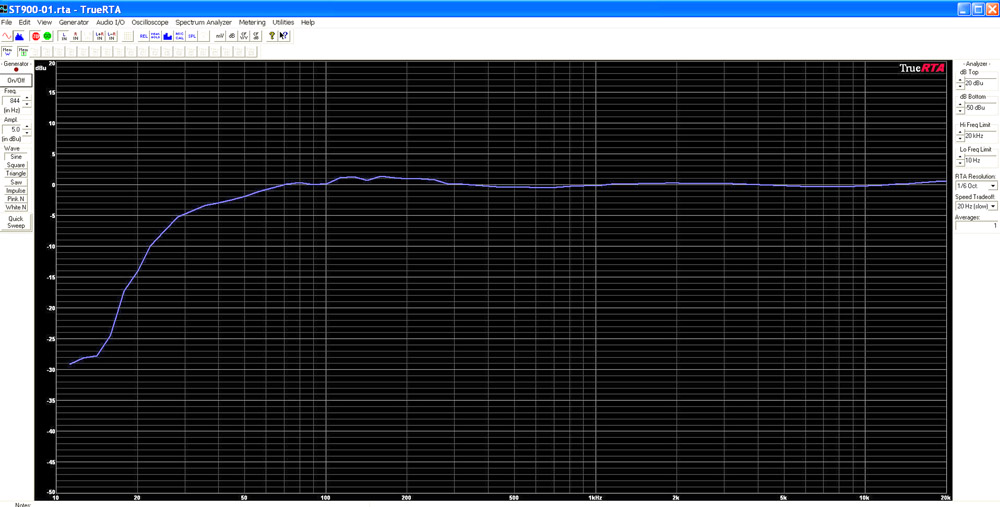
here's a TrueRTA chart showing the freq response of setting the ST900 with the tone controls adjusted as flat as i could get it:

ST900flatgraph.jpg


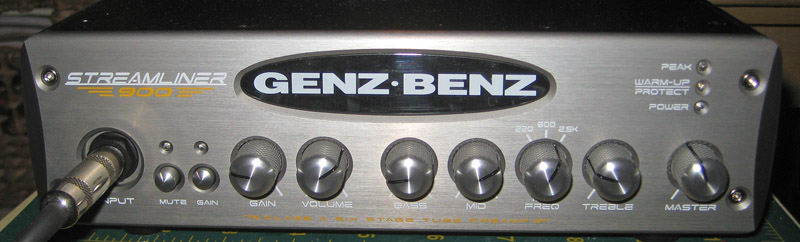
rather than describe where the knobs were to get it, here's a pic of the front panel when i swept the preamp (w/stock tubes):

ST900-flat.jpg
 
I would like to see a graph with your FLAT setting .. but only vary the GAIN control to see what effect that has...

i did actually do that, and it didn't make a ton of difference, but i'll run it again and post the charts tonight if you'd like.

BTW, i'm glad to hear that some of you have found the posting of the RTA result of the flat setting useful.
 
Thats crazy, my EXACT favorite settings. :cool:
This is where I start & change from here

Just look at how different that is from a normal amp that starts with all knobs on noon.

Normal Amp= Modern SS Amp

Try to set a Fender Tube Amp Flat and look at ye knobs. :D

Normal = my definition of my current perception of reality. :D
 
Very cool info.. Thanks for doing that and posting them.. Very informative.

i did actually do that, and it didn't make a ton of difference, but i'll run it again and post the charts tonight if you'd like.

BTW, i'm glad to hear that some of you have found the posting of the RTA result of the flat setting useful.
 
i did actually do that, and it didn't make a ton of difference, but i'll run it again and post the charts tonight if you'd like.

BTW, i'm glad to hear that some of you have found the posting of the RTA result of the flat setting useful.

Did you not see a noticeable difference response-wise between having the Gain button in vs. out? I feel like I hear a difference in the harmonics with the button in as you have it in your "flat" setting vs. with the button out, even with the Gain control set pretty low such as you have it. Could just be that I am not balancing my volumes as well as I think though...
 
okay, here it is with the same eq settings as previously used to set it as flat as possible, with the only difference being the gain settings. the chart below from bottom to top, is:

orange: gain=9:00
turquoise: gain= 10:30
violet: gain=12:00
yellow:gain=1:30
blue: gain=3:00

ST900-gains900-1030-1200-130-300.jpg


as you can see, it doesn't change the frequency response curve much at all (starts rolling off @ 50hz), but it's mostly its amplitude. however, when you start clipping it into distortion with a bass, you tend to notice the mids and highs a little more since that's where you hear the 'grit' the most.

and no, it didn't make any noticeable difference with the gain button in or out other than to change the level.
 
not to get off topic, but i wanted to compare another one of my heads (a GK1001RBII) just to see what it took to get its flattest response using the tone controls. here's the chart with and without the 4/5 switch (sub bass), and the pic below of the front panel is where the knobs have to be set to get it that way:

1001RBIIsetflatwithandw-o5stringsw.jpg


flat eq setting:
GK1001RBIIflat-settng.jpg


and here's how it looks with all of the tone controls at 12 o'clock, with and without the 4/5 string switch (no contour or presence):

1001RBII12oclockwandw-o5stringsw.jpg


so you can see that it is also pretty 'scooped' with the controls at noon, although it's scooped more in the mid bass than the ST900.
 
Interesting information, thanks! That GK seems to have quite an inherent mid scoop, and I'm sure thats quite 'normal' for their amps?! I've never been a big GK user but from what I know they are quite grindy up top with deep lows?!

Anyway, regardless, I think the idea of 'flat' (as close as they can be) amps is fairly new to me. I do like my mids, (more so the low mids area) but so far, once I boosted 'slightly' on the STL900, im having no issues.

Thanks for the work.
 
The big difference I see between the two is that dialing in a "flat" setting on the GK didn't require both cutting bass and treble to an extreme as well as boostig the mids. I bet you could dial in a decently flat response by just cutting Bass and Treble too- on my 800RB, finding a good tonal balance usually just requires a slight cut in treble and a slight boost in low-mids. I think that amp has a similar preamp voicing to the 1001 in the 4-string setting...

On the Streamliner my settings have been very close to your "flat" setting, but in some situations I feel like I want a little more here or a little less there and there is just no more room for adjustment. I am pretty pleased with my overall tone from the amp as it is set now, but I want to "love" it and just don't have quite enough room to adjust it that last little bit unfortunately! Luckily I have an extternal preamp that DOES get me there, but I wish I didn't need to rely on it...
 
Cool charts. Of course, once you hook the head up to a cab, flat kind of goes out the window, and quite different knob positions would be needed in most cases if one wanted a relatively even tone coming out of the entire system.

I guess one of the cool things is that virtually everyone who has posted 'favorite tone settings' of the Streamliner has done some basic level of low cut, mid boost, and in many cases, a bit of treble cut. The head sounds great at these general settings, and as Andy posted, it is cool to also have that strong low end response (like many all tube amps) to really make this head work like the old tube amps when using a sealed, one way multi 10 cab. Pretty cool!

With my recent trials of the Acme 112's, which are tuned quite low (I believe they are -3db below 40hz, and don't hit -10db until the low 30's), the low end voicing of the Streamliner really comes through. I'm assuming it is the hi pass filtering that makes the Streamliner low end (at least partially) sound so deep and full and fat and creamy, but yet doesn't totally push the drivers to that massive pistoning you get with some heads when you turn up the bass control. To my ear, the Streamliner is the definition of 'maximum usable low end in a head'.

With the cabs I use, I've rarely cut the bass control more than 11 o'clock or so, and rarely boosted the mids past 2 o'clock, and achieved a nice articulate but fat tone. However, that would be very cab specific.
 
  • Like
Reactions: Bass Dao
okay, here it is with the same eq settings as previously used to set it as flat as possible, with the only difference being the gain settings. the chart below from bottom to top, is:

orange: gain=9:00
turquoise: gain= 10:30
violet: gain=12:00
yellow:gain=1:30
blue: gain=9:00

...as you can see, it doesn't change the frequency response curve much at all (starts rolling off @ 50hz), but it's mostly its amplitude. however, when you start clipping it into distortion with a bass, you tend to notice the mids and highs a little more since that's where you hear the 'grit' the most.

and no, it didn't make any noticeable difference with the gain button in or out other than to change the level.

A few additions to John's comments about tone vs Gain setting:

You have to be careful when testing, to make sure that you're making an apples-to-apples comparison. For example, I used a narrow, 30dB vertical scale on my graphs, in order to make any variations in frequency response more visible. John used a wider 70dB scale. This is more in line with what most amp manufacturers post, and gives you a much flatter line, for the same actual frequency response.

Mine:

50-80dbscale.jpg


Exact same response curve, but using the wider scale:

10-80scale.jpg


If you look at the legends on the two graphs, you can see that one line on the upper one, is worth 5dB. On the lower graph, each line is 10dB: twice as wide. Remember this, the next time you're looking at a manufacturer's brochure. This is why every kind of gear from mics, to speakers, to amps, tends to show a much better frequency response on paper, than you experience in person.

Another difference to consider, is that I use a 20-20K horizontal scale, whereas John's graphs go all the way down to 10Hz. That makes it look as though his amp has more roll-off at the low end.

Also, signal levels matter a lot. I have a fairly high-output bass, with EMG P5's in it. With my test tones level-matched to my bass, I got a flatter treble response from the the boost switch (ie; less treble rolloff), even with the Volume backed off to retain the same level. When I lowered my test tone levels, that effect wasn't visible. Similarly, I ran a set of curves with the signal too hot (as though I was using a boost pedal in front of the amp), and got a whoop-ass load of extra upper mids and treble. All extra harmonics from clipping, of course...

Last but not least, John only took the Gain up as far as 1:30. There's a distinct change in the graphs as you get up around 3:00 o'clock. If you keep your levels below the clipping point, you actually get a fairly hefty treble rolloff- I think this was illustrated in the first set of graphs that I posted.
 
Cool charts. Of course, once you hook the head up to a cab, flat kind of goes out the window, and quite different knob positions would be needed in most cases if one wanted a relatively even tone coming out of the entire system.

...With the cabs I use, I've rarely cut the bass control more than 11 o'clock or so, and rarely boosted the mids past 2 o'clock, and achieved a nice articulate but fat tone. However, that would be very cab specific.

+1. Cabs are the biggest deal in anyone's signal chain. The tonal difference between a Squire CV and a Fender Custom Shop is negligible, when you compare it to the difference between an Ampeg HLF and a Bergie AE.

This is also why bad matches happen. The powerful low end of the Streamliner is going to be perfect for tight, controlled-sounding cabs, and not so good for looser, flabbier ones.
 
I've been wondering lately about all the obsession with flat response from the amp. I find these charts interesting but so far they've mainly confirmed what I think I've been discovering lately: I don't like "flat". I like colored.:)

And I agree about the cabs making a huge difference, but also the bass. The sound I'm liking from the current rig I've ended up with seems to be a synergistic result from the interaction of the amp, two different style cabs and a particular bass. Take any one out of the mix and it's not the same. That's not even considering the room effect or interaction with the rest of the band.

And I'd still like to hear John's thoughts on the amp after using it in the gig compared with the SVT.
 
Thank you. awesome!

okay, here it is with the same eq settings as previously used to set it as flat as possible, with the only difference being the gain settings. the chart below from bottom to top, is:

orange: gain=9:00
turquoise: gain= 10:30
violet: gain=12:00
yellow:gain=1:30
blue: gain=9:00

ST900-gains900-1030-1200-130-300.jpg


as you can see, it doesn't change the frequency response curve much at all (starts rolling off @ 50hz), but it's mostly its amplitude. however, when you start clipping it into distortion with a bass, you tend to notice the mids and highs a little more since that's where you hear the 'grit' the most.

and no, it didn't make any noticeable difference with the gain button in or out other than to change the level.
 
not to get off topic, but i wanted to compare another one of my heads (a GK1001RBII) just to see what it took to get its flattest response using the tone controls. here's the chart with and without the 4/5 switch (sub bass), and the pic below of the front panel is where the knobs have to be set to get it that way:

1001RBIIsetflatwithandw-o5stringsw.jpg


flat eq setting:
GK1001RBIIflat-settng.jpg

Looking at the two lines, it's interesting to note that the "4/5 switch" actually works the same as the "bass boost" on the Genz Shuttles. Considering that all it does is remove a built-in roll-off, it isn't really a boost at all- it should really be called the "flat switch"!

This is significant for what it tells us about the rest of our gear. The fact that most people think of the "flat switch" as a bass boost (on the Genz as well as GK, from what I've read on TB), emphasizes just how much extra "woof" is dialed into most bass guitar cabs.

This also explains why the "flat switch" suddenly becomes more useable (and the Streamliner sounds tighter and more attractive) when you switch to a cab with less of a low-mid bump, like the fEarful, Audiokinesis Thunderchild, etc.
 
I've been wondering lately about all the obsession with flat response from the amp. I find these charts interesting but so far they've mainly confirmed what I think I've been discovering lately: I don't like "flat". I like colored.:)

How much "flatness" works for you, depends on how much you like the natural sound of your basses and cabs. With my current rig, I don't need much EQ at all.

Still, I'm not sure that any of us have an obsession about it. I'm probably one of the strongest advocates of flat-response amps and cabs on TB, yet I rarely run them absolutely flat on stage.

The biggest deal about flat, is simply that it gives you a more predictable starting point for further EQ. Most bass cabs are highly coloured to start with. When you combine one with a highly coloured head, if the two curves don't line up well, you're going to be in trouble.

Also, if you know where "flat" is, it makes it easier to predict what a given EQ change will do, and what gear combinations will work for a given situation.

For example, one curve that I can't dial into the Streamliner without external EQ, is a nice sharp hump, up around 2.5-3KHz. This probably explains why Ken Jung likes it better with his P than his Jazz basses...
 
How much "flatness" works for you, depends on how much you like the natural sound of your basses and cabs. With my current rig, I don't need much EQ at all.

Still, I'm not sure that any of us have an obsession about it. I'm probably one of the strongest advocates of flat-response amps and cabs on TB, yet I rarely run them absolutely flat on stage.

The biggest deal about flat, is simply that it gives you a more predictable starting point for further EQ. Most bass cabs are highly coloured to start with. When you combine one with a highly coloured head, if the two curves don't line up well, you're going to be in trouble.

Also, if you know where "flat" is, it makes it easier to predict what a given EQ change will do, and what gear combinations will work for a given situation.

For example, one curve that I can't dial into the Streamliner without external EQ, is a nice sharp hump, up around 2.5-3KHz. This probably explains why Ken Jung likes it better with his P than his Jazz basses...

Big +1. I don't mind some coloration, but too much causes me to loose a lot of EQ range having to compensate. I've found my basses sound great pretty flat, so I don't need to deviate too far from there.