• TalkBass has been independent since 1998. Add your voice.
    Create a free account to reply to discussions, view embedded media, and browse with fewer display ads.
    Join freeLog in
    Want zero display ads or expanded classifieds tools? Compare plans.

GHS Balanced Nickel strings

Hey people, this is a thread about GHS Balanced Nickels.

If you want to discuss on the Pressurewounds, here's the thread you should be looking at:

Review: GHS Pressurewounds ~ Tangy Not Twangy
Agreed. I had only posted here rather than in Tangy Not Twangy because I was specifically asking about the L7200s compared to the ML7200s and you here just yesterday (post 888) you would be trying these out for your 62-year old battle scarred hands. I am in the same position except mine are only 59 years old. I am interested in what you have to report.
 
Agreed. I had only posted here rather than in Tangy Not Twangy because I was specifically asking about the L7200s compared to the ML7200s and you here just yesterday (post 888) you would be trying these out for your 62-year old battle scarred hands. I am in the same position except mine are only 59 years old. I am interested in what you have to report.

I understand what you're saying... I realize I'm partly responsible for bringing PWs into this thread. Good to know someone is actually reading my posts. ;):D

Once I have the new PWs ready to go in the new year, I will be posting my findings in the above-mentioned PW thread. Stay tuned...
 
  • Like
Reactions: Arthur U. Poon
why would that be? nickel is a softer metal than steel.
Sorry to bring up a zombie post, but clarification is needed. Pure nickel is, indeed, softer than steel. But it is also denser. Tension is a function of (among other variables) mass. So if two strings have the same diameter and geometry core, and the same diameter and geometry to the wrap, pure nickel, having more mass, will cause the string to have more tension than the NPS.
 
Sorry to bring up a zombie post, but clarification is needed. Pure nickel is, indeed, softer than steel. But it is also denser. Tension is a function of (among other variables) mass. So if two strings have the same diameter and geometry core, and the same diameter and geometry to the wrap, pure nickel, having more mass, will cause the string to have more tension than the NPS.

This is exactly what I said in post #874...

Pure nickel is a heavier metal than Nickel-plated Steel, so comparing the same sizes tuned to the same pitch, the BN would naturally have more tension than the RCB.
 
Of course they are. You're tuning them down two whole steps on a shorter scale bass. ANYTHING off the shelf is going to be very loose with that setup.


Yeah, you're gonna have to have a new nut made for that tuning. The H3045 set (50-70-95-115) may not work for you, as it's not that much different from the 4L-NB set that you have. However, since Bass Boomers have a hex core instead of round, that stiffness may be what you are looking for.

H3045 Set - C Standard Tuning at 33" scale
DYB50 - 30.6lb
DYB70 - 33.4lb
DYB95 - 38.2lb
DYB115 - 29.0lb

4L-NB Set - C Standard Tuning at 33" scale
NB44 - 28.2lb
NB60 - 27.3lb
NB80 - 27.1lb
NB106 - 26.6lb


If I were you, I'd just get singles. Here's what I'd do, based on the feel/tension of a M3045 set at 34" scale.

C Standard Tuning at 33" scale
DYB60 - 44.6lb
DYB80 - 47.6lb
DYB105 - 44.7lb
DYB130 - 39.0lb

M3045 Set - E Standard Tuning at 34" scale
DYB45 - 44.8lb
DYB65 - 50.2lb
DYB85 - 49.4lb
DYB105 - 42.3lb

@Jon Moody

Strings arrived today - Nervously stringed the 'Rick' up and tuned it to C Standard followed by a full setup.

*PERFECT* string tension matey - Like, these play like butter! Still not really sunken in yet I am playing in C standard on a 33" instrument and it feels like my trusty old friend.

From the bottom of my heart, Thank you!

ctlAMlx.jpg
 
Strings arrived today - Nervously stringed the 'Rick' up and tuned it to C Standard followed by a full setup.

*PERFECT* string tension matey - Like, these play like butter! Still not really sunken in yet I am playing in C standard on a 33" instrument and it feels like my trusty old friend.

I thought for a moment you were talking about the Balanced Nickels (which this thread is about) but looking at the photo, I see you're talking about the Boomers. ;)
 
Hey @Linnin sorry to be a pest again.

If u have the BNs on your jazz bass, or if you have already put the new RCBs on, would I be able to get some audio of it if you’re able to do so? Interested to hear either stringset on a jazz bass, so I get a clearer picture if it’s the string I should put on my jazz bass or not.

Thanks
 
  • Like
Reactions: trothwell
I'll be interested in your comparisons of lighter-gauge Pressurewounds.

Sure thing. I'll be posting my findings both on L7200 on my Yamaha and M7200 on my Jazz in the main PW thread by @Linnin ("Tangy not twangy").

Hi @TomB, just letting you know the PW L7200 are on my Yamaha now (3 days so far) and I have posted my first impressions on the above-mentioned PW thread.
 
After much experimentation with my p bass, I finally decided on the medium balanced nickels as the perfect strings for that bass. I am blown away by how even the volume and tone is all over the fretboard.

Does anyone have any experience with the medium 5 string set? I'm curious as to whether the b string is capable of achieving the same even tonal balance as the other strings.
 
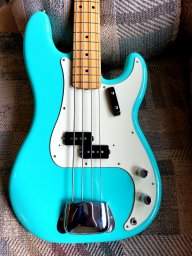
Ever since @Bruiser Stone posted THIS THREAD this past Saturday, I haven't been able to get the color green off of my mind. ;) Maybe it's time I revisited the Balanced Nickels for my P bass instead of the Brite Flats I've been planning to put on it next when the Pressurewounds are ready to be replaced.

The simple fact of the matter is I'm still half-hearted about half-rounds at this point based on my so-so experience with them on my J bass last year. And as much as I love the Pressurewounds on my Yamaha and my Jazz, I'm starting to think Alloy 52 with its extra responsive nature may not be the best thing for my P bass with the stock CS60 pickup, especially with the idea I'd rather have "warmth and fullness" out of my P rather than "punch and crunch". I also like the idea that the pure nickel/round core combo would give my P a tonal flavor that's uniquely different from my other two basses.
 
  • Like
Reactions: Bruiser Stone
Ever since @Bruiser Stone posted THIS THREAD this past Saturday, I haven't been able to get the color green off of my mind. ;) Maybe it's time I revisited the Balanced Nickels for my P bass instead of the Brite Flats I've been planning to put on it next when the Pressurewounds are ready to be replaced.

The simple fact of the matter is I'm still half-hearted about half-rounds at this point based on my so-so experience with them on my J bass last year. And as much as I love the Pressurewounds on my Yamaha and my Jazz, I'm starting to think Alloy 52 with its extra responsive nature may not be the best thing for my P bass with the stock CS60 pickup, especially with the idea I'd rather have "warmth and fullness" out of my P rather than "punch and crunch". I also like the idea that the pure nickel/round core combo would give my P a tonal flavor that's uniquely different from my other two basses.

I really like the Brite Flats on my fretless Jazz bass. I thought they were just okay on my Precision bass. I did not like them at all on my fretted Jazz bass.

I think the Balanced Nickels would be a more universally-good choice.

But you already have the new Brite Flats set, right? Need to find something to put them on! :-)
 
I think the Balanced Nickels would be a more universally-good choice.

Agreed. Based on everything I've read, the BNs would definitely be more versatile than the BFs.

But you already have the new Brite Flats set, right? Need to find something to put them on! :)

Maybe it's time for me to start shopping around for a decent fretless Jazz? ;) Or else, I would have to find someone who might be interested in trying them out on their fretless Jazz. :D