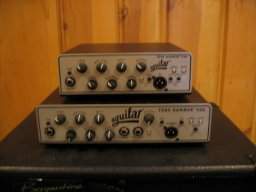
So THAT'S what them little handles are forEvery time I pick it up I do a few pinky curls with it because I can't do that with my SVT or 1001RB-II.
.
TalkBass has been independent since 1998. Add your voice.
Create a free account to reply to discussions, view embedded media, and browse with fewer display ads.
Join free Log in
Want zero display ads or expanded classifieds tools? Compare plans.
So THAT'S what them little handles are forEvery time I pick it up I do a few pinky curls with it because I can't do that with my SVT or 1001RB-II.
.
Real men do pinky curls with entire combo amps...So THAT'S what them little handles are forEvery time I pick it up I do a few pinky curls with it because I can't do that with my SVT or 1001RB-II.

Is that one of the hydrogen filled versions? I hear they can get a bit "boomy" compared to the helium filled onesReal men do pinky curls with entire combo amps...
Invalid Link Removed
.Real men do pinky curls with entire combo amps...
Invalid Link Removed
Oh please hes stressing there. Besides Im going for reps not a max out.
Oh please hes stressing there. Besides Im going for reps not a max out.

Naw, my veins always pop out like that.


A couple things...Sure man sure.
So I finally had a chance to use the MB200 with my band last night at practice running through an 8 ohm SWR 115. The drummer can be heavy handed and my guitar players use a Vox AC130 and a Matchless Vox AC130 equivalent respectively so in short we can get pretty loud.
As one would expect it sounded good, the eq is pretty flexible, and it was loud. I turned up to about 1:00 on the dial with eq more or less straight up. A little cut in the highs and lows with a little boost in the low mids. At the volume I was running the tone seemed to get slightly compressed. It fell a bit short on the dynamic response I am used to from my 1001RB-II. To be honest I feel as though if I had a 4 ohm cab, the little amp would have delivered what I wanted. Next time I will try the DI to the PA.
This is a great backup amp option for those who have bigger amps. Its also a really killer practice amp. It could definitely be used as a primary amp for small gigs and medium ones with PA support. Perhaps it's not the end-all be-all of small amps but for the price, I couldn't ask for more.
A couple things...
Your results (basically running out of headroom when cranking it that much) don't surprise me. In fact, given your description of what you were trying to keep up with, I'm pretty impressed.
On the 4 ohm vs 8ohm, if you're talking about the same amount of radiating area, just the lower impedance, honestly, that's not gonna' buy you much. Increasing your "loudness" is ALL about increasing your radiating area.
For example, going from an 8 ohm 115 to a 4 ohm 115, meh, not a huge diff. However, going from an 8 ohm 115 to an 8 ohm 215, HUGE difference.
So if you go to a 4 ohm cabinet, AND it has more radiating area in it, I would think you'd be very pleased. Personally, I'd just add another 8 ohm cab to that 115... like maybe an 8 ohm 210 or even 112 cab. Should be killer.
While I agree with you in general, this is a case where a switch to 4ohms would probably make a large difference, due to:
1) The low absolute level of power.. going from 120 to 200 watts or whatever, can result in a meaningful change in the low end response and the compression the OP mentioned.
2) Expanding on 1, a decent 15" driver should be able to actually use that additional dose of power (i.e., the mechanical limits of the driver will probably still not be reached).
To Vic's point, will it turn your 115 onto a 215... no. But, given the very low wattage output of that head, almost doubling the power into 4ohms, and into a 15" cab that can handle the additiona wattage might make a bigger difference than you think... a touch louder, but more importantly, less of that compression you hear as that little amp runs out of steam at 8ohms.
IMO there.

I'd defer to some experts like greenboy or billfitzmaurice for the ultimate answer on this, but I still don't think it'll be that big of a difference. This comes from subjective testing of one of the D.I.S.T 115 cabs, switching between 4 and 8 ohms, and at least IME, I wouldn't expect the diff between 120 and 200W to be that big of a deal to our ears at the end of the day, with the same radiating area. Just has not been my experience. As you know, it's not a linear thing at all... it's exponential... when it comes to amp power vs SPLs.While I agree with you in general, this is a case where a switch to 4ohms would probably make a large difference...
 . If I hear back about a job I'm supposed to get today I'll maybe have Flite (about 10 miles from me) make me one - should be about 30 lbs .
I'd defer to some experts like greenboy or billfitzmaurice for the ultimate answer on this, but I still don't think it'll be that big of a difference. This comes from subjective testing of one of the D.I.S.T 115 cabs, switching between 4 and 8 ohms, and at least IME, I wouldn't expect the diff between 120 and 200W to be that big of a deal to our ears at the end of the day, with the same radiating area. Just has not been my experience. As you know, it's not a linear thing at all... it's exponential... when it comes to amp power vs SPLs.
I'm no expert on it tho, just how it's been for me in the past going between 100W and 200W class amps/combos, and my more recent (tho only subjective) switching test.
FWIW.
I generally agree with your description, and as a result, personally wouldn't use the word "HUGE" to describe that difference, but that's just MHO, I guess.120 to 200 can be HUGE (again, not volume, but that was not his issue) on open low end response and compression (which he was reporting) if you go from 'not enough' to 'just enough'.
I agree not night and day, but a touch louder, and possible less compressed when pushed. You obviously wouldn't hear any difference until you reached the limit point of the amp and or cab, so hard to test this at home. It won't make the volume jump at all at the lower impedance, but should (in this case) allow that relatively large cab to sound a bit more full and less compressed. IMO and a bit of IME there.
I generally agree with your description, and as a result, personally wouldn't use the word "HUGE" to describe that difference, but that's just MHO, I guess.
It also gets a bit dicey when you start to talk about "volume jumping at the lower impedance." Of course the lower impedance literally has no effect on volume. It's the power increase you get from the amp by lowering the impedance if you don't also compensate by reducing a gain setting.
That said, if you DO lower the impedance without compensating gain, it actually WAS noticeable to me at least, even at the lower gain settings where the amp wasn't working very hard in either case. Like you said tho, definitely not at all night/day.
And at least personally, even when an amp was being pushed hard, I just didn't get that much more when I lowered the impedance, and this was even with a 500W class head.
The net result of my testing (albeit not at all scientific, only subjective), is I'd personally not be very interested in spending a bunch of money to get a dual impedance cab (or even buy the same thing as what I already had just at a lower impedance). I'd rather just add another cab.
Again tho, just MHO/IME
Just to make sure we're on the same page, I'm not advocating throwing away power. I'm just saying if he's already got the 8 ohm cab, what's the best next step to take in spending money to make optimal use of all the amp's power? Buy a 4 ohm version of the same cab (IMHO, no) or just buy another 8 ohm cab and add it to the rig (IMHO, yes), or replace the 8 ohm cab with a 4 ohm cab that ALSO has more radiating area (IMHO, yes). Bottom line, you want more SPLs from that amp, adding radiating area should be the best way to achieve that.Though the volume difference between 140 and 200 watts may be small, I would think that there would commonly be situations where you want every drop that amp has to offer.

Real men do pinky curls with entire combo amps...
Invalid Link Removed

Since when did they start making helium filled "lighter than air" combos?