
• TalkBass has been independent since 1998. Add your voice.
    Create a free account to reply to discussions, view embedded media, and browse with fewer display ads.
    Join freeLog in
    Want zero display ads or expanded classifieds tools? Compare plans.

I have a theory about maple fingerboards

Status
Not open for further replies.
The King is in his altogether and altogether it's altogether the......

Basses will sound different for all sorts of different reason and, in my humble experience, any subleties between maple and rosewood boards are insignificant compared to a gentle nudge of eq.

Even if these subtleties could battle their way through an entire signal chain, I can tell you now that there is not one person on this forum who would be able to tell the difference in a gig situation competing with a loud drummer and a couple of Marshall half stacks.

I can't imagine that I would ever find myself doing a sound check trying to get a great sound to underpin a loud Les Paul and a snarling SG in a difficult room and find myself sobbing "oh damn, I wish I'd bought my bass with the maple fingerboard instead of this rosewood one"

More to the point, most of the audience won't even be able to pick out the bass in the mix at all, but even if they can they probably won't be able to tell a graphite necked multiscale bass with Q tuners and stainless roundwounds from an EBO with nylon tapewounds. The only people that might will be other bass players and they'll only be bitching about how your tone is vastly inferior to theirs anyway.
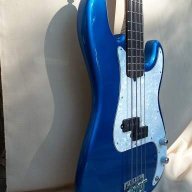
 
I have a theory about maple fingerboards- while maybe not as warm as rosewood, it allows the tone of the bass to "breathe" more. Thus, allowing the more subtle nuances of the bass to come through. It can always be dulled down by turning the tone knob down. Thoughts?

And you can brighten up a dull sound by turning the tone knob up. What's your point?
Not trying to be mean, but if you can alter the tone of that maple board so readily with the tone knob, i doubt the wood the 'board is made of is going to make that much of a difference. MHO.
Having said this, I have built several guitars from parts, and modded even more. The neck does have an impact on the overall voice of the instrument, as does the body wood to some extent. But there is so much difference in any two pieces of wood, even from the same tree, that describing the tonal differences between woods is and always will be done in generalities. You can say "This wood is generally warmer/lighter/darker, etc., than this wood", but you'll always run across that piece of wood that gives the lie to those generalitles. And IME and IMO, the neck as a whole will make much more difference than what the fretboard itself is made of. I believe this is what a lot of people hear when they switch a maple fretboard neck for a rosewood one and vis versa. They're not just replacing the fretboard, but the maple in the necks are different, from different trees, and different parts of the tree, with different tone all by themselves. MHO.
 
the basses in the vid did sound different.

I have significant hearing loss due to chemotherapy and repeated high SPL exposure (go figure) so I would no say my ears are "golden"... but the maple board had more zip. Throw a guitar in there and it would be minimal, but it is there.
 
The King is in his altogether and altogether it's altogether the......
"Even if these subtleties could battle their way through an entire signal chain, I can tell you now that there is not one person on this forum who would be able to tell the difference in a gig situation competing with a loud drummer and a couple of Marshall half stacks."


I just love the "absolutes" you guys toss around, and we don't all play with loud drummers and Marshall Stacks.
We're talking about the "acoustic characteristics" of different fretboard woods. What gets amplified is what your instrument produces acoustically. Sure, electronics alter that but cannot CHANGE the sonic acoustic "footprint" of your bass.
 
I just love the "absolutes" you guys toss around, and we don't all play with loud drummers and Marshall Stacks.
We're talking about the "acoustic characteristics" of different fretboard woods. What gets amplified is what your instrument produces acoustically. Sure, electronics alter that but cannot CHANGE the sonic acoustic "footprint" of your bass.

exactly!
 
I get more of a clank with the initial fretting on my maple boarded bass than on my rosewood one. They are of course completely different otherwise, but I hear it even if it isn't amplified coming from the place where I just fretted.
 
.....................................More to the point, most of the audience won't even be able to pick out the bass in the mix at all, but even if they can they probably won't be able to tell a graphite necked multiscale bass with Q tuners and stainless roundwounds from an EBO with nylon tapewounds.............

if that were the case, then why even bother having a bass that inherently has the tone that you want in the first place?
 
I don't think wood really plays that much a difference in amplified tone. Sustain, maybe. I don't believe that "alder has this sound" "ash has this sound" etc. If you find a bass thats light weight and resonant, keep it!

I find that the biggest contributors to tone are the bridge, strings, electronics, and pickups (and their locations) Most of what we hear is in our heads in my opinion.

Example: I play a 57 RI P-bass with the stock pickup and I swapped out the original pots (they were shot) It was strung with Labella James Jamerson flats. It has a swamp ash body and a maple maple neck. I recorded a bassline at an advertising studio where my friend sampled a bit of a conga beat that also included Jamerson himself hitting a C#. I had to build a bassline around that C# and once it was recorded they sounded virtually identical. I've also strung the same bass with rounds and have gotten a very Entwistle-like tone.

Add this into the fact that even basses that are made of the same materials and have the same setup and strings will sound slightly different.

Not to mention that your pickups aren't even reproducing an accurate acoustic signal. I believe the closest you'll come is Alembic type pickups and a transparent preamp like a glockenklang and then through an amp designed to give a clear tone like one for an acoustic bass.
 
i have lots of basses with both maple and rosewood necks, i've built 100's of them over the years and i agree with the OP completely. i have also switched between maple and rosewood on the same basses to determine whether i could hear a difference, and i definitely can. especially one-piece maple necks. IME, the veneered ones do not exhibit as big of a difference. IMO, it also has to do with the fact that most maple boards have a gloss finish. it's not a huge difference, but it is there.

I just noticed the same thing with my basses independently of this thread. I had my '09 MIA Oly White/Maple Jazz out yesterday, and was reminded that it has my absolute favorite tone of all my basses. I idly thought....hmmmm.....I really like the warmth of the tone of my Squier VM fretted, too......maple fretboard.......my 50's MIM Precision has such a warm fat tone, too.....maple fretboard........

It isn't like my rosewood fretboard instruments are BAD, but they don't have the same warmth as the maple fretboard ones, to my ears. I can't explain it, but it is there.

Roger
 
i have lots of basses with both maple and rosewood necks, i've built 100's of them over the years and i agree with the OP completely. i have also switched between maple and rosewood on the same basses to determine whether i could hear a difference, and i definitely can. especially one-piece maple necks. IME, the veneered ones do not exhibit as big of a difference. IMO, it also has to do with the fact that most maple boards have a gloss finish. it's not a huge difference, but it is there.

I'm surprised the difference is that much, but I'll trust you. :)
I've tried the same bass with rosey and maple boards, and the difference isn't worth worrying about for my purposes.
A whole neck made of the same material is a whole different premise. The all rosey Stingray necks are great.

RE: Maple VS Rosey;
For me - it's a little about how it looks, and more importantly;
On a DARK STAGE, maple is easier to see what I'm playing.
 
I use to own a shop and built professional level banjos for several years on a full time basis and can tell you that the type of neck wood on those made a huge difference in the tone and volume. Maple is the brightest and louded soundng neck wood. Mahogany is warm. Walnut falls somewhere between maple and mahogany. This all may not have anything to do with a bass and having never built one, I have no experience with how the neck wood affects the tone of a bass but, I would assume that it does. On guitars and banjos, the fretboard alos has a huge affect on the tone. Ebony is brighter than rosewood. Maple and rosewood fingerboards sound similar to me on a guitar.
 
I use to own a shop and built professional level banjos for several years on a full time basis and can tell you that the type of neck wood on those made a huge difference in the tone and volume. Maple is the brightest and louded soundng neck wood. Mahogany is warm. Walnut falls somewhere between maple and mahogany. This all may not have anything to do with a bass and having never built one, I have no experience with how the neck wood affects the tone of a bass but, I would assume that it does. On guitars and banjos, the fretboard alos has a huge affect on the tone. Ebony is brighter than rosewood. Maple and rosewood fingerboards sound similar to me on a guitar.

Neckwood or fretboard.?

MY OPINION...is that the neckwood makes a difference...considering thats most of the mat'l from one end of the string till it meets the body.

the fretboard...eh.not as much..(on a fretted instrument)
 
your pickups are a microphone for the sounds of the resonance of vibrations reverberating through wood...for an extreme example... Maple with lots of lacquer on it is much brighter than a rosewood board...


just like acoustics in rooms..hard walls sends back sound very quickly, carpeted walls floors absorb sound... hard being laquer soft being the absorbent qualities of non lacquerd wood..
 
OPBASSMAN1994 said:
With Jazz Basses, I'd go maple all the way. I have experienced many a J, and I've always found that when they've got maple boards, they are more comfortable to play, look cooler, and I've sometimes noticed a very slight subtle tonal differenece. However, it's so insignificant that it wouldn't really matter to anyone but a tone-nut who probably would be buying some 10K boutique bass anyway.

With a Ric, I'm fine with rosewood (don't really have a choice do I? :D). A Ric actually carries a brighter tone than a jazz, and a more, clanky sound, and has rosewood.


When it comes down to it, it's all about hardware (bridges especially), strings, pickups and the hands. The woods only do a little bit of the job. Unless you play upright, in which case you're on the wrong half of the forum my friend.

The chris squire rick have african vermilion, I think
 
Having seen a bunch of "Guess which one is <choice A> and which is <choice B>" threads here and on various recording websites, I'm thoroughly convinced that the VAST majority of people VASTLY overestimate their ability to identify which is which. It's always fun seeing them guarantee they can identify which is maple/rosewood, or P/J, or HiBeam/Roto, etc.. but the real fun is watching all the excuses come out after they're proven wrong when the OP reveals the correct answers. :D

Can people hear a difference between two samples? Ahhh, that's a VERY different question. Yes, I believe it's much easier to hear differneces between the samples in these tests (as in, "I prefer sample B to sample A because ..."), but that's rarely the question asked. The question that is almost always asked in these tests is "Can you identify which is which - CONSISTENTLY?" And from what I've seen, these tests show pretty consistently that people generally do no better than if they merely guessed.

(* putting flame-retardant suit on...*)
:hiding:
 
Having seen a bunch of "Guess which one is <choice A> and which is <choice B>" threads here and on various recording websites, I'm thoroughly convinced that the VAST majority of people VASTLY overestimate their ability to identify which is which. It's always fun seeing them guarantee they can identify which is maple/rosewood, or P/J, or HiBeam/Roto, etc.. but the real fun is watching all the excuses come out after they're proven wrong when the OP reveals the correct answers. :D
coffeescreen.gif

Can people hear a difference between two samples? Ahhh, that's a VERY different question. Yes, I believe it's much easier to hear differneces between the samples in these tests (as in, "I prefer sample B to sample A because ..."), but that's rarely the question asked. The question that is almost always asked in these tests is "Can you identify which is which - CONSISTENTLY?" And from what I've seen, these tests show pretty consistently that people generally do no better than if they merely guessed.

(* putting flame-retardant suit on...*)
:hiding:
+1, by your side, with fully charged 1-3/4" CAFS hoseline, connected to a water supply.
fireman1.gif
 
Status
Not open for further replies.