Hey everyone. Longtime lurker, but this is my first actual post.
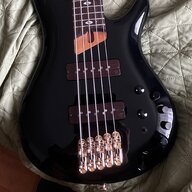
Managed to pick this up just after Christmas for just under £300 UK with case. It's a 2007 WMI-made (Korean) BTB 555 MP (maple top on mahogany body; it has some slight flame, but nothing like the 1005s). It had previously been owned by two guitarists, both of whom had immediately decided they didn't like 5-strings, so I was told it had spent most of its life as a case queen and, based on the cleanliness, I mostly believe it. The saddles were all the way up, which set my spidey-senses a-tingling when I got it home but, not to worry, as soon I sorted the neck relief out, the saddles and their attendant action came all the way back down to 'reasonable'. Just needed a decent set-up, basically.
It's the heaviest bass I own at 4.63Kg (10 lbs 3 oz), but it's really not that bad. It's at the upper end of my tolerable zone, but still definitely within it.
Have been loving it so far, although it made a significant change from my usual J's. Having now got used to it, the only thing I don't really like is the medium frets. I tend to prefer jumbos and 6105s, and have consequently developed a fairly light-fingered fretting style. If you're playing stiff-ish flatwounds on mediums, you sometimes have to bury the string into the fingerboard to get it to ring true, whereas with taller frets you can just give them a light squeeze, sometimes not even touching the fingerboard. Nothing that a change of fretting style can't adjust for, but I still prefer my J's for that. I'll refret it with 6105 stainless at some point, and then the issue will solve itself, but I'm in no particular rush as it plays and sounds fine with a slight style adjustment.
Talking of flats: I found I had to do without my usual beloved Labellas. I found that, with the tapered low B string, it was almost impossible to intonate to anything more than a handful of frets at a time. The monorail's design (all captive-ball-end designs, actually ...) makes it impossible to adjust the string length such that the fat part of the string starts immediately after the saddle, and so you get large amounts of taper overhanging the scale length and buggering-up the intonation. On a toploader or through-body, you can add or remove shims to 'move' the taper point, but you can't in a captive-ball-end bridge.
The solution turned out to be Ernie Ball
stainless flats (
not the cobalts, the 'group' flats; I went with group II, as I like a stiff flat, but you can adjust to taste). These don't have a taper (neither do GHS precisions, although you might need the 'specialist' longer B string from the GHS; I haven't tried them yet, but the Ernie 'B' works fine). The Ernies are a bit strange in that, out of the packet, they're too metallic and 'zing-y' for my tastes, and they're coated in some weird 'gritty'/'scaley' outer substance that almost makes them feel as if they've been galvanically-dipped (like a BZP coating); in contrast to Labellas which feel mirror-smooth. However, the 'zing' goes away (or at least recedes) over the course of three-to-six weeks, and the coating takes about 6-12 weeks to blow-off/wear-smooth. *Now* (four months later) they feel and sound much more similar to Labellas and I
really like them a lot, which surprised me because for the first couple of weeks I was sceptical to the point of considering selling the bass. I wouldn't dream of doing it now as the combination is awesome, but it took a while to marinade, so to speak. Real 'ugly duckling'-type strings.
Anyway ... pics ...