

Enjoy the benefits of a premium membership!
Upgrade Account
-
TalkBass has been independent since 1998. Add your voice.
Create a free account to reply to discussions, view embedded media, and browse with fewer display ads.
Join free Log in
Want zero display ads or expanded classifieds tools? Compare plans.
You are using an out of date browser. It may not display this or other websites correctly.
You should upgrade or use an alternative browser.
You should upgrade or use an alternative browser.
Is making a strat- bass a good idea?
- Thread starter JPkstms
- Start date
More options
Who Replied?
$50 Squier Bullet hardtail with an SX 2" string spread short scale bridge:


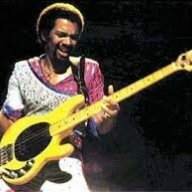
If i wanted a p bass id make one. So no. Ill make a neck using my mighty mite for dimensions and such and favricate it to fit a strat body. And probubly fretless. Not p pickups either.
I wasn't quoting you. It sounded like Lz4005 said they'd want a Strat bass with a single split coil->that's pretty much a P bass. What you're doing sounds like building a short scale bass guitar with 3 pickups.

Thats a good idea$50 Squier Bullet hardtail with an SX 2" string spread short scale bridge:
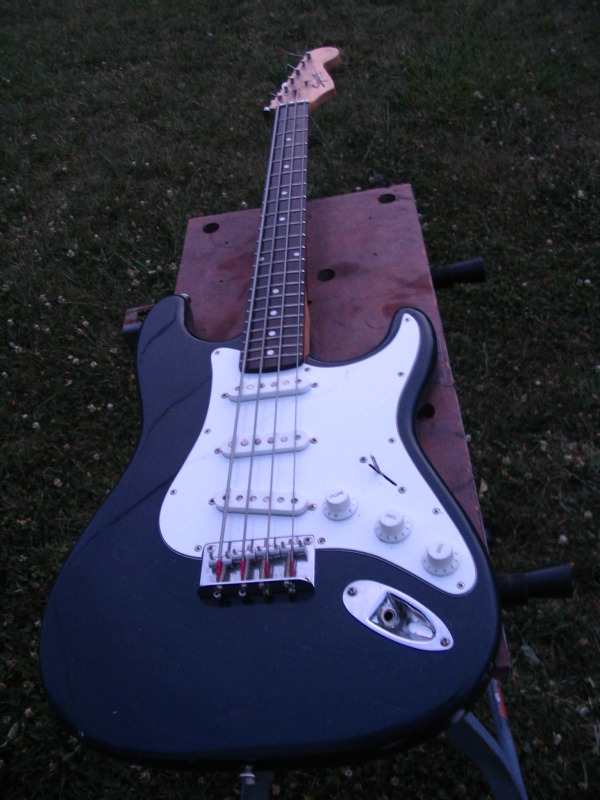
I'm part way through converting a Strat clone to a bass, it works but doesn’t intonate properly (yet) and isn't pretty. It is however great fun to play.
Spec :-
Strat body with modified string spacing P type bridge.
Strat neck - tuner holes filled and re-drilled for bass tuners, nut re-cut.
2 band (Pre EBMM spec) preamp.
Currently has a Les Paul style humbucker taped in for testing purposes.
Old knackered set of rounds fitted for testing purposes.
To do list :-
Shim neck to accommodate the higher bridge.
Fill trem block hole so bridge can be mounted in the correct place.
Needs thicker strings as 34" scale are a bit slack on a 26" scale bass.
Pickup type to be finalised.
Pick guard / control plate to make.
Cut new nut.
Refinish ??????? Probably not!
Spec :-
Strat body with modified string spacing P type bridge.
Strat neck - tuner holes filled and re-drilled for bass tuners, nut re-cut.
2 band (Pre EBMM spec) preamp.
Currently has a Les Paul style humbucker taped in for testing purposes.
Old knackered set of rounds fitted for testing purposes.
To do list :-
Shim neck to accommodate the higher bridge.
Fill trem block hole so bridge can be mounted in the correct place.
Needs thicker strings as 34" scale are a bit slack on a 26" scale bass.
Pickup type to be finalised.
Pick guard / control plate to make.
Cut new nut.
Refinish ??????? Probably not!
Just do it or get this. I have one and it is great:
Godin Shifter Bass - Trans Cream | Sweetwater.com
Godin Shifter Bass - Trans Cream | Sweetwater.com
This is my favorite TalkBass "Strat Bass" build: (TB member FatStrings)
Strat style shortscale bass build | TalkBass.com
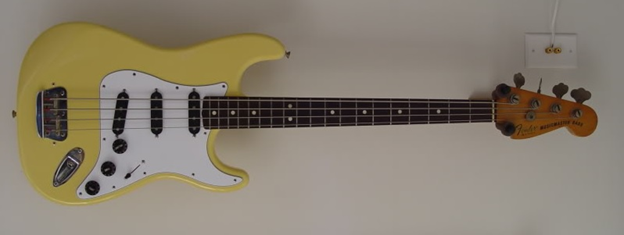
Strat style shortscale bass build | TalkBass.com


My friend and I have a joke that one of us is going to make the precision guitar... But to add irony it's going to be fretless so in order for it to be PRECISE we are only selling it to people who have obtained SUPERIOR INTONATION
Isn't strat is more of a jazz like type, since both of them use single coil pickups, and there is a resemblance on the body shape.Seems to me it's been done - P basses.

Isn't strat is more of a jazz like type, since both of them use single coil pickups, and there is a resemblance on the body shape.
Nope. Definitely closer to a Precision.
@JPkstms; I say "go for it!" I've been thinking of doing a similar conversion to the Squier Standard Stratocaster pictured above. As far as the "scale & intonation" issues are concerned, I've been thinking of commissioning an engineer-friend of mine to fabricate a 3D-printed block to occupy the tremolo space. It would have string-thru holes running down, then diagonally towards the front/bottom, terminating at the surface with "ferrules" to hold onto the ball-ends. This THEORETICALLY SHOULD let me use 30" short-scale strings despite the normal, 25.5" scale of a Strat.
Now, if it didn't have the trem-space, I'd just push the bridge back to the tail-end and probably have some ferrules drilled out. That, or get a set of Triple-Lock-Down singles from Hipshot. Again, I'd have it made string-thru to add a little more string-length…like how a Mustang, being string-thru, uses medium-scale strings on a short-scale platform.
If you're making your own body and the trem-space is occupied by more electronics, I'd recommend the Hipshot single bridge pieces with ferrules drilled out or some kind of bridge that can mount to the tail-end…maybe something kinda Steinberger-ish.


The jazz bass is based off of the jazzmaster body shape with longer horns, the precision is based off of the strat body shape.Isn't strat is more of a jazz like type, since both of them use single coil pickups, and there is a resemblance on the body shape.

I know fender has jaguar, tele, mustang, and jazzmaster styled basses but what about a custom strat body bass? Bad idea or fun project
Carrots.

I also converted an Epiphone Les Paul Express 22" scale guitar into a bass. Here's a YouTube video I made, below are all the conversion details;
List of parts, prices and vendors:
•Epiphone Les Paul Express 22" scale guitar - $99 - zZounds.com
•Rotosound Tru-Bass RS88s short scale black nylon coated strings - $31.99 - Amazon
•Black Bass Bridge BA-1004BK L Shape Saddle - $19.99 - lotmusic (China) via Amazon
•Four 3/4" steel pan head machine screws that fit the bridge - $1.24 - Koontz Hardware, Los Angeles
•Tibesti 4 string black bass nut - $1.60 - Aaron Store via AliExpress.com (China)
•4 Chrome Guitar String Ferrules - $4.20 - C. B. Gitty Crafter Supply via Amazon
•4 Black plastic 3/8" hole plugs - $1.96 - Koontz Hardware, Los Angeles
Total Cost: $159.89 US
Here are the steps to do the conversion:
•Remove the 6 string parts; strings, nut (remove the truss bar cover plate first, the nut is tight so pry carefully), bridge (retain the silver screws) and the two lower tuners (plug the front and back with the black plastic plugs).
•On the 4 string black nut, shave off a slight amount from the lower edge facing the head, press it into place.
•On the bridge, remove the 1" saddle adjustment screws and replace them with the 3/4" steel screws. Also snip off the first 2 rings of each spring to shorten them, or find shorter springs (I used smaller springs from another bridge I bought).
•Attach the bridge using the original silver bridge screws in the two front original holes and drill new holes for the back screws. Or position the new bridge so the front edge just covers the front screw holes (gives the saddles more adjustment range), drill 4 new holes and screw down with the original silver screws. (I did not need to remove any black on the bottom of the bridge for the ground wire.)
•For the string-through holes at the tail, I used the original bridge and the center 4 string-through holes on it as a jig for my drill (but be careful how straight you hold the drill, a drill press would be advantageous). Measure it to center on the tail and clamp it down, then drill.
•For the ferrules, drill out the small hole at the bottom of each ferrule to fit the bass strings. Drill the top side of the string-through body holes to the proper size of the ferrules.
•After drilling, black out the raw wood edges with a Sharpie, then press in the ferrules on the top side.
•Last, put on the strings going up through the ferrules, through the rear bridge holes, along the saddle grooves to the tuners. The silk covered ends of the strings will just fit the original tuner holes.
List of parts, prices and vendors:
•Epiphone Les Paul Express 22" scale guitar - $99 - zZounds.com
•Rotosound Tru-Bass RS88s short scale black nylon coated strings - $31.99 - Amazon
•Black Bass Bridge BA-1004BK L Shape Saddle - $19.99 - lotmusic (China) via Amazon
•Four 3/4" steel pan head machine screws that fit the bridge - $1.24 - Koontz Hardware, Los Angeles
•Tibesti 4 string black bass nut - $1.60 - Aaron Store via AliExpress.com (China)
•4 Chrome Guitar String Ferrules - $4.20 - C. B. Gitty Crafter Supply via Amazon
•4 Black plastic 3/8" hole plugs - $1.96 - Koontz Hardware, Los Angeles
Total Cost: $159.89 US
Here are the steps to do the conversion:
•Remove the 6 string parts; strings, nut (remove the truss bar cover plate first, the nut is tight so pry carefully), bridge (retain the silver screws) and the two lower tuners (plug the front and back with the black plastic plugs).
•On the 4 string black nut, shave off a slight amount from the lower edge facing the head, press it into place.
•On the bridge, remove the 1" saddle adjustment screws and replace them with the 3/4" steel screws. Also snip off the first 2 rings of each spring to shorten them, or find shorter springs (I used smaller springs from another bridge I bought).
•Attach the bridge using the original silver bridge screws in the two front original holes and drill new holes for the back screws. Or position the new bridge so the front edge just covers the front screw holes (gives the saddles more adjustment range), drill 4 new holes and screw down with the original silver screws. (I did not need to remove any black on the bottom of the bridge for the ground wire.)
•For the string-through holes at the tail, I used the original bridge and the center 4 string-through holes on it as a jig for my drill (but be careful how straight you hold the drill, a drill press would be advantageous). Measure it to center on the tail and clamp it down, then drill.
•For the ferrules, drill out the small hole at the bottom of each ferrule to fit the bass strings. Drill the top side of the string-through body holes to the proper size of the ferrules.
•After drilling, black out the raw wood edges with a Sharpie, then press in the ferrules on the top side.
•Last, put on the strings going up through the ferrules, through the rear bridge holes, along the saddle grooves to the tuners. The silk covered ends of the strings will just fit the original tuner holes.
Whats with that headstock?Just do it or get this. I have one and it is great:
Godin Shifter Bass - Trans Cream | Sweetwater.com


