• TalkBass has been independent since 1998. Add your voice.
    Create a free account to reply to discussions, view embedded media, and browse with fewer display ads.
    Join freeLog in
    Want zero display ads or expanded classifieds tools? Compare plans.

is there anybody out there?!?

Just curious if there are more of u like me...I am RIGHT handed, i play right.h bass with strings reversed, or upside-down how ever you wanna say it...I do this cause the tabs to me are backwards, a guy finally showed me if i stand it up, then showed me tabs. I understand now, my bf says they read as if your looking down like on ur bass. All of it still is wrong!! Lol i try to play and naturally when i see tabs on e string (im trying to hit g, same for g, i try to hit top e) so i put the strings on backwards! Now i play awesome!! It just feels right, plus in my head the low e should be bottom...and high g top!! right?!?! anyways thats how i play, also im small so its very hard to reach the 2 main notes e & a on the 1-4 freds my first bass was short scale which i love! I just got a new ibanez and my bf begged me to TRY to play normal!! ( gave it a sporting chance) immediately i noticed the neck was longer, to hit e or a on 123 i had to literally line my arm wrist to elbow with the neck and i had about 5 sec till my wrist cramped up and i was like yep im stringing em back to how i had it!! when i was done i was like ahhhhh i tried normal for about a week after playing backwards for 2 years! btw thats what i call it i tell ppl i play backwards bass... why dont ppl ever say that its catchy!! lol originally i had usedthis as a reply but I joined the site for this topic so after going on and on i might as well copy paste lol
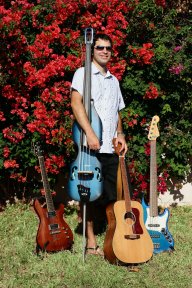
Some years ago a friend of mine, left handed, really liked a bass I was selling, and decided to learn bass "upside down". He is pretty good now and has been in a couple bands playing regularly. I say if it works for you and it feels good go with it, Rock on girl !!!!!

 
  • Like
Reactions: Marinda
As I would for any of my students, right or left-handed, I would recommend trying to make a "standard strung" instrument work. Making tabs easier to read is not a good enough excuse to flip in my book. You could learn to read a tab "normally" in a couple weeks/months, I don't believe it's worth a lifetime of difficulty buying/selling/sharing instruments to shave off a few weeks of learning.

You're not going to find instruments set up like that in a store (it's hard enough for lefties), it will be harder to visually communicate with other musicians (I have absolutely played songs on the fly by listening and looking at a guitar players hands), and if you ever wanted to transition to another string instrument, that will be a lot more difficult too. I even recommend lefties at least try righties for a while for the same reasons, in some cases it's obviously not gonna happen, but several students through the years have started on right-handed instruments and never looked back.

These are recommendations, not commandments, I'll teach whatever instrument somebody shows up with :-)
Kudos to you for being with the flip the strings around to begin with. As you can see, several famous players have done just fine "upside down," but in a lot of cases, those players didn't know any better. Now you know, and you're still in a very developmental phase of your career, so what you do with that information is your choice.

 
As I would for any of my students, right or left-handed, I would recommend trying to make a "standard strung" instrument work. Making tabs easier to read is not a good enough excuse to flip in my book. You could learn to read a tab "normally" in a couple weeks/months, I don't believe it's worth a lifetime of difficulty buying/selling/sharing instruments to shave off a few weeks of learning.

You're not going to find instruments set up like that in a store (it's hard enough for lefties), it will be harder to visually communicate with other musicians (I have absolutely played songs on the fly by listening and looking at a guitar players hands), and if you ever wanted to transition to another string instrument, that will be a lot more difficult too. I even recommend lefties at least try righties for a while for the same reasons, in some cases it's obviously not gonna happen, but several students through the years have started on right-handed instruments and never looked back.

These are recommendations, not commandments, I'll teach whatever instrument somebody shows up with :)
Kudos to you for being with the flip the strings around to begin with. As you can see, several famous players have done just fine "upside down," but in a lot of cases, those players didn't know any better. Now you know, and you're still in a very developmental phase of your career, so what you do with that information is your choice.

thanks, i appreciate the advice, my bf feels exactly the way you feel!! i also have a hard time with the reach on notes played most often...and if i were going any farther than my own living room, i would prob take the more difficult route, and learn the conventional way!! as for reselling, i dont think i will my bf and i collect them and if i were in a jam and had to, ill have to find a left handed kid that is desprate for a starter bass. but they both are sentamental to me!!

 
thanks, i appreciate the advice, my bf feels exactly the way you feel!! i also have a hard time with the reach on notes played most often...and if i were going any farther than my own living room, i would prob take the more difficult route, and learn the conventional way!! as for reselling, i dont think i will my bf and i collect them and if i were in a jam and had to, ill have to find a left handed kid that is desprate for a starter bass. but they both are sentamental to me!!


You say that your first bass was a short scale, did you play that with the strings in the usual positions or reversed?

I ask because it could just be a scale related issue.

There are many that say that there is no need for a short scale bass, that you should just learn on the regular scale because "insert name here" has smaller hands than you and does it no problem. Personally I play short scale basses because when I play regular scale my left wrist hurts after a short while. It is maybe a tecnique problem, or related to the times I have broken that wrist, but I don't see why I should need to experience pain when I don't have too.

The same applies to your way of stringing. There is no "correct" way, just the "usual" way, and while I agree with people like @Nickweissmusic who point out the difficulties you may experience (I have that issue with a different music related problem) I completely understand you and feel that you should do what suits you.
 
Welcome to TB Marinda.
Probably one of the most interesting and well responded post for a new TB'er than I've seen since I've been here.
I thinks it's pretty cool what you're doing.

I have a little trouble with the E string on some fingering due to arthritis.
Maybe the next time I restring, I'll flip 'em over just for kicks.
I don't play very well, just at home.
Not much to lose in starting over.

Pro golfer, Phil Michelson is right handed but golfs left handed.
That's because when he was learning he was face to face with whoever was teaching him and he was mirroring the other swing.
That's kind of like what you did with the tabs.
 
  • Like
Reactions: Spidey2112
I like your attitude, Marinda. To what's been said, I'd add that you should really try to learn things on your own by ear, without relying on tab or even YouTube videos. For any song you want to learn, listen to it, concentrating on the bass line, until you know it pretty well in your head, then sit down with a recording in whatever format works for you, that allows you stop & start it easily, and repeat selected phrases. If using a PC, the program Audacity is good for that and is free (you can select sections that it will repeat, you can alter the pitch and/or the tempo, etc). Start with simpler songs, and get to where you can pick out the notes on your own. It may take months, it may take years, but eventually you'll reach the point that if you can sing a bass line in your head, you'll be able to play it almost instantly. That skill is invaluable for improvisation, too, where if you know where the chord progression is headed, you can craft bass lines on the fly, limited only by your imagination and skill level - very satisfying!
 
That's wild. I've seen lefties play with the bass strung "upside-down" (i.e. strung rightie). But I don't think I've ever seen a rightie that strings their bass upside-down!

But, the mantra around is here play whatever and however works best for YOU, so do just that and play the hell out of it!
 
  • Like
Reactions: Marinda
ill get a pic up soon, i actually swapped those too and this time around i was smart enough to measure them and the pick ups are adjustable but they were not tilted so that i left alone but the top i need a new nut? is that what the strings lay into?? im getting a new one for now i have folded paper and the e string i had to groove it a bit to lay into...i got all strings to carry out except one at the end goes all goofy but not bad since the a and e were both flats i had to adjust with the alan wrench for about an hour, honestly i had them sounding good enough i figured it would be like that till i got the new nut thing but its good now
 

Attachments

  • image.jpg
    image.jpg
    417 KB · Views: 36
  • image.jpg
    image.jpg
    463.5 KB · Views: 28
Thar they is!
This type of bridge should work with reverse strings without an issue.
Worse case might... MIGHT be swapping the screws or springs around if they aren't the same length?
That's an easy to do thing with this style.

But the nut! We forget about the nut!
Can this just be turned around on this bass?
Like is it flat on the bottom? Symmetrical?

Does your E String ever slip out of place or does the tension keep it where it should be?
 
  • Like
Reactions: Marinda and IJBurns