My bass is an Ibanez BTB 1305e.
]
Learning on a 5 string!!! Lucky you're a logical fella!!!

TalkBass has been independent since 1998. Add your voice.
Create a free account to reply to discussions, view embedded media, and browse with fewer display ads.
Join free Log in
Want zero display ads or expanded classifieds tools? Compare plans.
My bass is an Ibanez BTB 1305e.
]

Hi guys,
I'm trying something with my Bass Majors over Spring Break. I took only TWO of Jeff's patterns from his Beyond Chops Column in Bass Player of August 1998 "Wake Up Call" (Thanks Commreman!)
Here's what they are doing:
We took 3-5-7-R and 5-7-R-3 and we're all playing them out of time over one of the following 3 tunes:
Autumn Leaves
All The Things You Are
Stella By Starlight
On Autumn Leaves the chords are:
Am7 D7 Gmaj7 Cmaj7 etc.
So the 3-5-7-R and 5-7-R-3 is:
(Am7) C-E-G-A (D7) A-C-D-F#(Gmaj7) B-D-F#-G (Cmaj7) G-B-C-E etc.
If you take each consecutive pair of chord tone groups there is about 5 years of work just on one Jazz Standard. I chose Standard Tunes because that's the likely vehicle they'll be dealing with. The object is not to play these studies in Performance through the Standard, but to increase harmonic awareness and feed the student's subconscious with how this all sounds.
So far, everyone's really motivated with this and we'll see what transpires in their playing.
Hi guys,
I'm trying something with my Bass Majors over Spring Break. I took only TWO of Jeff's patterns from his Beyond Chops Column in Bass Player of August 1998 "Wake Up Call" (Thanks Commreman!
Here's what they are doing:
We took 3-5-7-R and 5-7-R-3 and we're all playing them out of time over one of the following 3 tunes:
Autumn Leaves
All The Things You Are
Stella By Starlight
On Autumn Leaves the chords are:
Am7 D7 Gmaj7 Cmaj7 etc.
So the 3-5-7-R and 5-7-R-3 is:
(Am7) C-E-G-A (D7) A-C-D-F#(Gmaj7) B-D-F#-G (Cmaj7) G-B-C-E etc.
If you take each consecutive pair of chord tone groups there is about 5 years of work just on one Jazz Standard. I chose Standard Tunes because that's the likely vehicle they'll be dealing with. The object is not to play these studies in Performance through the Standard, but to increase harmonic awareness and feed the student's subconscious with how this all sounds.
So far, everyone's really motivated with this and we'll see what transpires in their playing.
Cool! It's great to have a designated practice space.
Learning on a 5 string!!! Lucky you're a logical fella!!!


And it breaks my heart to hear that the school that set me on the musical path that I now walk may have veered from the path that it once pioneered.
This is great.Hi guys,
I'm trying something with my Bass Majors over Spring Break. I took only TWO of Jeff's patterns from his Beyond Chops Column in Bass Player of August 1998 "Wake Up Call" (Thanks Commreman!
Here's what they are doing:
We took 3-5-7-R and 5-7-R-3 and we're all playing them out of time over one of the following 3 tunes:
Autumn Leaves
All The Things You Are
Stella By Starlight
On Autumn Leaves the chords are:
Am7 D7 Gmaj7 Cmaj7 etc.
So the 3-5-7-R and 5-7-R-3 is:
(Am7) C-E-G-A (D7) A-C-D-F#(Gmaj7) B-D-F#-G (Cmaj7) G-B-C-E etc.
If you take each consecutive pair of chord tone groups there is about 5 years of work just on one Jazz Standard. I chose Standard Tunes because that's the likely vehicle they'll be dealing with. The object is not to play these studies in Performance through the Standard, but to increase harmonic awareness and feed the student's subconscious with how this all sounds.
So far, everyone's really motivated with this and we'll see what transpires in their playing.
Motorcyclist and bassist! You're my people!The entire room is my "man cave". If I were Superman, it'd be my fortress of solitude. Here's another view of it:

Motorcyclist and bassist! You're my people!
My garage isn't nearly so big, or so clean, but it's got that same Markbass combo with a 1x15 extension cab, my '08 Concours 14, my '06 Suzuki M50, and my roommate's Sportster Iron. Along with the various shelves full of motorcycle gear, tools, junk, etc.
If you're a computer guy for a living we might just have to be friends.

IT Manager for my company. An uber geek extrodinare.
You'll be a good Bass player!
I busted out some old BP issues recently, in the August 2004 issue there is an article by Adam Nitti (Chads teacher I believe). Its called "Intro to Chordal Improvisation".
I busted out some old BP issues recently, in the August 2004 issue there is an article by Adam Nitti (Chads teacher I believe). Its called "Intro to Chordal Improvisation".
The idea behind the article is to give some options to use when playing over a certain chord, in situations where there may not be many chord changes in the music. It is supposed to help us "move around the neck" instead of staying in one position playing the same few things.
In my own words (for the most part)... According to the article....
-----------------------------------------------------------
If you wanted to solo over a static Cm7 chord, you could of course use the Cm7 arpeggio- but that will only get you so far. So to expand- we can use notes from the C Dorian mode, now we have 7 notes to work with.
Furthermore, C Dorian could be expanded to include Bb major, since C Dorian is basically the Bb major scale, it just starts on the 2nd degree and ends on the 8th. Its also safe to say that we can use any mode built off the Bb major scale, and still retain the C Dorian "sound".................................... but "we will also be able to move around and play ideas stemming from any of Bb major's seven scale degrees".
So we can take a sequence of arpeggios harmonized in the order of the Bb major scale we come up with.
(1) Bbmaj7, (2)Cm7, (3) Dm7, (4) Ebmaj7, (5) F7, (6)Gm7 and (7) Am7b5
-----------------------------------------------------------
The article was not written out in Notation or in TAB, it was just written out sort as I've done above. In order to help me understand it better, and help me with my notation reading, I wrote it all out in bass clef.
I then wrote out the Bb major scale- and of course all of the notes of the arpeggios in the article fell within Bb major.
So if I ever need to play over over a static _m7 chord I know there are lots of options, and now I know how to find them. However, I am not sure exactly how I would go about applying this concept over a _maj6 chord. I guess I am wondering if there is some sort of formula that would apply to that as well. Or perhaps the answer is that I simply need to know what mode/modes the maj6 chord falls into, and how to harmonize arpeggios that using each scale degree, that all fall within a certain key?
I've got a lot to learn!
It seems this article really has given me a taste of one of the ways to "open up the fretboard". Its something I've needed for a long time. I can jam along with a group by either being given the chords, or by finding them by ear. However, when jamming on a static chord- I am at a loss as to how to keep it fresh. I just can't reliably wander out of a strict 1 or 2 octave scale based on the Root of the static chord. Nor can I really recognize chord structures and note intervals in jazz, at least not as easy as I can in everything else I listen to.
Can anyone else expand on this idea of how to figure out ways of opening up the music/fretboard- that directly relates to that article?
I'm a huge "logic" guy. I HAVE to know why something is the way it is. I am enjoying learning about music, but much of it is simply over my head at this point in my journey.
I had a lesson last night, and I can't emphasize enough the value of a good teacher. He showed me what I'll be able to do when I become proficient with what he's wanting me to learn, and it's amazing. I'm really not that far away from doing some really good stuff, I just have to keep working at it.
My bass is an Ibanez BTB 1305e. I've only seen one other like it for sale, and that's here:
http://www.theperfectbass.com/explo...103200101&W=STORE&P=N&S=1001081&U=1&SS=1&CR=Y
I don't know if that's a good thing or a bad thing. I bought mine used and didn't pay a bunch for it.
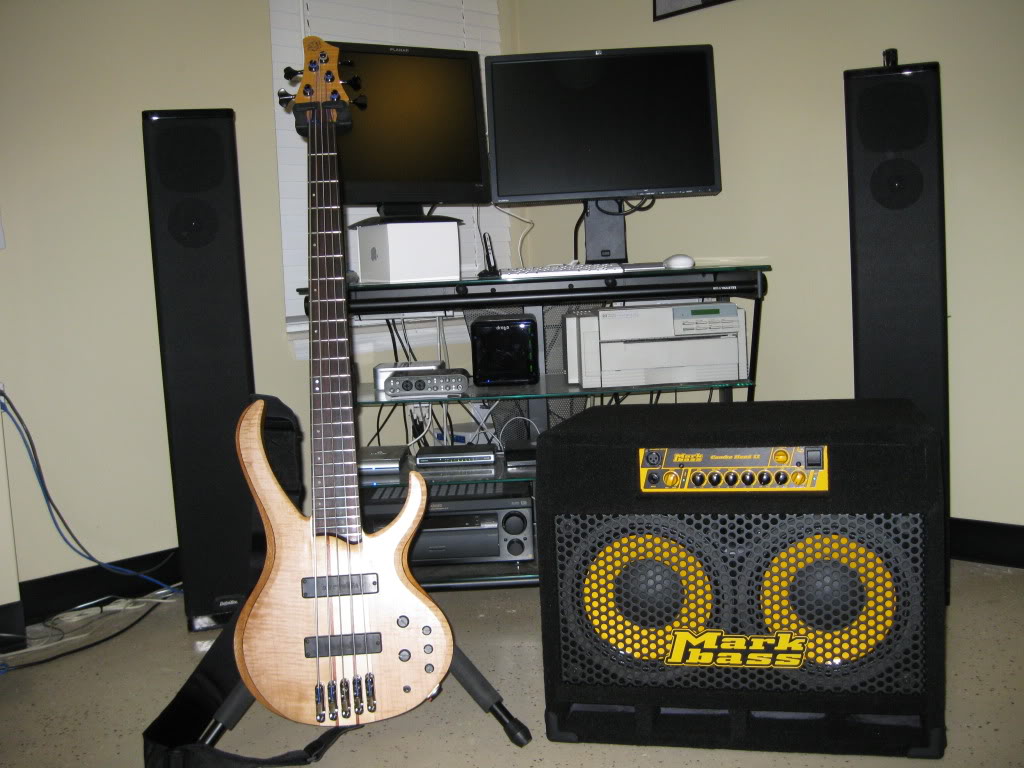
Here's my rig, and where I do all my practicing. I moved my chair and music stand out of the way, but I spend a lot of time here:
Sad, but true. A glimmer of hope is that once I've taken the time to explain some reading strategies and given them some easy Bach to work on, most of my students find TAB a distraction and a drag and come up with their own fingerings.As i believe is the case with most books...no tab, no deal. The players that buy the book because it has tab subsidise it for those that want notation. Welcome to the real world folks
If one of those two monitors over there is attached to a computer of some kind, might I recommend getting Band in a Box www.pgmusic.com. It will generate a Robo-Band backup for any chords you type in it and they've recently added real samples for most instruments. There are B in a B files for the Real Book all over the internet. You can set tempos as fast or slow as you like. I prefer using this over Practicing/Performing with a metronome because you can hear the chord changes from the Piano or Guitar. It makes the Chord Studies for Bass material and the approach tones a little easier to hear, IMO.
Not as good as a real group of players, but better than a metronome or drum machine.

If one of those two monitors over there is attached to a computer of some kind, might I recommend getting Band in a Box www.pgmusic.com. It will generate a Robo-Band backup for any chords you type in it and they've recently added real samples for most instruments. There are B in a B files for the Real Book all over the internet. You can set tempos as fast or slow as you like. I prefer using this over Practicing/Performing with a metronome because you can hear the chord changes from the Piano or Guitar. It makes the Chord Studies for Bass material and the approach tones a little easier to hear, IMO.
Not as good as a real group of players, but better than a metronome or drum machine.
I'll give Band in a Box a look see. Sounds very very cool.
.


