• TalkBass has been independent since 1998. Add your voice.
    Create a free account to reply to discussions, view embedded media, and browse with fewer display ads.
    Join freeLog in
    Want zero display ads or expanded classifieds tools? Compare plans.

Double Bass Kay DB - Excess Neck Bow from Loose FB

I have an old Kay M-4 that I set up with nice low action. It was a blast to play. One time I picked it up to play and the neck relief had way too much bow. I looked closer and saw that the fingerboard glue had lost most of its adhesion to the neck. I recalled reading on TB years ago that on the Kay basses, the FBs are glued on with the neck clamped flat or perhaps slightly backbowed, to basically do a the same job that a truss rod would do, except without the adjustability. Thus, when the glue dries and the neck/FB is put under string tension, the counterbowed assemblage is pulled into a proper amount of bow to prevent buzzing and allow low action. Makes sense to me. In order to do that, the gluer/luthier must know how far to backbow while gluing.

I can do luthier stuff, but I decided to farm this job off to a DB luthier over doubts over the proper clamp arrangement to exert the counter bow, and "how far" to counter bow while gluing. I live off the beaten track, so I was happy to find a DB specialty luthier about 2 hours away and emailed him for a quote. He responded with a cockamamie plan to "repair my damaged neck" by routing a channel and adding a truss rod, prior to installing a new FB. I gathered my wits and politely told him that nothing was "damaged" on my Kay, and if he didn't understand the concept of backbowing a Kay neck to get the proper relief during a FB replacement, then he would not be working on my Kay.

So, more time has passed and I really miss playing my old M-4. I have decided to do the FB replacement myself, but I cannot for the life of me find any info about how far to counter bow (flat, 1/8" counter? 1/4" counter? who knows?), or descriptions/pics of recommended clamp arrangements. I have had no luck with TB or Google searches. Can anybody help me out? I didn't dream all this backbow stuff, did I?
 
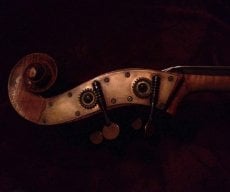
Pics of the old M-4, for fun and entertainment, and well, no pics no bass. Its a 1937, first year of production.

Kay.M4.front.jpg

Kay.M4.back.jpg

Kay.M4.tuners.jpg
 
...He responded with a cockamamie plan to "repair my damaged neck" by routing a channel and adding a truss rod, prior to installing a new FB.
Trust the expert! Your neck IS damaged. Damage does not always mean missing/cracked wood. Not "cockamamie" at all. I suggest that you first apologize and then ask if he'll take on the job.
 
  • Like
Reactions: RandyMolson
Old Kays with a tired 70 year old factory specs can be a frustrating experience; old Kays rebuilt from the right hotrod shop are an incredible amount of fun! Yours is one of the very early models with the non standard 3 piece neck that was outsourced from another shop. 'Very cool! There was a scroll from one of these on ebay a few weeks ago. I tried to buy that one and a few others, but the seller was....um ...how to be polite....a bit rigid and out of touch.....right now he's asking $50 for one that was clearly destryed in a fire and is a useless piece of wall art...

The general treatment plan prescribed is right on track and similar to what I would do on my own old Kay. Now would also be a great time to thicken up the neck in some manner, like a new fingerboard or a shim. In an ideal world, you would be able to play a working example of this at the luthier's shop, too verify the results of the plan on a similar model.

If you already have the confidence and skills to "do the luthier stuff...", another option would be a private session with someone who knows how to (re) build up a nice old Kay neck with more experience than you who will take you on as a paying student to show you the ropes. Fix your bass for a day or learn to fix your bass for a lifetime. Don't show up critical of someone's work and ideas and then ask to take up a bunch of their time while complaining about how broke you are, the dog ate my homework, and wanting a free lunch in the process.

Also- there are several known vintage Kays floating around that actually DO have a working factory installed truss rod!

j.
www.condino.com
www.kaybassrepair.com
 
  • Like
Reactions: RandyMolson
That's a real nice bass! Unless the neck is twisted, if this was my project I'd consider simply having the luthier reglue the board, plane the surface for proper action and set up. Shouldn't be hugely expensive to do that, under 500 bucks? I'd avoid using the graphite unless it is absolutely necessary. If you are going to remove or replace the board and start adding a shim to get more neck depth or bridge height, you really shouldn't need the graphite unless there is a twisting problem. It looks like a nice thickish ebony board...I'd keep that on there if at all possible. Just my opinion.
 
You can do whatever you want to the neck, but I can say with confidence that with an already skinny and bowed original spec Kay neck, the more you plane it out, the more it will bow, the more you'll dress it out again, the more it will continue to bow, et cetera until the thing is the size of a worn out telecaster neck and as stable as a wet pasta noodle and you finally step up and have to add carbon fiber to stabilize it... and then you just added another fingerboard R & R to the cost since you toasted the other one and it will cost you half the value of the bass now...'jus sayin'....if that is where you are headed, let the folks here make an offer. A '37 Kay with a cool neck and nice vibe deserves to be treated right so that it can rock another 50 years of gigs. Everyone has their own opinion, but among Kay nerds ( and there are a LOT of them), a'37 is the pinnacle of vintage years. I can selll one in a few hours here in Asheville.

Either way, keep us in the loop and let us know how the thing turns out. I sure hope...no, I PRAY... that it doesn't wind up like that thread with the American Standard neck last year where the fellow was given very solid, consistant advice on how to fix the issues correctly and then he bottom fed it and completely destroyed the bass, turning a great old classic into a worthless parts rig.....

j.
www.condino.com
www.kaybassrepair.com

edit: 'Sorry to get excited. Cool bass. 'Pretty manageable fix. Besides- who needs some sissy luthier......

image_zps99f67a5a.gif
 
Last edited:
  • Like
Reactions: MR PC
"Doing the fingerboard replacement yourself"...that isn't a an easy job to do right. Lining it up, gluing, and trimming excess material are just the beginning steps of that operation.
 
Oh God, James, PLEASE don't jinx this nice old bass by invoking the fate of that poor American Standard. Last I heard, Wayne was still trying to unload it.

I'm not qualified to dip water for many of the folks posting in this thread, but having lived with and loved more than a few Kays, I'm 100% for pulling the old board, doing a heat bend on the (very cool) neck, inlaying a CF rod or two and adding a nice thick new ebony board.

It should come out stronger, sounding better with more fundamental and easier to play with a little more beef to the neck.
 
LOL, the only thing that's clear from the OP is that his M4 has a loose board, and a prescription for major structural work and a large financial investment is being given without seeing it in person. We even have talk about another bass being ruined in another thread, a guy trying to unload said ruined bass, and pics of another bass that's being tortured back into service with galvanized woodscrews. "This could happen to you!" I just love Talk Bass. :-)
 
  • Like
Reactions: james condino
Trust the expert! Your neck IS damaged. Damage does not always mean missing/cracked wood. Not "cockamamie" at all. I suggest that you first apologize and then ask if he'll take on the job.

The luthier did say "routing a channel and adding a truss rod". Unless he was actually referring to an inlay, I'd be suspicious. Also, as far as the amount of work, adding a CF inlay but keeping the original board seems like the right prescription here.
 
LOL, the only thing that's clear from the OP is that his M4 has a loose board, and a prescription for major structural work and a large financial investment is being given without seeing it in person. We even have talk about another bass being ruined in another thread, a guy trying to unload said ruined bass, and pics of another bass that's being tortured back into service with galvanized woodscrews. "This could happen to you!" I just love Talk Bass. :)

You're right! Maybee too much coffee. I wouldn't call it major structural work; more like right on schedule for an old Kay neck. Since the fingerboard will come off to reset it, it is the perfect time to add carbon fiber and it is not much extra $ for all the added benefit. Good luck.
 
  • Like
Reactions: MR PC
Okay; trying to get clarification of things said in a couple of posts here.

1) Are "carbon fiber rod" and "truss rod" being used as synonyms? CFR is fairly obvious, but on the other side of TB "truss rod" usually means not only metal, but adjustable as well. I suppose it is possible to install an adjustable metal truss rod in a DB neck, but I doubt it is advisable. A metal rod, I expect, would add a LOT of weight and do who knows what to the tone. But in this thread, how is "truss rod" being defined?

As a corollary, on the EB side of TB, the fat) finger can do wonders with some basses when it comes to eliminating or ameliorating dead spots. But a lagniappe is that it often improves the "good" notes, usually by emphasizing the fundamental in the harmonic spectrum. Would DBs be influenced as well by this cause and effect?

2) When replacing the fingerboard, how does one remove the overhang on the sides? I thought maybe of test-fitting the 'board and marking the overehang, then taking it down with bandsaw,
handsaw, or planer; but I can see so much potential for making an irreversible screw-up with any of those methods that they have been banished from my thoughts.

So what's left? Glue the board into place and THEN trim the overhang? With what? Only thing I can come up with is drawknife/spokeshave to remove most of the excess wood, and then use
scraper/sandpaper for final shaping. Seems like a lot of handtool work here.
 
I have an old Kay M-4 that I set up with nice low action. It was a blast to play. One time I picked it up to play and the neck relief had way too much bow. I looked closer and saw that the fingerboard glue had lost most of its adhesion to the neck

The FB loosing adhesion and popping up absolutley means the neck is warped? I've had this situation a couple of times with different basses, the cure was simply to reglue. And it hasn't posed any problems, so far...like many years. Still a good reco to get it to a luthier though.
 
The FB loosing adhesion and popping up absolutley means the neck is warped? I've had this situation a couple of times with different basses, the cure was simply to reglue. And it hasn't posed any problems, so far...like many years. Still a good reco to get it to a luthier though.
Almost all Kays have warped necks even with the board firmly attached. If you put a straightedge on the glue line of a couple dozen, you'll see what I mean.

So if the neck hasn't had the stiffness of the board to help it resist the string tension, its definitely going to be warped. You'd be astonished at how flexible a Kay neck is without the board. :thumbsup:
 
  • Like
Reactions: robobass