
Enjoy the benefits of a premium membership!
Upgrade Account
-
TalkBass has been independent since 1998. Add your voice.
Create a free account to reply to discussions, view embedded media, and browse with fewer display ads.
Join free Log in
Want zero display ads or expanded classifieds tools? Compare plans.
You are using an out of date browser. It may not display this or other websites correctly.
You should upgrade or use an alternative browser.
You should upgrade or use an alternative browser.
More options
Who Replied?


I requested the PTC and I am digging it. Also requested the 34” scale and black hardware. To awhile to find the right top, but I knew it when I saw that one. The guys knocked it out of the park. I couldn’t do the stacked volume/tone because it is P/P for active/passive. So the additional knob was almost necessary. Not saying there could have been another option that worked, but we did explore several.Interesting. Was this a request from you?
I’m getting a tech to make some alterations to my 55-94 including adding a passive tone control, but rather than adding an extra control I’m having a stacked bass and treble. I’m also getting a push pull mid switch to switch between my two favourite mid settings. Imo having the mid switch accessible via the dipswitch in the back is kinda pointless.
Very much looking forward to getting my bass working the way I like. How are you finding the passive tone control?

Wow- that’s gorgeous! Excellent choices all around!So I ordered a Lakland face mask and look what they threw in...
25th anniversary, 34” scale, roasted ash body, roasted flame maple neck with ebony board, Bart pickups and preamp and flame maple top. Anybody notice anything else?

Wow what a pair, that quilt looks so deep. Those are definitely KEEPERS!I should join this group. I have a 1998 US 4-94 and a 4-76 custom - not sure on how old it is.
I should join this group. I have a 1998 US 4-94 and a 4-76 custom - not sure on how old it is.
Killer basses!
Is there a way to join this group, or do you just follow the thread? Asking for a friend (actually me)...


Wow! Both are gorgeous! Especially love that quilt!I should join this group. I have a 1998 US 4-94 and a 4-76 custom - not sure on how old it is.
PM Doug (@basspraiser ) if you wish for a club number. He's not on here every day. he does real work n stuff

Jedi Bass,
Thanks for the reply. I agree that the “word” from Lakland can be a little skewed. I’ve gotten bad information from them before about the history of a bass. I’m a carpenter as well as musician, so I’m familiar with wood grain. I started to suspect rift sawn, which makes sense from your “diagram”. The end grain being what it is, the actual body of the neck doesn’t look flat sawn at all, all the grain runs in one direction, but it doesn’t look as tight as quarter sawn does. (I attached another diagram)
Jimmy
Jimmy & Jedi
Thank you both for the descriptions and images. I've had lots of basses/guitars and never knew riftsawn was a thing usually calling it "almost quartersawn". There has to be something tonally going on with the width and thickness changing at the same rate because those necks were killer. Most easily bowing neck I had was a G&L quartersawn that looked like a crescent moon when I changed to higher tension strings.
On another note as a martial arts master/school owner myself and my students have broken some boards over the past 45 years. Yes they're pine and I've found riffsawn by far breaks the easiest followed by quartersawn then flatsawn. When breaking two boards stacked on top of one another and especially more than two you'd better hope there's no flatsawn in the mix. Or not make the mistake I made one time and stacked three boards with the middle one turned cross-grain. That F'n hurt more than breaking rocks.
You’re not helping me sell my bass at all...Jimmy & Jedi
Thank you both for the descriptions and images. I've had lots of basses/guitars and never knew riftsawn was a thing usually calling it "almost quartersawn". There has to be something tonally going on with the width and thickness changing at the same rate because those necks were killer. Most easily bowing neck I had was a G&L quartersawn that looked like a crescent moon when I changed to higher tension strings.
On another note as a martial arts master/school owner myself and my students have broken some boards over the past 45 years. Yes they're pine and I've found riffsawn by far breaks the easiest followed by quartersawn then flatsawn. When breaking two boards stacked on top of one another and especially more than two you'd better hope there's no flatsawn in the mix. Or not make the mistake I made one time and stacked three boards with the middle one turned cross-grain. That F'n hurt more than breaking rocks.

You’re not helping me sell my bass at all...
Hey Jimmy I'd be happy to trade with you at any time.
With that $500 bonus you like to include you could become known as "Jimmy Stimulus".

I imagine chopping wood in half with your hand and taking into account wood grain when making instrument necks is a slightly different mindset... flat sawn is the most available because it yields the most dimensional lumber per log...tone wise is subjective in my opinion, from playing lots of instrumentsJimmy & Jedi
Thank you both for the descriptions and images. I've had lots of basses/guitars and never knew riftsawn was a thing usually calling it "almost quartersawn". There has to be something tonally going on with the width and thickness changing at the same rate because those necks were killer. Most easily bowing neck I had was a G&L quartersawn that looked like a crescent moon when I changed to higher tension strings.
On another note as a martial arts master/school owner myself and my students have broken some boards over the past 45 years. Yes they're pine and I've found riffsawn by far breaks the easiest followed by quartersawn then flatsawn. When breaking two boards stacked on top of one another and especially more than two you'd better hope there's no flatsawn in the mix. Or not make the mistake I made one time and stacked three boards with the middle one turned cross-grain. That F'n hurt more than breaking rocks.
Hey Jimmy I'd be happy to trade with you at any time.
With that $500 bonus you like to include you could become known as "Jimmy Stimulus".
hilarious... Jimulus
Last edited:
I’ve broken some boards. Didn’t have my own school, but taught some TKD. The repeated hand injuries and the desire to play bass ‘til I die were big factors in my giving up MMA. The injuries were weird sparring accidents that I won’t go into unnecessary detail about. I have pain all the time from them.
Anyways... I can totally see why quartersawn boards would split easier along the grain. But, necks aren’t subject to impacts down the middle or splitting forces (punk rock stage antics don’t count LOL). It also makes sense why quartersawn necks should be stiffer than flatsawn.
All in all, after seeing rift and quartersawn compared, I can see why Jimmy H’s bass neck isn’t considered flatsawn by Lakland. The long straight grain down the length will look just like quartersawn. Only the end grain looks flat-ish. For some, like me, it’s totally a NON-issue. Jimmy and I have messaged and I would buy or trade for his bass in a second if I could.
Anyways... I can totally see why quartersawn boards would split easier along the grain. But, necks aren’t subject to impacts down the middle or splitting forces (punk rock stage antics don’t count LOL). It also makes sense why quartersawn necks should be stiffer than flatsawn.
All in all, after seeing rift and quartersawn compared, I can see why Jimmy H’s bass neck isn’t considered flatsawn by Lakland. The long straight grain down the length will look just like quartersawn. Only the end grain looks flat-ish. For some, like me, it’s totally a NON-issue. Jimmy and I have messaged and I would buy or trade for his bass in a second if I could.

So I ordered a Lakland face mask and look what they threw in...
25th anniversary, 34” scale, roasted ash body, roasted flame maple neck with ebony board, Bart pickups and preamp and flame maple top. Anybody notice anything else?
Such a Deal!!!!

I requested the PTC and I am digging it. Also requested the 34” scale and black hardware. To awhile to find the right top, but I knew it when I saw that one. The guys knocked it out of the park. I couldn’t do the stacked volume/tone because it is P/P for active/passive. So the additional knob was almost necessary. Not saying there could have been another option that worked, but we did explore several.
I’ve got a passive tone on my 55-94 and it’s great and very useful.
(In my case East Uni pre- vol, blend, passive tone w pp active passive, stacked bass and treble with pp pick attack boost, stacked mid and freq)
it’s also very much flatsawn. Not that it matters
That is the same pre I would like to put in a 44-02. Have a East pre in another bass and it is very versatile and very high quality.
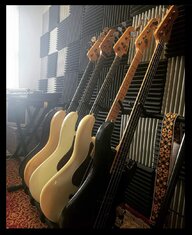
Nice pair!I should join this group. I have a 1998 US 4-94 and a 4-76 custom - not sure on how old it is.
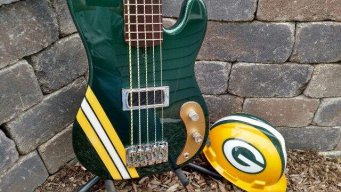
Killer basses!
Is there a way to join this group, or do you just follow the thread? Asking for a friend (actually me)...
PM me and I will set you up!


