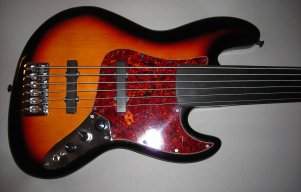
I got a cheap Yamaha TRBX with a 34" scale for now and the B is surprisingly tight. Tune it to A , maybe not.
All 34" scale B strings of the same type (gauge, type, brand) will have the same tension on every bass.

TalkBass has been independent since 1998. Add your voice.
Create a free account to reply to discussions, view embedded media, and browse with fewer display ads.
Join free Log in
Want zero display ads or expanded classifieds tools? Compare plans.
I got a cheap Yamaha TRBX with a 34" scale for now and the B is surprisingly tight. Tune it to A , maybe not.
mariachi plays a six string bass, With a low A as the bottom string, they aren't electric, but they've been around for long time.

And also used at the beginning of " La Bamba ", by Ritchie Vallens. Not to mention, a lot of Duane Eddy songs.

a cello is a bass instrument. The guitaron is also a bass instrument. It's tuned lowered than a piccalo bass. A regular bass does not go as low as a tuba. Not sure what point you are making.The guitarron is an old instrument, older than bass, but doesn't go as low as the bass because it has a mix of metal and nylon strings and the bass guitar is merely 80 yo... so for bass guitar it was special and still frown upon to have 6 strings.
According to Wikipedia it is tuned : A1 D2 G2 C3 E3 A2
While the Bass Guitar is : E1 A1 D2 G2

Beg to differ. " Tiger Love and Turnip Greens", "Because They're Young", and, " Kommotion " to name a few. Maybe not his biggest hits, but he did record with the Dano. If you check out the cover of the LP, " One Million Dollars Worth Of Twang ", you will clearly see the Dano, black 6 string bass, proudly displayed. In an interview with Duane, he stated that he thought the Dano 6 string was clearly an instrument made for him. To quote the man himself, " I walked into Music City at Sunset and Vine one day, and here was this six-string bass guitar. I thought, 'Boy, somebody designed this for me- or because of me.' I bought the Longhorn model first, and then went back and got the black-single cutaway model; I thought it looked better." If you get the cd box set compilation called, "Twang Thang ", there is a photo of him in the booklet playing the Longhorn model in the studio. So, Duane Eddy himself ? Uh.. yeah.Duane Eddy songs? Yes.. I play some of his songs on my Eastwood Sidejack baritone; works pretty well when played through my old Rick TR-7 combo amp, with some reverb and echo dialed in. Duane Eddy himself? Uh.. no. Most of his hits were played on a Gretsch G6120 Chet Atkins model guitar; just playing the bass strings, with lots of tremolo/echo. He did use a Guild later on, but his reputation was made on that Gretsch...

Congrats on the new bass.Just. Got a new 5er today ... i felt like the low B was a hidden treasure. Why was bass tuned EADG in the first place ?
Or amps that could reproduce them, I assume.Proper B strings that could reproduce those low notes weren't around in 1951 when the P bass came out. Not until 1975 or so.
I think it's because it's the lowest 4 strings of a guitar.
Jimmy Johnson and the Alembic.

Because that's the standard tuning of an upright bass.Just. Got a new 5er today ... i felt like the low B was a hidden treasure. Why was bass tuned EADG in the first place ?
.
Until relatively recently, our electric bass oriented pop music simply did not require the lower notes. In fact, you can still play a lot of cover music that does not have the lower notes in the bass part. So, a lot of players still use 4’s for good reason. But, increasingly, you may run into lower parts; and for those parts, either the D-tuner or a B string will get you there.
Since our pop music has a fair amount of improv in it, I suppose there is nothing intrinsically wrong with playing lower notes where they aren’t originally called for, as long as you audience is up for it. And, of course, if you are composing your own music, then anything is possible, whether or not your audience is hip to it.
As far as the so called 4 vs 5 parochial bickering that goes on here in this thread and more broadly on TB; I just wish players would get over it. They are all just basses. Players need to use whatever range covers the gig. Using the number of strings as some kind of tribal discriminator is just plain laughable. Get over it, and get on with playing bass on the gig. In whatever flavor works.
I disagree with all of this; except the part about playing classic lines differently using the lower register on a B string, which you completely misunderstood and turned around to suit your needs.I pretty much don't agree with any of this.
First off it's not true that early pop did not require or make good use of lower notes. As a player of those early tunes I desperately wished for a Low Eb for horn keys instead of having to always go up an octave., Sure later synthbass made more lower notes "needed" to compete, but all was not happy-happy in the 4 string world even with some of the old classics.
But having said that and speaking as 5 string player, I have found there IS something intrinsically wrong with putting low notes into older classic bass lines. Perhaps it's just because I'm a hack, but in my experience trying to "improve" the basslines of the masters is a plan that generally does not end well. For that reason I find that if you want to cover classic lines then being restrained by 4 strings helps keep you in line.
And lastly, there is tribal discriminator between 4 and 5+ players. They are like two different instruments and all the people who think the difference is only about a couple lower notes just don't get this. Because with 5+ strings you have greater range across the neck you develop a different style which does not have the up and down the neck thing of a 4 string. People who think it is only about a couple lower notes just don't get this. However let me add that there is no rule that you can't belong to both tribes.
And to sort of change the subject. I must say that I have tried BEAD on a 4 string thinking that I didn't use a G string all that much only to find on the gig that actually I did. And that's why I went to 5 strings rather than BEAD. However, having switched and not looked back, it became obvious to me (probably from my Eb dreams) that one really doesn't need a low B for much of anything. So had I been thinking back when I wanted an Eb a more viable answer would be to tune the whole 4 string bass down not to BEAD but maybe half that far, like say starting with a low string of C or maybe even D. Of course there are a couple problems with doing this. One is that now you've changed the note positions on all the strings and you have to relearn the neck. And in addition just down-tuning an E string to D or C may not play so well unless you go with fatter strings which are going to be harder to find that just BEAD strings.
So there are lots of ways to deal with things and no one way is really "best". You just have to see what works out for you for the things you want to do. And for me currently, that means 5 or 6 strings.
I disagree with all of this; except the part about playing classic lines differently using the lower register on a B string, which you completely misunderstood and turned around to suit your needs.
Tribal behavior aside, you just seem to be picking a quarrel. Go try someone else.
I was referring to the apparently intentional misinterpretation of my statement about using lower notes for cover tunes that don’t have them otherwise.I disagree with what you said and you disagree with what I said. It's not a quarrel, it's a difference of opinion. A discussion. It's what TB is for.

Just like in Orchestra, between the bow and pizz players.Everyone knows the real feud is between pick and finger player tribes.
I was referring to the apparently intentional misinterpretation of my statement about using lower notes for cover tunes that don’t have them otherwise.
If you want to think that there are 5 string bassists and 4 string bassists, and there is an ongoing feud between them, that’s your business. You are welcome to that opinion. I disagree.
And further, you are disputing my recounting of the background with the upright bass. I’ve only been playing Orchestra for 40+ years; so, what do I know.
Get a 5 string and you can tune it to FRAUD.I'm going to start tuning my basses FEUD

Look, my post was directed at the OP question; which was how the 4 string came to be tuned EADG instead of BEAD. The rest of this discussion is pretty much off topic.I don't know what you consider a "misinterpretation". I was merely describing my experience with playing covers with 4 and 5 string basses. Given I've been playing covers for 40+ years I do have some experience.
And I DO think there are 4 string bassists and 5/6 string bassists (and some who can do both). As to an ongoing feud, the only one I notice is some 4 string players who seem determined to make sure that everyone plays the same number of strings they play because anything else is "not needed". My view is you play whatever gives you what you want for the music. Simple as that. And interestingly enough, the whole subject of this thread is that 4 string basses may NOT be adequate as is and maybe a new tuning to get "those few lower notes" could be useful.
As for your orchestral comments, perhaps I was not clear that I was NOT disputing that part of your post in any way. I started out playing upright ( though I haven't for many years, but every now and then I do get GAS to buy an upright again. And indeed your comments on 5 string uprights (which is what I would buy now) and extensions (I think are sort of a klooge like hipshots) just provides confirmation of my early complaints about a 4 string tuning not going low enough especially to Eb. My upright,of course, was 4 strings and did not have an extension. I should have experimented with lower tunings back then, but I didn't. Back then I studied piano for years (I still suck on keys) so that made the missing low notes on an instrument that people called a "bass" really obvious.