

Enjoy the benefits of a premium membership!
Upgrade Account
-
TalkBass has been independent since 1998. Add your voice.
Create a free account to reply to discussions, view embedded media, and browse with fewer display ads.
Join free Log in
Want zero display ads or expanded classifieds tools? Compare plans.
You are using an out of date browser. It may not display this or other websites correctly.
You should upgrade or use an alternative browser.
You should upgrade or use an alternative browser.
NEW Electro Harmonix LIZARD QUEEN Octave/Fuzz Pedal
- Thread starter Karli
- Start date
More options
Who Replied?
1st test run with the BIG one.
Sounds like basically every octave fuzz out there. So far I'm liking this pedal with a blend. On it's own it's a mush fest.
You don't have to speculate. It's right on the EHX site.I don't know the workings of Josh's mind, so I cannot speculate how this design came about.
About a year ago, JHS wanted to do an homage to EHX 70s pedals, so they made a prototype based on 70s tech and graphics. He basically just reached into a bucket of old transistors and spent a few days making something he thought sounded good, wasn't in their 70s lineup, but would still make sense for a 70s pedal.
It wasn't originally intended as a real pedal, but apparently someone at EHX liked it enough (or just realized it was generating buzz), so they collaborated.
Josh did in fact come up with the circuit. Putting together existing transistors in novel ways -- or in ways that deliberately try to imitate earlier designs, or only put a slight spin on an existing type of effect -- y'know... that's what pedal designers do. So yes, the description on EHX's site is as accurate as anything else ever written by a marketing department.

You don't have to speculate. It's right on the EHX site.
About a year ago, JHS wanted to do an homage to EHX 70s pedals, so they made a prototype based on 70s tech and graphics. He basically just reached into a bucket of old transistors and spent a few days making something he thought sounded good, wasn't in their 70s lineup, but would still make sense for a 70s pedal.
It wasn't originally intended as a real pedal, but apparently someone at EHX liked it enough (or just realized it was generating buzz), so they collaborated.
Josh did in fact come up with the circuit. Putting together existing transistors in novel ways -- or in ways that deliberately try to imitate earlier designs, or only put a slight spin on an existing type of effect -- y'know... that's what pedal designers do. So yes, the description on EHX's site is as accurate as anything else ever written by a marketing department.
Wait, first you’re telling me to believe the EHX website, and then you tell me the stuff on that site is just marketing lies? The latter is likely closer to the truth. You cannot convince me that you can reach into a bucket of transistors and come up with this particular design, without knowledge of the existing circuits. The similarities are just too great, to the point that even the same values for caps and resistors are used. There are, in my opinion, two things need to be separated, and both come in gradations: the degree of originality of the circuit and the claims made about the circuit (either by EHX marketing or by Josh himself).
In the pedal world, it would be really hard to come up with a truly original design, but there are degrees of originality. Pedal companies differ in the degree of originality of their designs, and also different pedals from one company can differ. This one gets a bad score on originality, from looking at the posted schematics. If the original circuits would have been patented, EHX/JHS would be in big trouble. As it is, the circuits were not patented, but freely given away to the DIY community. So, anyone could use them, also for commercial purposes. A pedal can be non-original and still sound great and fill a niche, so a bad score on originality is no biggie to me.
I can accept that marketing involves a bit of exaggeration, but there are degrees of dishonesty. Some pedal companies are quite open about their inspirations, some blatantly lie and claim that a mere copy is their original design (and even resort to legal threats to protect those claims). Even within a company’s product line, different strategies can be applied to different pedals. This one gets a rather bad score on this aspect: you cannot combine two existing circuits and claim the result as your "original" and "unique" design.
To be fair, other companies have had similar (and even worse) cases, but that does not make the practices okay. To be even more fair: EHX/JHS did not try to hide the fact that this is not an original in the pedal's construction (e.g., they could have gooped the board). Still, this makes me sad, and I also don’t understand why this was done. It wouldn’t have hurt to give a tip of the hat to the DIY community, or simply refrain from claims on the superb originality of design.
Wait, first you’re telling me to believe the EHX website, and then you tell me the stuff on that site is just marketing lies? The latter is likely closer to the truth. You cannot convince me that you can reach into a bucket of transistors and come up with this particular design, without knowledge of the existing circuits. The similarities are just too great, to the point that even the same values for caps and resistors are used. There are, in my opinion, two things need to be separated, and both come in gradations: the degree of originality of the circuit and the claims made about the circuit (either by EHX marketing or by Josh himself).
In the pedal world, it would be really hard to come up with a truly original design, but there are degrees of originality. Pedal companies differ in the degree of originality of their designs, and also different pedals from one company can differ. This one gets a bad score on originality, from looking at the posted schematics. If the original circuits would have been patented, EHX/JHS would be in big trouble. As it is, the circuits were not patented, but freely given away to the DIY community. So, anyone could use them, also for commercial purposes. A pedal can be non-original and still sound great and fill a niche, so a bad score on originality is no biggie to me.
I can accept that marketing involves a bit of exaggeration, but there are degrees of dishonesty. Some pedal companies are quite open about their inspirations, some blatantly lie and claim that a mere copy is their original design (and even resort to legal threats to protect those claims). Even within a company’s product line, different strategies can be applied to different pedals. This one gets a rather bad score on this aspect: you cannot combine two existing circuits and claim the result as your "original" and "unique" design.
To be fair, other companies have had similar (and even worse) cases, but that does not make the practices okay. To be even more fair: EHX/JHS did not try to hide the fact that this is not an original in the pedal's construction (e.g., they could have gooped the board). Still, this makes me sad, and I also don’t understand why this was done. It wouldn’t have hurt to give a tip of the hat to the DIY community, or simply refrain from claims on the superb originality of design.

Got my small box EHX in today; sounds good; was planning on running it in the loop of my HX Stomp so I could blend but this one does not play well with buffers. I like it, think it'd sound great with the blend, but I don't feel like buying another pedal to go with my pedal :/
Here's a quick demo with a P-Bass with flats
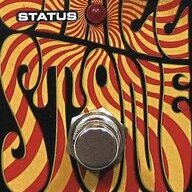
If you want an octave fuzz with blend, the MXR Bass Suboctave Fuzz is kind of close. The blue fuzz on there sounds rather like the Octavix, with less extreme melting sagging and less/no octave up harmonic on high notes. It’s close to the very cool sound clip right above by Halech54. IIRC. I’ll have to A/B them some more.
The Lizard looks to be basically an Octavix but with “balance”~= tone, instead of a gain knob, which is kind of different.
The Lizard looks to be basically an Octavix but with “balance”~= tone, instead of a gain knob, which is kind of different.
Last edited:
I really bought this out of intrigue more than anything else; and hoped that I could blend it with my Stomp as stated. I'll just stick to the Tall Font Russian that I've loved and abused for many years nowIf you want an octave fuzz with blend, the MXR Bass Suboctave Fuzz is kind of close. The blue fuzz on there sounds rather like the Octavix, with less extreme melting sagging and less/no octave up harmonic on high notes. It’s close to the very cool sound clip right above by Halech54. IIRC. I’ll have to A/B them some more.
The Lizard looks to be basically an Octavix but with “balance”~= tone, instead of a gain knob, which is kind of different.
Here's a quick demo with a P-Bass with flats
Very nice! Like it.
Cheers from Germany
Karli

The balance def does more o. The LQ than act as a tone control, when at sun you get a more agressive distortion and more mellow in the oppositeIf you want an octave fuzz with blend, the MXR Bass Suboctave Fuzz is kind of close. The blue fuzz on there sounds rather like the Octavix, with less extreme melting sagging and less/no octave up harmonic on high notes. It’s close to the very cool sound clip right above by Halech54. IIRC. I’ll have to A/B them some more.
The Lizard looks to be basically an Octavix but with “balance”~= tone, instead of a gain knob, which is kind of different.


- Feb 16, 2008
- 21,240
- 23,633
- Disclosures
- John K Custom Basses
i'm currently making my own large box lizard queen with a built-in dry blend in a 1590B.
i should have it ready for testing by the middle of this coming week.
i should have it ready for testing by the middle of this coming week.
I am loving this EHX Lizard Queen pedal. It works for me very, very well with the Sheehan Ultimate Drive's drive loop, with the proviso of having to lower the drive on the distortion signal so it doesn't become too much (unless I have very low settings on the Lizard Queen, which would be a bit pointless IMHO.) I have a few other distortion/overdrives/one muff, etc. and this is very unique and easy to love right away.
Despite the set fuzz, it is *very* adjustable, and I find most settings would be useful for someone out there.
I tested it on its own first when I took it out of the box, and in my humble estimation, it could be usable for bass as-is if set right-however, I love having the original bass tone always available to me in one way or the other, and that is why I prefer it blended in (with the Sheehan pedal, in my case.) It definitely works well for bass, depending of course on your own threshold of what "well" means for you. Low frequencies are there for sure.
A winner, and the USD price new ($99) is too good.
(My unit is not defective, noisy, nor does it sound thin. Must be noted, because I have read comments to the contrary.)
Despite the set fuzz, it is *very* adjustable, and I find most settings would be useful for someone out there.
I tested it on its own first when I took it out of the box, and in my humble estimation, it could be usable for bass as-is if set right-however, I love having the original bass tone always available to me in one way or the other, and that is why I prefer it blended in (with the Sheehan pedal, in my case.) It definitely works well for bass, depending of course on your own threshold of what "well" means for you. Low frequencies are there for sure.
A winner, and the USD price new ($99) is too good.
(My unit is not defective, noisy, nor does it sound thin. Must be noted, because I have read comments to the contrary.)

I was ready to be very impressed until I got to the part where he states he is using a blend pedal

tbh with the way the pedal does eq for it to work really well on bass you do kinda need the blend however you can get away with out dependant on the sound you are going for or even your setupI was ready to be very impressed until I got to the part where he states he is using a blend pedal
IMO the blended sound of this pedal is one of the best bass dirts I have personally ever heard. Last thing I need is another useless fuzz I'll never use beyond the bedroom though so hard pass until they are selling for like $40 used.
tbh with the way the pedal does eq for it to work really well on bass you do kinda need the blend
I was checking again the blue fuzz on the MXR Bass Suboctave Fuzz and it really is quite close to my Octavix, which is close to this Lizard Queen sounds like. With the MXR you get the dry signal to mix in, also the suboctave of course. The “red” fuzz on the MXR is more thin and smooth.
- Feb 16, 2008
- 21,240
- 23,633
- Disclosures
- John K Custom Basses


