
Are you still using the RDs??
Amazing sound you are getting!
Ok, RD D&G on their way, I miss that sound. I'm going to pair them with Spiro E and Jazzer A this time.
Cheers everyone!

TalkBass has been independent since 1998. Add your voice.
Create a free account to reply to discussions, view embedded media, and browse with fewer display ads.
Join free Log in
Want zero display ads or expanded classifieds tools? Compare plans.
Are you still using the RDs??
Amazing sound you are getting!
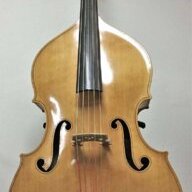
I don't know if anyone is still following this thread, but I was reading in an article that you can raise your saddle height, and get much lighter string tension.Its true, these strings are fat compared to steel cores or plain gut. Do you have bridge adjusters? 1/2 inch is about 12 mm, that's much higher than I'd want to set my action. Are your slots wide enough for the new strings?

yes but this can have an effect on how you perceive the tension of the string although the actual tension of the string does not change. I only know this because I have a bass with an adjustable saddleI think by raising the saddle, you in effect reduce the break over angle of the strings over the bridge, which reduces the loading of the top table of your bass, which (potentially) affects the response/volume of the instrument. The strings still have to be stretched to the same "tension" in order to tune them up.

raising the action and raising the saddle are two different things. Raising the saddle has no effect on the action, or string height.If you had frets, you would hear your intonation change for specific locations on the fingerboard as you raise the action, because the distance to press the strings down to the fingerboard is increased, also increasing tension. So raising the saddle does affect tension for exact fingering locations, it's just that on a fretless fingerboard, played by an intonation-sensitive player, the intonation is automatically corrected.
So ... What is the advantage of having an adjustable saddle? I am aware I am aware of intonation, and positioning to correct it if it is a tad off in places when playing. I have very good pitch, and have experienced it on fretless instruments for years. I am new to DB, but have been playing stringed instruments for many years. Intonation is affected when the bridge is moved by different factors on different stringed instruments, but not from raising or lowering on a fretted instrument. if your bridge shifts position for whatever reason on a DB it would make sense to me that the intonation would change. From what I have read raising or lowering the saddle height increases or decreases the angle of the part of the strings after the bridge. So with that in mind geometrically thinking, as long as the bridge position on the on the table of the DB doesn't move from where it has previously been set for good intonation, then the intonation wouldn't change. However also geometrically thinking, decreasing the angle in which the string crosses the crosses the bridge from the saddle should decrease the string tension a bit?raising the action and raising the saddle are two different things. Raising the saddle has no effect on the action, or string height.

However also geometrically thinking, decreasing the angle in which the string crosses the crosses the bridge from the saddle should decrease the string tension a bit?
Well I guess I learn something every day AG. thanks! however you are stating that raising or lowering the saddle on a DB does change the string tension, which I agree with. So that being said, once you raise the saddle height you need to change the bridge position to correct any intonation issues? So if you raise the saddle height, you would need to lengthen the string length to correct the intonation hence tightening the tension back up on as DB? If that is correct wouldn't that make raising the bridge a moot point?No. The three variables of pitch of a string are mass, length, and tension. Since raising or lowering the saddle does not change mass or length, then tension must necessarily remain the same as well.
however you are stating that raising or lowering the saddle on a DB does change the string tension
I'm not disputing anything in this conversation. I understand that position changes can correct the intonation of the instrument. I was just trying to understand how you if there is a way:You adjust intonation on double bass by moving your hand.
I have an adjustable saddle on my bass. The reason I did it it's because I wanted to experiment with the exact tension that this particular bass needed to speak most optimally. it turns out this base needs less tension downward on the top in order to vibrate freely. Now that I have the angle that I need the adjustable saddle is not useful anymore. It's going to stay where it is forever. in my experiments with raising and lowering the saddle I said that the perceived tension of the string does indeed change. I didn't say the tension changes I said the perceived tension changes. How it feels to the player. If you don't believe me get an adjustable saddle and try it
I was just trying to understand how you if there is a way:
1. To adjust the intonation mechanically?
2. does the raised actually change the tension on the strings?