Enjoy the benefits of a premium membership!
Upgrade Account
-
TalkBass has been independent since 1998. Add your voice.
Create a free account to reply to discussions, view embedded media, and browse with fewer display ads.
Join free Log in
Want zero display ads or expanded classifieds tools? Compare plans.
You are using an out of date browser. It may not display this or other websites correctly.
You should upgrade or use an alternative browser.
You should upgrade or use an alternative browser.
New mesa subway amps and cabs!
- Thread starter mexicant
- Start date
More options
Who Replied?
IvanBassist
Commercial User
- Jun 8, 2008
- 3,754
- 11,151
- Disclosures
- Content Manager at Darkglass Electronics, Dingwall Guitars Artist
Yes. I've done plenty of recordings and live shows using the DI out of the WD-800Greetings TBers!
I hope you all are enjoying good health during these weird times.
A bandmate and I are going to try the Jamkazam experiment. If it works, we'll try to get the two other bandmates wired up as well. Figured two of us could take the plunge before having others invest in what appears to be a sketchy fool's venture (but we're getting desperate and who doesn't like a new adventure?). All this is new to me, so I wanted to check in here to tap the collective wisdom of TB.
I just bought a Audient EVO 4 interface and was initially thinking that I would use a pedal or two for tone shaping between the bass and EVO. However, it occurred to me that rather than plug into the instrument input on the EVO, I could run the DI (at mic level) from the WD-800 into one of the XLR inputs on the interface and get the benefit of the WD-800 tones. Is anyone else doing this? If so, how has it worked for you? Are there better methods to get a usable signal from the WD-800 into an interface?
Thank you and stay safe out there!

IvanBassist
Commercial User
- Jun 8, 2008
- 3,754
- 11,151
- Disclosures
- Content Manager at Darkglass Electronics, Dingwall Guitars Artist
Example:Greetings TBers!
I hope you all are enjoying good health during these weird times.
A bandmate and I are going to try the Jamkazam experiment. If it works, we'll try to get the two other bandmates wired up as well. Figured two of us could take the plunge before having others invest in what appears to be a sketchy fool's venture (but we're getting desperate and who doesn't like a new adventure?). All this is new to me, so I wanted to check in here to tap the collective wisdom of TB.
I just bought a Audient EVO 4 interface and was initially thinking that I would use a pedal or two for tone shaping between the bass and EVO. However, it occurred to me that rather than plug into the instrument input on the EVO, I could run the DI (at mic level) from the WD-800 into one of the XLR inputs on the interface and get the benefit of the WD-800 tones. Is anyone else doing this? If so, how has it worked for you? Are there better methods to get a usable signal from the WD-800 into an interface?
Thank you and stay safe out there!
If you want to get the tone out of the WD, you will need to set it as post-EQ on the DI


Sorry if this has been addressed...
Are there any advantages to running a passive bass with the active switch on on the WD-800? Does it make the input stage more/less sensitive to the knob turns? Maybe it warms things up? I still get a nice drive at 4 o’clock (instead of 1). I think I hear things that are different but I can’t put my finger on it and I don’t know if maybe I’m just imagining stuff.
Are there any advantages to running a passive bass with the active switch on on the WD-800? Does it make the input stage more/less sensitive to the knob turns? Maybe it warms things up? I still get a nice drive at 4 o’clock (instead of 1). I think I hear things that are different but I can’t put my finger on it and I don’t know if maybe I’m just imagining stuff.

Typically when you engage the “active” switch it pads the input signal of the bass by -15db because an active bass will have a higher output than a passive bass.Sorry if this has been addressed...
Are there any advantages to running a passive bass with the active switch on on the WD-800? Does it make the input stage more/less sensitive to the knob turns? Maybe it warms things up? I still get a nice drive at 4 o’clock (instead of 1). I think I hear things that are different but I can’t put my finger on it and I don’t know if maybe I’m just imagining stuff.
Typically when you engage the “active” switch it pads the input signal of the bass by -15db because an active bass will have a higher output than a passive bass.
Yes. I understand the function of the “active” switch and know there are a couple different ways they can be implemented.
I am curious if anyone has discovered any “side effects” that may happen with it engaged, especially with a passive instrument.

- Feb 12, 2006
- 61,047
- 5
- 220,999
- Disclosures
- Development Engineer-Mesa Boogie, Development Engineer-Genzler (pedals), Product Support-Genz Benz
The active/passive switch changes the gain of the input amp but does not change the impedance. It merely re-scales the range that the gain control works over.
There are some high output passive basses that are hotter than many active basses, the constant impedance input is much more usable to those basses.
I believe the pad is about 12dB on the D-800/800+
There are some high output passive basses that are hotter than many active basses, the constant impedance input is much more usable to those basses.
I believe the pad is about 12dB on the D-800/800+

High output passive basses, like a g&l L2xx , or other MFD equipped Bass.The active/passive switch changes the gain of the input amp but does not change the impedance. It merely re-scales the range that the gain control works over.
There are some high output passive basses that are hotter than many active basses, the constant impedance input is much more usable to those basses.
I believe the pad is about 12dB on the D-800/800+
Mine love the Subway amps.

Chef
In Memoriam
Of your passive bass is driving the amp into harmonics and over driver sooner than you prefer, using the active mode may let you be clean at higher gain levels

Al Kraft
Supporting Member
- May 2, 2016
- 10,776
- 40,458
- Disclosures
- Mesa Boogie beta product tester and player support
Active mode works great on my MM Sterling. IME with the SW heads using the input pad isn't the tone muffler it can be on some heads.
IvanBassist
Commercial User
- Jun 8, 2008
- 3,754
- 11,151
- Disclosures
- Content Manager at Darkglass Electronics, Dingwall Guitars Artist
Yeah, input pads on other amps seem to suck the life out of the instruments.Active mode works great on my MM Sterling. IME with the SW heads using the input pad isn't the tone muffler it can be on some heads.
- Feb 12, 2006
- 61,047
- 5
- 220,999
- Disclosures
- Development Engineer-Mesa Boogie, Development Engineer-Genzler (pedals), Product Support-Genz Benz
Correct Ivan, we addressed this specific issue in the design of all of the Subway models.Yeah, input pads on other amps seem to suck the life out of the instruments.
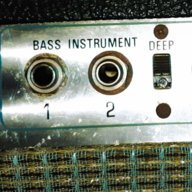
This topo get me curious about this so I pick up the FLUKE meter and make a survey of the resistive part of the input impedance of my amp in the studio, what I get is very surprising, here it is:
Bassman: both channel in#1 = 1 meg (1000 k)
in# 2 = 140k
Mpulse600 passive = 1 meg
active = 10k
BigBlock passive = 25k ???????
active = 10k
Traynor active very high (may be capacitor coupling, I didn't check yet)
passive = 66k
Tech21 Paradriver = very high (may be capacitor coupling, I didn't check yet)
Tech21 VT Deluxe = very high (may be capacitor coupling, I didn't check yet)
Most pedal = 1 meg
Mesa bottle rocket V1 = 1 meg
The most intriguing is the BigBlock, I think I will use a tuner/buffer pedal in front of.
It is a good idea to keep a high impedance on active, as the passive input. But if you put a non-true bypass pedal between a passive and the amp you don't have to care about low impedance input.
Keep playing.
Bassman: both channel in#1 = 1 meg (1000 k)
in# 2 = 140k
Mpulse600 passive = 1 meg
active = 10k
BigBlock passive = 25k ???????
active = 10k
Traynor active very high (may be capacitor coupling, I didn't check yet)
passive = 66k
Tech21 Paradriver = very high (may be capacitor coupling, I didn't check yet)
Tech21 VT Deluxe = very high (may be capacitor coupling, I didn't check yet)
Most pedal = 1 meg
Mesa bottle rocket V1 = 1 meg
The most intriguing is the BigBlock, I think I will use a tuner/buffer pedal in front of.
It is a good idea to keep a high impedance on active, as the passive input. But if you put a non-true bypass pedal between a passive and the amp you don't have to care about low impedance input.
Keep playing.
- Feb 12, 2006
- 61,047
- 5
- 220,999
- Disclosures
- Development Engineer-Mesa Boogie, Development Engineer-Genzler (pedals), Product Support-Genz Benz
The Big Block should also be about 1M but this may change a little bit depending on if the overdrive function is selected.
It's possible that somebody (previous owner or the infamous friend of a previous owner) "modded" your amp however, the modding culture often doesn't consider everything necessary to avoid creating entirely new problems.
For products that I repair, all mods come off except factory updates or factory approved changes. Generally, this fixes all of the problems with no need for additional repairs. Just sayin'
It's possible that somebody (previous owner or the infamous friend of a previous owner) "modded" your amp however, the modding culture often doesn't consider everything necessary to avoid creating entirely new problems.
For products that I repair, all mods come off except factory updates or factory approved changes. Generally, this fixes all of the problems with no need for additional repairs. Just sayin'
Thanks Agedhorse, here a precision, I made my reading quickly with power off, when it is ON the reading rise to 1.4 meg , in overdrive or not, in passive mode (10k in active) which is more standard.The Big Block should also be about 1M but this may change a little bit depending on if the overdrive function is selected.
It's possible that somebody (previous owner or the infamous friend of a previous owner) "modded" your amp however, the modding culture often doesn't consider everything necessary to avoid creating entirely new problems.
For products that I repair, all mods come off except factory updates or factory approved changes. Generally, this fixes all of the problems with no need for additional repairs. Just sayin'
As usual you are d*** right!
- Feb 12, 2006
- 61,047
- 5
- 220,999
- Disclosures
- Development Engineer-Mesa Boogie, Development Engineer-Genzler (pedals), Product Support-Genz Benz
Yes, the power must be on, but sometimes the circuit itself must be analyzed because of things like bootstrapping, switching or biasing that causes an additional increase or change in input impedance. Of course, capacitor coupling will also throw off simple measurements.
The way we do it in the lab is to inject a known signal with a known series resistance that's about 10% of the expected load impedance and measure the voltage drop across the known resistor. From this and Ohm's law, the current can be calculated and from the source voltage (I typically use 1V) the impedance can be calculated. This does require accurate, somewhat quality instrumentation though.
For a 1M input impedance:
Source voltage: 1V
Series resistor: 100k
Measured voltage across the 100k resistor: ~90mV
This gets close enough. When switching to say a 47k active input, you would need to change the series resistance to say 4.7k and calculate from there.
Source voltage: 1V
Series resistor: 4.7k
Measured voltage across the 4.7k resistor: ~90mV.
[edit for missing decimal point]
The way we do it in the lab is to inject a known signal with a known series resistance that's about 10% of the expected load impedance and measure the voltage drop across the known resistor. From this and Ohm's law, the current can be calculated and from the source voltage (I typically use 1V) the impedance can be calculated. This does require accurate, somewhat quality instrumentation though.
For a 1M input impedance:
Source voltage: 1V
Series resistor: 100k
Measured voltage across the 100k resistor: ~90mV
This gets close enough. When switching to say a 47k active input, you would need to change the series resistance to say 4.7k and calculate from there.
Source voltage: 1V
Series resistor: 4.7k
Measured voltage across the 4.7k resistor: ~90mV.
[edit for missing decimal point]
Last edited:

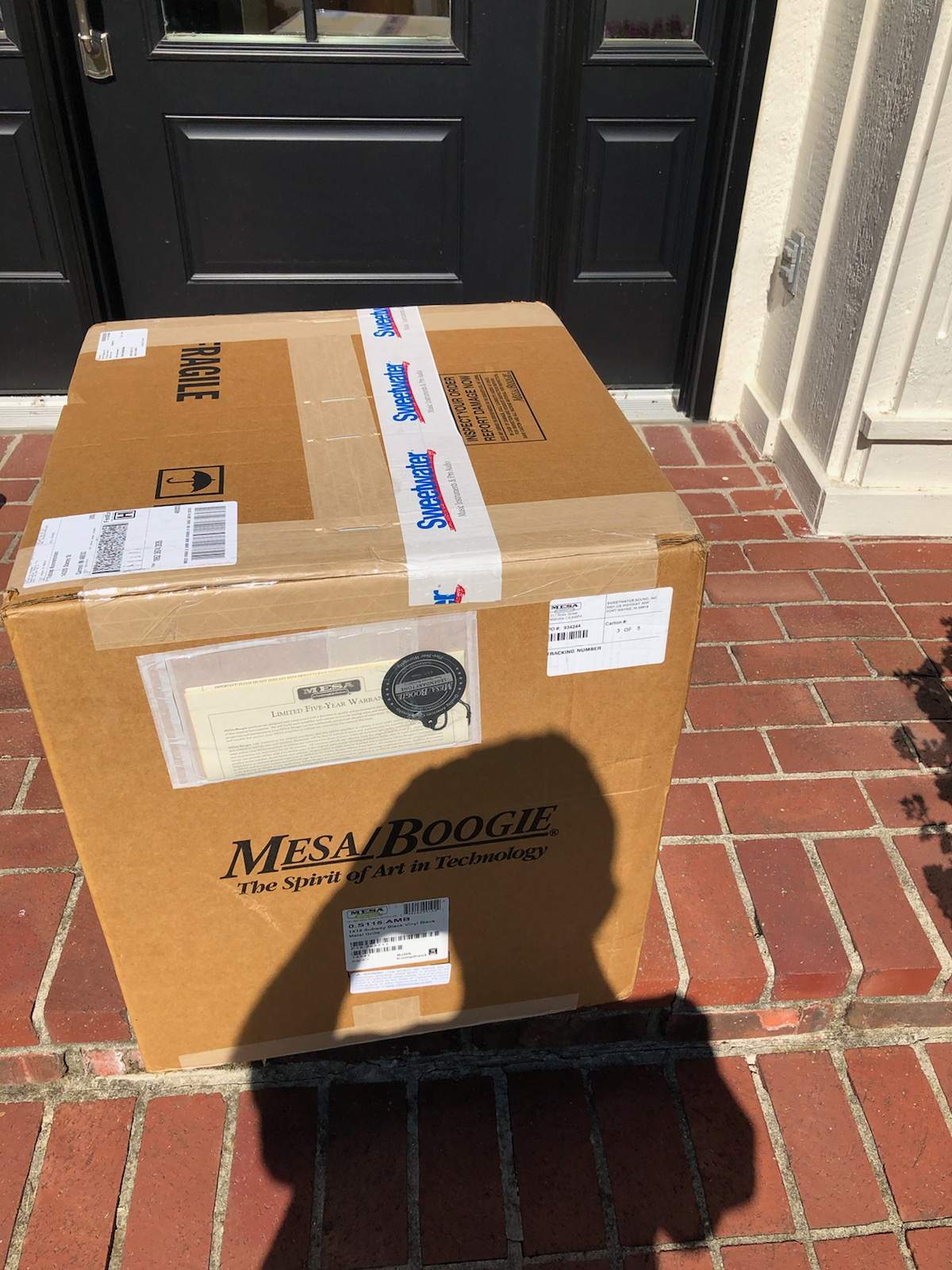
So after what has felt like an eternity Christmas showed up on my front porch today - whatever could it be?
Well, I don't have the schematic of the Mesa. Typical tube input have an input resistor which almost determine the total impedance, (I did it quickly this morning with my meter) but I kmow it can be différent.Yes, the power must be on, but sometimes the circuit itself must be analyzed because of things like bootstrapping, switching or biasing that causes an additional increase or change in input impedance. Of course, capacitor coupling will also throw off simple measurements.
The way we do it in the lab is to inject a known signal with a known series resistance that's about 10% of the expected load impedance and measure the voltage drop across the known resistor. From this and Ohm's law, the current can be calculated and from the source voltage (I typically use 1V) the impedance can be calculated. This does require accurate, somewhat quality instrumentation though.
For a 1M input impedance:
Source voltage: 1V
Series resistor: 100k
Measured voltage across the 100k resistor: ~90mV
This gets close enough. When switching to say a 47k active input, you would need to change the series resistance to say 4.7k and calculate from there.
Source voltage: 1V
Series resistor: 4.7k
Measured voltage across the 47k resistor: ~90mV.
Probably in example 2 you mean 90 mV across the 4.7k?
Thanks Andy.
- Feb 12, 2006
- 61,047
- 5
- 220,999
- Disclosures
- Development Engineer-Mesa Boogie, Development Engineer-Genzler (pedals), Product Support-Genz Benz
Yes, the decimal point got dropped.Well, I don't have the schematic of the Mesa. Typical tube input have an input resistor which almost determine the total impedance, (I did it quickly this morning with my meter) but I kmow it can be différent.
Probably in example 2 you mean 90 mV across the 4.7k?
Thanks Andy.