jvbjr said:
I still don't get it. Tuned in fourths you gain 5 notes per string, so 11 strings gives you 55 notes, plus 16 more for the .004 with 36 frets, so you yield 71 notes in total. I can not see how you can have your thumb behind the neck and play the bassiest string, my fingers are too short for sure.
Since there is so much repetition of notes, you could play all of the 71 notes with less than 11 strings if you moved away from 4th tuning, at the expense of chords being to far apart.
So is that low string more of a problem playing or is the chordal issue, and which makes more sense to which user?
The bass is tuned in 4ths.when I play a chromatic scale starting with the lowest open note,play up five note,I now have the same note as the next highest open sting.Continuing this way using open strings and moving up vertically, staying within the first 4 frets,and not playing the same note twice, by the time I play the 5th note on the highest string,I have played 60 notes.
When I continue chromatically on the highest string,by the time I reach the highest fret, I have played a total of 92 seperate notes spanning 10 octaves.
The low note is not a problem. I can use A, B and C block voicing usually only accessed by a keyboard,or a horn section. I can use orchestral string voicings . The neck looks about 3/4" thick,and for an inline 12 string,it's amazing.The bass plays itself.
Remember that I had specific ideas I developed over the years and shared them with Mike.The bass looks and plays like it does because of Mike 's vision and skill as a builder. i wantedit to feel,play and sound a certain way in my mind.Mike did a superb job in taking this concept and making it a reality.
I wasn't thinking about how another player would use it.I had my own concepts to explore.The neck is not as wide as the Adler 11-string.Compare this partial shot of the neck in my hands to the one above:
http://www.gopromusic.com/detail.php?siteid=264
It was made to be fully functional.


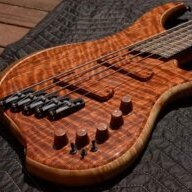

 ) that has three times the strings as it does. Then I said, damn, I gotta play it