• TalkBass has been independent since 1998. Add your voice.
    Create a free account to reply to discussions, view embedded media, and browse with fewer display ads.
    Join freeLog in
    Want zero display ads or expanded classifieds tools? Compare plans.

Old School vs. New School Amplification

My '73 Black Line SVT failed mid-show on two different occasions over 7 years.

A stupid diode kept popping on the board.

I realize that could happen with any amp, but I bought it to be rock solid reliable and going to the shop twice in 7 years is not exactly strong reliability.
 
To me this is the same argument that spans so many fields - things of old were always better and new stuff is not the same and just cr@p. Cars, house's, guitars whatever the subject, the old days were better because that is what we were used to. Even music, "music is just terrible these days" I hear so much. I think if people would approach things with an accepting standpoint they might always find some things are actually better, some not but everything has to be weighed with an open mind. I love my GB Streamliner and it does not leave me with ANY desire while playing. Everyone says "I can't believe that little box sounds like that" all the time. And, at the end of the night I can leave after sounding like that with bass on back, amp in one hand and cab in the other one trip to the car...........I will never go back. My .02


The other thing that confounds and confuses this discussion is the concept of 'I don't like it if I can't fix it myself'. There is no denying that some of the early amp executions, just like old cars, could be maintained by a skilled amateur in electronics. Just like TV's and computers, those days are pretty much over with modern amplifiers. I find that a very good thing, with reliability much higher, power amps more powerful, and lighter weight and better features. However, if you are looking for something to buy for 30 years, and in 20 years get your soldering gun out and replacing a transformer, those days are pretty much gone. Again, for me, thank god, since I remember all those old amps piled up to the ceiling at repair shops back in the day.

The other thing that confuses discussions are comments like 'this amp blows away that amp'. What that usually means is 'I like this amp better than that amp' (which of course, is valid). However, in the OP's case, the massively wide open low end of an Alembic preamp through a C9 would make, as an example, a Genz Shuttle 9 sound thin down low, and overly bright up top. That isn't a 'better or worse' thing again, but a massive difference that can lead to posts like 'I tried a micro amp and they suck', etc.

There are massively differently voiced lines and specific executions of small amps out there, one of which would most likely make every player on earth pretty happy, with the possible exception of guys who drive tube power sections to snarl and overdrive and distortion.
 
Last edited:
  • Like
Reactions: TheRealKong
My '73 Black Line SVT failed mid-show on two different occasions over 7 years.

A stupid diode kept popping on the board.

I realize that could happen with any amp, but I bought it to be rock solid reliable and going to the shop twice in 7 years is not exactly strong reliability.


Yes, the 'higher reliability back in the day' is really, really wrong (I was there!). Easier to fix in a local shop, yes. Less likely to fail, not so much.
 
  • Like
Reactions: Bob Lee (QSC)
I buy old school hand wired not because I want to be able to fix it myself, but because any qualified tech worth their salt can find parts off the shelf or easily have them overnight for an emergency repair.

With proprietary boards and components, you may first have to find and then ship the amp to an authorized service center
and then deal with the down time, sometimes months, and the risks of shipping.
 
To Gab124 I'm sorry the old stuff is much more fun and romantic, I hate plastic cars. That is why I drive (every day) a 1973 Ford F-100 with a 240 straight six and get 20 MPG. All original with 62,000 original miles. New Tires and New Spark Plugs. Impervious to EMP!
1973F100_zps3b82a915.jpg

Great Ford F-100..
OMG,..20 MPG ...:D... Great thing has it's price, I guess
 
I buy old school hand wired not because I want to be able to fix it myself, but because any qualified tech worth their salt can find parts off the shelf or easily have them overnight for an emergency repair.

With proprietary boards and components, you may first have to find and then ship the amp to an authorized service center
and then deal with the down time, sometimes months, and the risks of shipping.

Not really the case any more. Many of those mom and pop repair shops are gone at this point, and parts availability for older units are becoming less available. Also, given the backlog that the few remaining shops have on keeping lots of old stuff working, unless you are VERY good friends with the owner/repairman, 'emergency repair' is a thing of the past.

Service and support is key though, and many amp companies have national service networks that are very efficient. The small companies have parts on hand and do the work themselves, etc.

Even better, it is very, very easy now (financially, and space-wise) to carry a backup amp, which eliminates the entire issue IMO and IME. Wonderful feeling to have a second amp with you when on the road. Even though I haven't had an amp fail in the 'modern era' (other than a couple 'early adopter purchases' with failure literally right out of the box from the first production run), it is a nice feeling though to be able to swap an amp in a minute if something happens. I've bailed out a few monitor systems and keyboard rigs with my spare for sure.

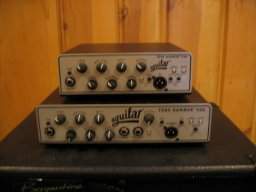
Nothing better for me that a high quality, highly reliable amp with identical or similar backup (in my case, the Aguilar TH500 with TH350 backup when on the road), made by a small company (you can get the owner on the phone), and close enough to ship the amp back if something eventually does go wrong for little cost or time.

Again, IMO and IME.

Edit: To your point though, buying an amp with the company headquarters located across the pond from where you live can result in some service issues and does have a bit of risk for long delays in repairs if needed. For that, the retailer is key when choosing an amp like a Glockenklang, TecAmp, etc. when in the US.
 
That Soldano would be expensive to repair. Take a hard look at it! Changing a cap on it is no cake walk. Two things that are problem here - that wiring forces some serious disassembly to flip the main board over and don't underestimate the time it takes to research obtaining the correct parts.
I'd quote at least four hours for even a simple repair. I charge a bit more than Mr Goodwrench, and I charge for research time on oddball products.

Still want vintage amp?
 
That Soldano would be expensive to repair. Take a hard look at it! Changing a cap on it is no cake walk. Two things that are problem here - that wiring forces some serious disassembly to flip the main board over and don't underestimate the time it takes to research obtaining the correct parts.
I'd quote at least four hours for even a simple repair. I charge a bit more than Mr Goodwrench, and I charge for research time on oddball products.

Still want vintage amp?

I buy hand wired new and vintage because they are the easiest to service over the long haul.

That Soldano is at least reasonably well built and also carries a life time warranty.

I have a very good tech who charges $75.00 per hour and is worth every bit of it.
 
I don't think it is wrong to like the old stuff, in fact it will be people that do who will ensure there are units to play far into the future. If it were forgotten they would just disappear. I still like the lightweight stuff though :hyper:
 
One very real difference that hasn't been mentioned so far is clipping. Tubes tend to round off the top of the waveform, where SS designs will flatten it. The tube sound at clipping is inherently more musical, and pleasant to the ear. That's why more headroom is needed with SS designs.
my $0.02

It depends entirely on the design, not specifically that it's a tube or transistor power amp for example.

I can take a tube or solid state power amp and with suitable design adjustments make the solid state amp clip more softly and the tube amp clip more abruptly just by altering the global feedback loop and altering what happens when feedback is lost upon clipping. In fact, I have done just this within several of the Genz Benz products. How it sounds and how it feels is at least as much based on the design choices as it is on any specific topology.
 
Last edited:
  • Like
Reactions: Bassdirty
To me this is the same argument that spans so many fields - things of old were always better and new stuff is not the same and just cr@p. Cars, house's, guitars whatever the subject, the old days were better because that is what we were used to. Even music, "music is just terrible these days" I hear so much. I think if people would approach things with an accepting standpoint they might always find some things are actually better, some not but everything has to be weighed with an open mind. I love my GB Streamliner and it does not leave me with ANY desire while playing. Everyone says "I can't believe that little box sounds like that" all the time. And, at the end of the night I can leave after sounding like that with bass on back, amp in one hand and cab in the other one trip to the car...........I will never go back. My .02

Agreed. The good 'ol days were not always as good as some of you may rember. The failure rates of today's higher quality products are probably 5-10 times lower than say 30 years ago. I put myself partially through school by managing a service center that serviced both hi-fi and pro audio, there were no shortage of failures back then... in fact there was a lot of gear that even when repaired was not all that reliable and it was not unusual to see the same piece in a couple of times throughout it's 1 year, non-transferrable warranty period. Today, there are a sizeable number of companies that offer 3-5 year warranties that are fully transferrable. This wouldn't have been possible at yesterday's failure rates. Some of those "good 'ol day's" products were hand wired and were no better than their PCB counterparts.

Today, it is possible to build the absolutely highest quality product using PCBs and modern design/assembly methods. The highest quality mixing consoles (digital or analog) are all pcb based and rack up years of daily service under extreme conditions. That's as many as 10's of thousands of components within a single product, many with 3-5 year warranties. The repeatability of today's modern designs means that when you build 10 amps, or 100 amps, every one sounds the same. You don't have the variability, some with hum, some with oscillations, some with radio in the background. Why? Because with PCB construction (and, of course, proper deisgn/layout) it's possible to reduce these antenna loops to a tiny fraction of what's possible with hand wiring. Every wire (trace) is placed in exactly the same position, ground planes can be placed precicely where they do the most good, the stray inductances and capacitances are much smaller and no longer variable. Gone are the days of the "Snowflake Amplifier Company" where no two amplifiers sound the same.

Now there is an art AND a science to proper layout of a PCBs. There are good examples and there are bad examples, just as with hand wiring approaches. As the number of components increases, the PCB approach is a much better way to manage the thouseands of variables theat present themself with increased parts count.
 
  • Like
Reactions: Bob Lee (QSC)
I think you're either lucky or unlucky. You're lucky if you prefer the sound of an amp that is small, light, and easy to transport OR you're willing to sacrifice tone for portability. You're unlucky if you prefer lead sleds and big massive rigs AND aren't willing to sacrifice tone for portability. I haven't found a mini rig that I love yet- so I'm stuck lugging the gear I prefer tonally. As soon as I find a mini rig that produces what I'm looking for I'm all over it as I couldn't care less about "old is better" or "has to be big to be good" etc. I judge with my ears on the road and in the studio....
 
had a 1997 Fender custom shop rumble bass. it was basically a 300 watt %100 tube using 12 ax and 12 au 7s and (ithink there were) 8 6550s. the thing ALWAYS broke down on the road. i would usually drive over to the next few towns for road trips and shows. thing would make it through the first half of the first song in sound check and something would blow. Im buying a class D right now to see what all the fuss is about i mean if arena tours use them, i want to try one in my life.
 

Latest posts