• TalkBass has been independent since 1998. Add your voice.
    Create a free account to reply to discussions, view embedded media, and browse with fewer display ads.
    Join freeLog in
    Want zero display ads or expanded classifieds tools? Compare plans.

Old School vs. New School Amplification

The Reeves 400 is the big brother to the 225.
Also mil spec turret board construction.

The average buyer will experience some sticker shock when looking for a serious tour worthy rig.

The modern recreation, adaptation and improvements of the best build methods are still available, but not at typical
consumer electronics prices.

Just found a chassis shot of an SVT-VR.

6659d1255989108-svt-vr-bot-chss.jpg


Now if you wanted a NEW professional bass rig, would you feel more comfortable with
that modern SVT build quality or go for something more like this?

Reeves 400 chassis.
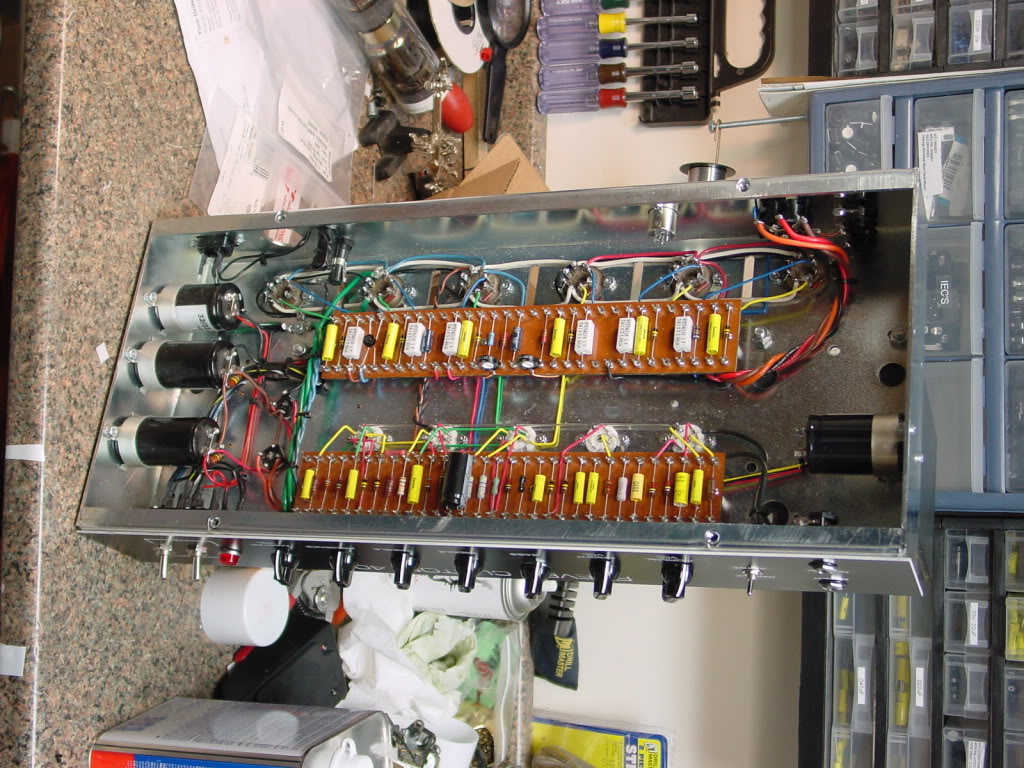
DSC00057.jpg


It would depend on how each one sounds, and also the reliability record, which my guess is, would have zero correlation with the way things are wired.

I don't really understand your premise at this point. While I've been relatively unimpressed with anything (other than the Heritage stuff) that Ampeg produces at this point, there seems to be very little issue with reliability these days (especially compared to 30 years ago) with a professional grade bass amp made by a companies like Genz Benz, Aguilar, Glockenklang, GK (for the most part), etc.
 
The point or premise is simply to show the differences in old school, vs, modern mass production build quality.

There is an improvement is tonal quality that you can't appreciate until you play through a fine hand built amp.

Adding an example of Fender Silver Face construction with eyelet board.

100_2829.jpg
 
The point or premise is simply to show the differences in old school, vs, modern mass production build quality.

There is an improvement is tonal quality that you can't appreciate until you play through a fine hand built amp.

Adding an example of Fender Silver Face construction with eyelet board.

100_2829.jpg

I again disagree with your premise. The 'thickness of the board' (etc.)has a zero correlation with tone... zero. Of course, just like back in the day, there are crap products out there at the very low end. In general, though, things have massively improved.

Much better to use your ears versus your eyes when choosing a rig. Again, IF there was a dip in reliability over time, I would then feel a bit differently. However, by ANY measure, the average reliability of bass amps has massively improved over the last 30 years.

Again, play what you like, and like what you play. Everyone must choose a rig based on what is important to them for sure.
 
I come from the premise of demanding reliable tour worthy gear after playing and average 300 nights per year.
I've played through good stuff and a whole lot of crap and I'm done with crap.

The thickness of the board and the thickness of traces and layout of the traces and whether the board requires double sided access for service. Does indeed matter.
Are the tubes mounted to the chassis or to the PCB? Does the amp have real pots and real hardware switches and jacks attached to the chassis or just plastic clips to a board?

Found and Aguilar AG500 Chassis

Link Removed
 
Last edited:
Every amp is a set of compromises.

Don't get hung up on the technology behind the sounds, nearly every sub amp on every large PA system is class D these days. What I will say though is that I've never been able to tell if an amp is handwired or not by playing through it.
 
Last edited:
Our friends in UK and EU are getting completely hosed by the Big Logos.

The hand built amp that would cost me $2400.00 here will cost you guys like $3200.00+
due to import duties, taxes and retailer profiteering.

You guys are stuck paying a 30% premium cost for substandard, mass production, mostly Asian built, consumer electronics grade gear.
 
Tonal Richness, touch sensitivity, warmth, detail, natural voicing, essentially classic benchmarks in tone.

While I am no tech myself, my father ran a repair facility with 10 full time bench technicians, so I've been around the best and worst since the mid 60's.

He lovingly referred to my SVT as The Maggot Box.
He did not like Magnavox workmanship.

He thought Vox's were the worst, figuring catching fire was a good thing.
Marshall hand wired, a total crap shoot, reminding him of Lucas ignitions on an old Jag XKE.
Hiwatt he praised, mi spec, roadworthy, the way he was trained in the Air Force, built like tank.
Fender he tolerated.

I still have a Peavy Mark III that will not die, but that's emergency backup only.
The tone is horrid even through a vintage SVT AlNiCo 8X10.

I've been dirt poor and had to make sacrifices, but when I'm in position to buy the best, no more compromise.

Guys my age are out there spending $9K on ATV's, $50K plus on a sports car or boat, $30K for a tractor, so I'm just not going to feel bad for spending $2400.00 for a good solid bass head.

Now this is not bad, new Ampeg Heritage B-15

Wiring.jpg


Please quantify the tonal characteristic imparted via construction technique.
 
Last edited:
I've gone the class D/ ( Aguila TH 500 GK 2X12) neo cabinet route strickly for compatablity and ease of transporting a smaller rig, now I do have a larger rig and I will say that I do notice a difference in overall tone when I A/B'ed against Mesa Carbine 900 and Aguilar GS 4X10 Cabinet,but with that being said at the age that I'm at now, I've become a fan of minimalism even more so. So the class D may not have the fatness of my larger rig,but I'm alright with it.
 
Tonal Richness, touch sensitivity, warmth, detail, natural voicing, essentially classic benchmarks in tone.

While I am no tech myself, my father ran a repair facility with 10 full time bench technicians, so I've been around the best and worst since the mid 60's.

He lovingly referred to my SVT as The Maggot Box.
He did not like Magnavox workmanship.

He thought Vox's were the worst, figuring catching fire was a good thing.
Marshall hand wired, a total crap shoot, reminding him of Lucas ignitions on an old Jag XKE.
Hiwatt he praised, mi spec, roadworthy, the way he was trained in the Air Force, built like tank.
Fender he tolerated.

I still have a Peavy Mark III that will not die, but that's emergency backup only.
The tone is horrid even through a vintage SVT AlNiCo 8X10.

I've been dirt poor and had to make sacrifices, but when I'm in position to buy the best, no more compromise.

Guys my age are out there spending $9K on ATV's, $50K plus on a sports car or boat, $30K for a tractor, so I'm just not going to feel bad for spending $2400.00 for a good solid bass head.

Now this is not bad, new Ampeg Heritage B-15

Wiring.jpg
But what exactly imparts those qualities? What do add or take away for more warmth? What is used to control tonal richness or touch sensitivity? What adds natural tone? How are any of those altered with PCB's? At what point do the electrons decide to behave differently?
 
But what exactly imparts those qualities? What do add or take away for more warmth? What is used to control tonal richness or touch sensitivity? What adds natural tone? How are any of those altered with PCB's? At what point do the electrons decide to behave differently?

The sum of all components, the quality & values of the individual sub components, the type of wire, the length and routing of wires, the quality of the sockets, switches, jacks, and generally the least complex circuit will yield the purest tone.
Massive transformers, big warm power section tubes, all come together with a tonal richness, you just can't get going solid state.

Beyond the tone, any working full time musician must consider reliability and serviceability.
How many amps you have in service rotation, backup, downtime.

If you are playing the most important show of your life and your rig goes down, what's that
worth to you?
 
Last edited:
The sum of all components, the quality & values of the individual sub components, the type of wire, the length and routing of wires, the quality of the sockets, switches, jacks, and generally the least complex circuit will yield the purest tone.
Massive transformers, big warm power section tubes, all come together with a tonal richness, you just can't get going solid state.

Beyond the tone, any working full time musician must consider reliability and serviceability.
How many amps you have in service rotation, backup, downtime.

If you are playing the most important show of your life and your rig goes down, what's that
worth to you?

Ok so let's say that all the a components are of equal quality. What is it that a PCB does to tone or reliability?
 
Ok so let's say that all the a components are of equal quality. What is it that a PCB does to tone or reliability?

How to explain the complexities of variable signal path science is beyond me.
Going through PCB tends to add a processed sound or it's so sterile and clinical that there's
no life to it, a more mechanical sound.

Why is a 65 Ford AC Cobra more fun to drive than a new Mustang?

[Invalid or Expired Link Removed]

I can't afford one of these or the garage to keep it in, or the insurance, but I sure as hell can afford the best bass amp available.
 
Last edited:
I will state categorically that there is no improvement in "tone" in a hand wired turret or eyelet construction over pcb based construction where the curcuit is identical. If the circuits are different than it's not a comparison of construction techniques. This is up to the designer to design in both cases.

Properly designed, PCB construction is superior in every meaningful way. Everything gets assembled exact the same way each and every time. There's a reason why the military and avionics industries no longer use "hand wired" construction and it's because pcb construction is more reliable.

There nothing wrong with prefering the look of hand wired construction, I have done my share of hand wired art myself. To claim that it's superior to my equivelant pcb layouts though would be disingenuous at best. It is just another way to build an amp, one that I often find harder to repair rather than easier.
 
There is an improvement is tonal quality that you can't appreciate until you play through a fine hand built amp.

Now I really have heard it all. Hand-built is not necessarily (and for some designs/layouts not ever) better than automated, and even then only in terms of reliability. How can hand building possibly influence tone?

EDIT: And by the way, what on earth is "variable signal path science"? And which is variable- the signal, the path or the science?
 
Last edited:
  • Like
Reactions: TheRealKong
Hand building, and any layout can influence tone because of coupling between wiring paths, component placement and spacing, etc. once you achieve the "perfect layout", it's so much more repeatable when using pcb assembly techniques and predefined automation fabricated wiring harnesses. Everything is identical do now the variables fall to component tolerances which apply to both construction styles the same, though even here there is an advantage to pcb construction techniques in that many of the smaller components are more available in tighter tolerance ranges. Another advantage of tighter layouts is that loop areas and stray inductance/capacitance issues are much lower and less problematic.
 
You can build off a schematic going robotic PCB or go old school and build the board mil spec turret board,
I assure you they will sound different.

If you are talking military spec build quality in a PCB Bass amp, it would be helpful to see the chassis.

My guess is you're not going to find it at Guitar Center or Thomann.

If the amp is done right, reliability and consistency may be improved going with machine built boards, but there's still some human/analog variable affecting the same basic design going hand wired.


Now I really have heard it all. Hand-built is not necessarily (and for some designs/layouts not ever) better than automated, and even then only in terms of reliability. How can hand building possibly influence tone?

EDIT: And by the way, what on earth is "variable signal path science"?
 
Last edited: