• TalkBass has been independent since 1998. Add your voice.
    Create a free account to reply to discussions, view embedded media, and browse with fewer display ads.
    Join freeLog in
    Want zero display ads or expanded classifieds tools? Compare plans.

Old School vs. New School Amplification

I drove a 1956 Chevy Apache for a long while and did enjoy it a great deal. I would not want to drive that today for anything, I love my power steering, AC and dependability much more. Not to mention getting into tight spots around town. Now days I love my Nissan Frontier for all that it offers. But, I do agree that those old vehicles are a lot of fun!! I used to take a truck like yours to Colorado from Tulsa every year, ours had the duel tanks and we could do it without a gas stop. Of course now I would have to take out a small loan to put that much gas in it!! Great looking Ford by the way!!

That is not my truck I'm too lazy to take a picture of it. It looks identical to that one though. It's a one owner purchased knew in the same town I live in. It has been parked in a garage for 20 years. It had 50,000 original miles on it when I got it. That's right no power steering, no power brakes, no AC, and three on the tree. It does have front disc brakes and the original AM Philco radio. The station I listen to every day is available in AM and FM so I'm good. The Ford Straight Six is known as the indestructible engine. They have a reputation for running 500,000+ miles. Not sure I could get more dependable than that. The Frontier gets the same MPG as my 73 Ford truck.

My '73 Black Line SVT failed mid-show on two different occasions over 7 years.

A stupid diode kept popping on the board.

I realize that could happen with any amp, but I bought it to be rock solid reliable and going to the shop twice in 7 years is not exactly strong reliability.

That is fairly reliable for a PCB Tube Amp.

I buy old school hand wired not because I want to be able to fix it myself, but because any qualified tech worth their salt can find parts off the shelf or easily have them overnight for an emergency repair.

With proprietary boards and components, you may first have to find and then ship the amp to an authorized service center
and then deal with the down time, sometimes months, and the risks of shipping.

Like replacing a circuit board in an old Ampeg? Ever looked under the hood of an SVT? They sound greeat but it's a mess under there.

Your SVT is not Hand Wired. There was never a hand wired SVT.

1 For context there is point to point PTP which has no board at all and components connected directly to other components.

2 Turret board construction utilities a turret board with flying leads coming from the turret board to tube sockets, transistors, transformers, pots, etc.....

3 Eyelet board is same as turret board with a different type of board.

4 Printed circuit board PCB construction with flying leads, these have the board with wires connecting the other components.

5 Printed circuit board construction component mount, this construction employs PCB but there are no wires soldered to any components, there may be a few ribbon cables or similar type connectors but all components are directly soldered to the board.

All 5 of these could apply to tube or solid state amps.

Under the Hand Wired category would come point to point construction, turret construction, eyelet construction and the rest would not be considered hand wired.

Micro amps would come under the same category as component mount PCB.
 
There is good PCB done right, like Soldano, Suhr, Mark II Era Mesa, but today mil spec PCB is still way more expensive than typical GC consumer grade crap.

Soldano SLO Chassis.
4cie1hs.jpg

That is a nicely built amp! It too will fail at some point and need something replaced. The thing that gets me these days is most people think an amp should never fail but there is no such a thing. We live in an imperfect world. Maybe they have amps in Heaven with Golden Tubes that never fail but here on Earth stuff breaks sometimes.
 
My lead sleds were: Eden WT-800, Aguilar DB750, Glockenklang Heart-Rock, each with their respective 80- to 100-pound 410 cabs. My amps now are Gallien Krueger MB800, MB Fusion 800, Glockenklang Blue Soul and my current heavyweight, Mesa Prodigy at 29 pounds. My current cabs are all Bergantinos - an AE210, AE410 and a CN212. I can say without any reservation that, if there is any loss in bottom end between the heavy stuff and the light stuff, it's not within two orders of magnitude of causing me any grief over making the switch. I went to see a local funk band, 8 or 9 pieces with horns, the other night. The bassist was playing an Epifani UL 501 through a Bergantino AE410. No problem. In a gigging situation any difference between that and the heavy gear is indiscernible. There's absolutely no reason any more to lug all that heavy gear around when there are so many top-performing light weight heads and cabs out there. See agedhorse's post. If anyone knows, he does. And he does.
 
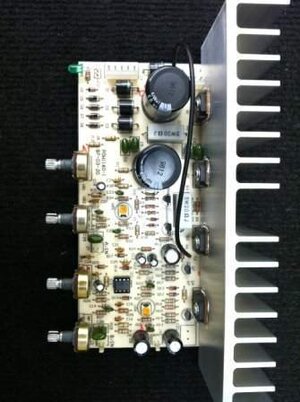
Here is an example of a simple, well executed PCB that was used in a product that had an incredibly low failure rate over a period of 15 years, in fact I can probably count the failures over the entire product's lifecycle on one hand. There's a connection for the power transformer, 2 speaker outs and 2 signal ins. It's a smallish MOSFET stereo power amplifier. Much more reliable than if we tried to hand wire (as my prototype was).

The second picture is of a bare PCB since most of you may never have seen one. The traces are essentially flat wires that we place exactly where we want them and is no different design-wise than how we develop a wiring plan for hand wiring except that we know exactly where they will end up, their exact cross-sectional area, their exact spacing etc. and yes, that is indeed real honest to goodness gold on the pad's surfaces... haven't seen any of that in those hand wired jobs.
 

Attachments

  • IMG_0328.JPG
    IMG_0328.JPG
    21.6 KB · Views: 254
  • IMG_0330.JPG
    IMG_0330.JPG
    65.5 KB · Views: 285
Last edited:
Old school to me was a Fender Bassman tube head and a Fender 2x15 bottom. New school to me is the Markbass amp and GK Bass amp and cab. The old school stuff sounded great at lower to slightly moderate volume, but the new stuff you can pick up with one hand and the sound will shake the walls.
 
There are some of us who don't mind paying a fair price for a hand built amp, made in USA.

Sharing chassis photos will hopefully have you taking a closer look at what you're getting for your hard earned money.

Reliability and consistency can test any builder.
Many go through serious growing pains when demand out-paces the ability to keep up with orders.
The early Marshalls & Voxes are perfect examples. One would be magical, the next one caught on fire.

The Hiwatt style mil spec turret board construction has proven to be one of the most reliable designs over decades
of use.

My early hand wired Ampegs and Supro are still getting it 50 years later with exceptional tone quality.

I expect my Reeves and my Bad Cat to hold up to those Old School standards.
 
  • Like
Reactions: GregC
There are some of us who don't mind paying a fair price for a hand built amp, made in USA.

Sharing chassis photos will hopefully have you taking a closer look at what you're getting for your hard earned money.

Reliability and consistency can test any builder.
Many go through serious growing pains when demand out-paces the ability to keep up with orders.
The early Marshalls & Voxes are perfect examples. One would be magical, the next one caught on fire.

The Hiwatt style mil spec turret board construction has proven to be one of the most reliable designs over decades
of use.

My early hand wired Ampegs and Supro are still getting it 50 years later with exceptional tone quality.

I expect my Reeves and my Bad Cat to hold up to those Old School standards.
I appreciate the gut shots, thanks for posting them.
 
Just my opinion, but when the whole band gets playing and you are going through the PA, no one will notice but you.

I've talked about this before, but I remember a few times being on multi-band bills in which I told my friends that they could use my 400+. Did it make a difference in the FOH mix? You bet it did! With a good engineer at the desk, that amp spoke with a certain something that you're not going to get out of another amp or even a nice D.I. box. Is the crowd going to be out there, thinking about how awesome the bass tone is? Probably not. However, they are going to respond to the authority driving the band, especially if you play for dancers.

That's not necessarily an argument that you need a tube amp to sound good. An Eden WT-800 is going to sound awesome too. Rather, people often say, "It doesn't matter what you play, because it all sounds the same in the FOH/nobody is gonna care." To that, I say bollocks. With a competent engineer at the board, the voice of your bass and rig will shine through and it is going to have an effect on the overall sound of your band.
 
  • Like
Reactions: bThumper38
The Ford Straight Six is known as the indestructible engine. They have a reputation for running 500,000+ miles. Not sure I could get more dependable than that. The Frontier gets the same MPG as my 73 Ford truck.

I used to own a F150 with the straight six and had a couple work trucks at my employer with them. A great engine, was my favorite in the ford truck line for flat out work truck duties, great for towing trailers loaded with front end loaders and nursery stock. I quickly sold mine though due to gas mileage, and none of them did the same as my Nissan in that department but YMMV - but they could pull two of my frontiers down the road against their will for sure, at least the 4 cylinder models like mine. My step dad still has his 74 (or maybe 76) but with the 8 cylinder.

Back to amp discussion. Someone said that no one will know the difference through the PA out front - and that's where the REDDI comes in!:hyper:
 
The other thing that confuses discussions are comments like 'this amp blows away that amp'. What that usually means is 'I like this amp better than that amp' (which of course, is valid). However, in the OP's case, the massively wide open low end of an Alembic preamp through a C9 would make, as an example, a Genz Shuttle 9 sound thin down low, and overly bright up top. That isn't a 'better or worse' thing again, but a massive difference that can lead to posts like 'I tried a micro amp and they suck', etc.

+1

IME, once you get to a certain level of amp, you're just moving sideways in terms of objective quality. At that high-end level, it really becomes a matter of personal taste and features.
 
Well, everyone certainly has their own opinions. That's fine.

In my case, I replaced an Alembic F1X into a QSC PLX16XX with a Trace Elliott Hexavalve; and then replaced the Hexavalve with a GB Shuttle 9 / ShuttleMAX 12. Why the GB Shuttle 9 has become the whipping boy amp for micros that sound "thin" is way past my understanding. Whatever. My Shuttle 9 produces all of what I ever got out of the Alembic F1X, and is not thin at all.

Here is one link I have posted before of the Shuttle 9 in the mix with no FOH support at all. Doesn't sound thin to me; but each to their own.


A player has to work with each amp to get it to respond to their own particular style of playing. Takes a bit of effort. Ultimately, the purpose of the amp is to sit well in the mix that the player is working with. If the amp does that, what more is needed?

My latest gig is with a modern country group that plays LOUDLY. The guitarist has an SVT at his place for rehearsals and expects my amplification to match up to that capability. If my Shuttle based rig doesn't make it, I'll report back. Until then, I find some of the back and forths to be somewhat living room academic. YMMV
 
Here is an example of a simple, well executed PCB that was used in a product that had an incredibly low failure rate over a period of 15 years, in fact I can probably count the failures over the entire product's lifecycle on one hand. There's a connection for the power transformer, 2 speaker outs and 2 signal ins. It's a smallish MOSFET stereo power amplifier. Much more reliable than if we tried to hand wire (as my prototype was).

The second picture is of a bare PCB since most of you may never have seen one. The traces are essentially flat wires that we place exactly where we want them and is no different design-wise than how we develop a wiring plan for hand wiring except that we know exactly where they will end up, their exact cross-sectional area, their exact spacing etc. and yes, that is indeed real honest to goodness gold on the pad's surfaces... haven't seen any of that in those hand wired jobs.
Back in the early '70s I did printed circuit board design - taking a hand-wired breadboard from engineering and laying black crepe tape by hand on mylar sheets. We tried to be elegant in our designs with as few punch-throughs as possible. Two sheets had to be used, one for each side of the board, and the registration marks had to be spot-on. Then the new innovation came out - "red and blue." Now you could do both sides of the board on one sheet - red on one side and blue on the other. They used different filters on the camera when they made the mask to go on the board for etching. I also did the logic diagrams after the boards were finished. That was mind-numbing work.

This was in the days before PCs even existed. We were making point-of-sale computers (cash registers) for inventory tracking. In those days integrated circuits made by Motorola were the size of a small thumb drive and each one contained four gates, (and, or, nand, or nor). That's maybe eight transistors as opposed to the millions they stuff into one chip now. Now all that design is done on computers. I still have some blueprints of the circuit boards and associated logic diagrams I designed.
 
It is all about the sound you want, and getting the equipment that can handle it. I play a 6 string bass with a low B, and I turn the bass EQ up high so most older tube amps will not work for me. The more vintage tones in an older amp just don't work that well when I'm playing death metal, though I have seen people do it!
 
Munjibunga- I too remember not all that fondly the mind numbing layout with donuts, crepe tape and pad patterns. I also remember making the transition to red and blue's and to this day I still use red for top and blue for bottom on my CAD layouts even though many folks do not.
 
Well, everyone certainly has their own opinions. That's fine.

In my case, I replaced an Alembic F1X into a QSC PLX16XX with a Trace Elliott Hexavalve; and then replaced the Hexavalve with a GB Shuttle 9 / ShuttleMAX 12. Why the GB Shuttle 9 has become the whipping boy amp for micros that sound "thin" is way past my understanding. Whatever. My Shuttle 9 produces all of what I ever got out of the Alembic F1X, and is not thin at all.

Here is one link I have posted before of the Shuttle 9 in the mix with no FOH support at all. Doesn't sound thin to me; but each to their own.


A player has to work with each amp to get it to respond to their own particular style of playing. Takes a bit of effort. Ultimately, the purpose of the amp is to sit well in the mix that the player is working with. If the amp does that, what more is needed?

My latest gig is with a modern country group that plays LOUDLY. The guitarist has an SVT at his place for rehearsals and expects my amplification to match up to that capability. If my Shuttle based rig doesn't make it, I'll report back. Until then, I find some of the back and forths to be somewhat living room academic. YMMV


+1 My point above (using the Shuttle as an example) is that every amp sounds different. The Shuttle is a good example of an amp that is 'tight and bright' . The low end voicing, along with the design and starting point of the bass shelving control, results in those amps punching down low and sounding very articulate up top (love it... even the big, full weight 1200 has a bit of this inherent voicing to my ear... has nothing to do with 'class of amp' or whatever). However, if someone is looking for massive low end extension, that amp would not be one I would recommend. Others do that better (some class D, some class A/B, some class G!).

My main point is that every amp has its own tonal profile. For some reason, those who try a micro amp that they don't like seem to quickly attribute what they don't like to the class of amp, or the size of the unit, or whatever. You rarely hear those who try a Thunderfunk550 (which has a similar punchy and somewhat attenuated low end) say, 'I tried a class A/B amp with a transformer and they sound thin down low' :)

Lots of different voicings in all these amps (tube, small, large, whatever). That is mostly due to the 'sound in the designers head', and is primarily influenced by the preamp voicing, the EQ center, Q and shelving start points, the hi passing and additional low end voicing, and the power management design that kicks in as you push the amp.
 
Last edited:
I agree that saldano has it right when it comes to the modern tube amp. I wish there was a 300 watt bass amp in the line up. beautiful pic! thanks for showing it!

The Reeves 400 is the big brother to the 225.
Also mil spec turret board construction.

The average buyer will experience some sticker shock when looking for a serious tour worthy rig.

The modern recreation, adaptation and improvements of the best build methods are still available, but not at typical
consumer electronics prices.

Just found a chassis shot of an SVT-VR.

6659d1255989108-svt-vr-bot-chss.jpg


Now if you wanted a NEW professional bass rig, would you feel more comfortable with
that modern SVT build quality or go for something more like this?

Reeves 400 chassis.
DSC00057.jpg
 
Last edited: