Why is that?

Enjoy the benefits of a premium membership!
Upgrade Account
-
TalkBass has been independent since 1998. Add your voice.
Create a free account to reply to discussions, view embedded media, and browse with fewer display ads.
Join free Log in
Want zero display ads or expanded classifieds tools? Compare plans.
You are using an out of date browser. It may not display this or other websites correctly.
You should upgrade or use an alternative browser.
You should upgrade or use an alternative browser.
On the floor or on a stand?
- Thread starter BassNoobTX
- Start date
More options
Who Replied?
Reading this thread I'm surprised how many people see stage coupling as a positive thing. I mean we have these expensive tuned cabs, and y'all wanna chuck that control and go with boomy stage resonance? Ok boomer...
How high do you put your cabinet?
It's a common misconception that moving a cab up up to crate and barrel height with acoustically decouple the cabinet from a floor.
See this: [Invalid or Expired Link Removed]
So at 40hz, at 1/4 wavelength you'd have to move the cabinet 7ft from a boundary. The floor, a ceiling, a wall are all boundaries.
It can't be done in most situations.
If it were true all drummers would be put on super high platforms to keep the kicks from coupling.
I prefer drummers behind sneeze shields



Is that a Bag End or Bergantino two-way amp tilter-backer?When using a single 115 or 112, I raise it about 18" when something is available, but I don't carry a stand. I do carry this high end two-way amp tilter-backer in my gig bag:
View attachment 3626314


Oh crate, here we go againYou guys are on opposite coasts! It must get EXPENSIVE shipping that back and forth.


IMHO a tilt-back stand is one of the single best ways to improve sound
The Gatorworks stand is one of the best $45 I've ever spent
Link Removed
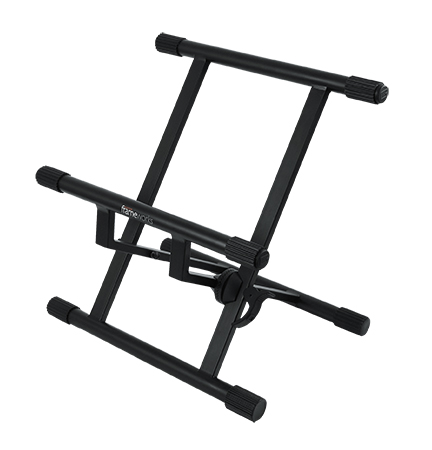
The Gatorworks stand is one of the best $45 I've ever spent
Link Removed
Most gigs are a blues/rock trio with cajon for percussion, or bluegrass quartet. Wineries and breweries, some bars and outdoor concerts. Always have PA line if needed.@alanloomis1980
how much band and how big a Room Do you handle with the rumble 100?
super tempted by the light weight.....
I did recently play a bar gig with a sub drummer. Tasteful player, but not exactly reserved either. I had the Rumble master at 1:00, and it was almost too loud. Again, PA line for the room, but plenty of stage volume.
If I was playing with a drummer regularly, I’d probably get a 200 or 500. I’ve also kicked around replacing it with a GK MB or Mark CMD 12” combo; which i think have more clarity and are better combos overall. But for the price point, you can’t beat the Rumbles IMHO. 2 years of faithful service, and I even bought a second to leave in the rehearsal room.

IMHO a tilt-back stand is one of the single best ways to improve sound
The Gatorworks stand is one of the best $45 I've ever spent
Link Removed
View attachment 3626416
I like this one better than mine, the one I have is pretty tall. I’ll have to get me one.
I use a 210 cabinet with my 17 piece big band. I sit the cab on a furniture dolly so I can elevate it and move/adjust it in very tight quarters.
Invalid Link Removed
View attachment 3625562
How do you like the Carvin BX head?
Why is that?
The ports for the mid driver point straight up. Can stand almost on top of the cab and still hear all the details clearly.
As a default, I put my rig on the ground. Bass frequencies are omnidirectional. When I want to bring high mids/highs closer to my ears, I use PJB Ear Box.
I lift the rig off the ground if there is a problem with boomy stage. It happens in roughly 10% of my gigs. Another reason to do it is when I play with cajon-to prevent vibrating of the ground interfering with mic in cajon.
I lift the rig off the ground if there is a problem with boomy stage. It happens in roughly 10% of my gigs. Another reason to do it is when I play with cajon-to prevent vibrating of the ground interfering with mic in cajon.

Don't confuse boundary cancellation with acoustic coupling. True, amp stands can't eliminate boundary conditions. But you can foil the mechanical coupling (speaker setting the floor into sympathetic vibration) with a stand or a pad. A tilted stand has the added benefit of pointing your beamy speakers at your ears so you can hear the higher frequencies better.How high do you put your cabinet?
It's a common misconception that moving a cab up up to crate and barrel height with acoustically decouple the cabinet from a floor.
See this: [Invalid or Expired Link Removed]
So at 40hz, at 1/4 wavelength you'd have to move the cabinet 7ft from a boundary. The floor, a ceiling, a wall are all boundaries.
It can't be done in most situations.
If it were true all drummers would be put on super high platforms to keep the kicks from coupling.
I prefer drummers behind sneeze shields


Yes, When I play my P bass it is muddy unless I place a wedge under the cabinet. It is still a little muddy. I now play a latest version of a indo made Sterling Ray 4, sounds better & cleanerReading this thread I'm surprised how many people see stage coupling as a positive thing. I mean we have these expensive tuned cabs, and y'all wanna chuck that control and go with boomy stage resonance? Ok boomer...
Don't confuse boundary cancellation with acoustic coupling. True, amp stands can't eliminate boundary conditions. But you can foil the mechanical coupling (speaker setting the floor into sympathetic vibration) with a stand or a pad. A tilted stand has the added benefit of pointing your beamy speakers at your ears so you can hear the higher frequencies better.
Pads do nothing.
Read here. (Submitted Article) – Bass Amplifier Isolation | Bass Gear Magazine
This is written for bass players, but there are several other papers on pads for stage and studio and they do nothing. It's a misconception.
On Mechanical vibration, the speaker moves back and forth. The vibration would tend to be sliding back and forth. Not up and down, not puffing out and in like a blow fish like the foam pad makers would have you believe. For machinery isolation pads can be designed but there's a lot that goes into those designs like the measure and direction of the vibration and the weight of the machine. Again foam padders never take this into account.
The tone of a bass includes mids and some highs. These are more directional, so it's best to have something pointing at your ear to hear this tone.
Yes, When I play my P bass it is muddy unless I place a wedge under the cabinet. It is still a little muddy. I now play a latest version of a indo made Sterling Ray 4, sounds better & cleaner
The wedge points the cab more towards your ears so you hear the mids and highs better. The bass isn't quieter, you just hear the mids and highs better.
Anything to tilt back or raise the cabinet to your ear would do it.

You could market this on Etsy as an Artisanal De-Coupling Unit Hand-Crafted in Reclaimed Wood. A bargain at only $139.99!When using a single 115 or 112, I raise it about 18" when something is available, but I don't carry a stand. I do carry this high end two-way amp tilter-backer in my gig bag:
View attachment 3626314
I really, really like feeling my bass vibrate the floor under my feet so I usually prefer positive contact between my rig and the stage. I know someone will tell me that's not the preferred mode but I'm never gonna stop doing it.
+1

That cheap? That is a bargain!You could market this on Etsy as an Artisanal De-Coupling Unit Hand-Crafted in Reclaimed Wood. A bargain at only $139.99!


