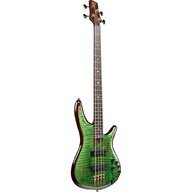
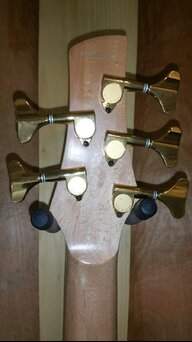
I’ve had a full weekend with the new USA Millennium including a band rehearsal, so here is that promised review and comparison with my AC BXP.
The basses both have winning features and I expect there might be a few surprises in this review for someone who hasn’t played both instruments.
First some pictures. As I suspected that transparent blonde finish is really difficult to photograph in such a way that the grain shows beneath. Even to the naked eye it’s tough to see unless you look close in good strong light.
To my mind the neck and body shape and dimensions of the Millennium basses are the apex of comfortable and playable bass guitar design. That is true for both the BXP and US models, which are essentially the same design-wise with the exception of the scale length which is 34” for the BXP and 35” for the US.
I’m sure I will acclimate just fine, but for now it’s quite an adjustment for me to add that extra inch to the scale length, mostly because of the perceptibly stiffer string tension. This may improve for me somewhat when I change out the Cirrus strings on the US to some High Beams. But for now I would have to give a slight advantage to the BXP for overall comfort. It’s also the lighter of the two basses.
Which brings me to woods. We’ve got an alder body, maple neck and pau ferro fretboard on the US and an agathis body with quilt maple veneer (mine is the black violet finish), maple neck and rosewood board on the BXP.
I’ve said it elsewhere, but it bears repeating that with regard to wood, a wood’s effect on tone (and it inarguably does have SOME effect) is not my primary reason for preferring one wood over another. EQ can compensate for tonal differences after all.
To me wood choice is about durability to weight ratio and appearance before effect on tone. With that in mind, I would have to give the BXP an edge here. Agathis is harder yet lighter than alder and the quilt veneer is eye catching. The pau ferro board with the maple dots on the US is the more attractive board IMHO, but the two boards don’t feel that much different for me to have a preference of one over the other.
BTW, if the US was a Plus model, I would definitely give the edge in woods to that one; full maple tops = awesomeness in durability, looks and AND tone.
The hardware on the two basses is made up of Gotoh tuners with a Hipshot Quadrajust bridge on the US and Hipshot Triple Lock Down Individual String Bridges on the BXP. I haven’t made any bridge adjustments, so I can’t speak to that aspect but I think the BXP’s individual bridges look sleeker. The US has better knobs, but I disagree with those that call the BXP’s metal dome knobs with rubberized rings cheap. I think they are fine. Hardware is a wash between the two basses.
Before I move on to electronics, one interesting difference between the US and BXP models is the heel shape. The US has a beveled heel that extends further up the neck.
The BXP is shorter and more rounded.
Both are very comfortable, but I would have to say the BXP’s is better! It feels more comfortable when playing high on the neck. It’s almost like playing a neck-through.
Now the electronics; pickups and preamps: This, as everyone knows, is where the US Millennium shines.
The US has the Millennium preamp with three band active EQ including sweepable mids, a VFL stacked single at the neck position and a VFL humbucker at the bridge position. The BXP has a preamp “based” (according to Peavey) on the US Cirrus model with three band active EQ and Cirrus VFL soapbar (humbucking) pickups. Both have master volume and pickup blend controls.
Whatever tone you want, from mellow thump to searing twang is in the US electronics. The BXP is rather mellowly voiced but does well with grind when a little overdrive is added.
I find the lack of sweepable mids is a real drawback on the BXP because the mid control is voiced in a place where I neither want a boost nor a cut (I like a high mid boost, which the US does really well). The bass control on the BXP really just makes the instrument louder and more overdriven. I find the only usable tone control on the BXP is the treble which I boost to get a usable sound.
The blend control on the BXP is unlike the true blend on the US. The BXP's blend does little actual blending, functioning more like a three way switch. I pretty much have to leave it set center.
The US wins the battle of electronics, hands down.
Finally taking a look a overall fit finish and quality of construction, it’s no surprise. The US is a more well-built instrument. Or at least I hope so. Time will tell. Here is what I mean. I’ve had the BXP two years. In that time I’ve had to replace the input jack and have a bent potentiometer post straightened. Now I’ve got two spots on the back of the neck where the satin finish has worn through to the bare wood just from normal playing. I hope you get what you pay for, and the US won’t have similar problems.
The Millennium AC BXP has a few advantages over the US in it’s feel and playability I think, especially if you prefer a 34” scale. It’s perhaps the better looking of these two basses and is built of harder, lighter wood. With a US Millennium preamp upgrade it would be a formidable weapon.
But in terms of quality of construction, versatility and the most important aspect, SOUND, out of the box, the US is clearly the superior instrument.
Quick and dirty, here are two sound clips. Both are recorded with a BOSS BR-8 using the “Drivin’ Bass” Patch into Garage Band with no effects. I dialed in my sound on the US and then did the best I could with the BXPs controls to duplicate that sound, without making any other adjustments.
US:
BXP: