But what if the stolen bass was covered by an insurance policy, doesn't the insurance company now have a legal right to it? It seems like that would be the case, and then perhaps the original owner could maybe get it back after reimbursing the insurance company what they paid out for the claim? How does it work in a situation like that?The answer to your question / comment is that the matter won't come up unless someone claims they are the rightful owner of property you, for example, are in possession of. In that case, in the US, if the, "guy you bought it from lied on or about the receipt", because the property is stolen property, you loose. How complicated is that?
There is a term known as, “chain of custody”, i.e., ordinarily used to document the sequence of custody, i.e. who has / had custody and control of evidence held by the authorities in a criminal case. There is also something called a, “chain of title”, ordinarily used in real estate transactions to document ownership / all prior ownership of real property. I used the term, “chain of custody”, to refer to the sequence of custody of property sold from one legitimate owner to another. I should have used the term, “chain of title”, which would have been more accurate, and easier to understand.
The documentation of the chain of custody or chain of title in this case would be the legitimate sales receipts held by all prior owners and passed on to each successive owner beginning from the original owner. The original owner would be the rightful owner if his property was stolen from him. Otherwise, the rightful owner would be whoever legitimately purchased the property from the original owner, etc., etc., etc. I’ve never heard of your, “chain of documentation”, although I know what you mean. Whatever you want to call it, a, “chain of documentation”, will have no standing or relevance if it has been falsified. That’s pretty simple, isn’t it?
If a person from whom someone purchased property faked a receipt and wants to take the chance of perjuring themselves in a court of law with something like that when the rightful owner shows up to claim their property, not to mention submitting false evidence to the court, then the rightful owner's receipt which can easily be substantiated as genuine will take precedence and supersede the fake receipt. The person who faked the receipt and then sold the property will be in hot water with the judge because judges take a decidedly dim view of people who do things like faking receipts, submitting false evidence and perjuring themselves in a court of law. Judges have been known to cite people who offend the dignity of the court for contempt of court, fine them substantial sums of money, and send them to jail to think about it. They will also refer the matter to the DA's office for possible prosecution for perjury, etc., while the receipt faker is waiting to get out of jail for contempt of court. Anybody feeling lucky?
On the other hand, in the event the receipt was faked further on down the line by someone other than the person selling the property, and someone purchases that property, and even if the purchase was made in good faith by both parties, the buyer of stolen property still looses once a legitimate receipt is produced by the rightful owner who is using the power of the court to claim their property. There's nothing complicated about this at all. It’s enshrined in the Uniform Commercial Code. Have your attorney explain it to you.
It’s up to the buyer to authenticate any receipts offered by a seller. If a buyer fails to do this correctly and the rightful owner shows up to claim their property, in the US, the buyer of stolen property looses. Simple.
If someone claims to be the rightful owner of property you are in possession of, or if you believe someone is in possession of property stolen from you, seek and obtain genuine legal advise from a licensed attorney. I am offering some examples I have seen along the way, but you can’t use me or TB to guide your actions in these kinds of cases. I don’t give legal advise to anyone. Good luck.

Enjoy the benefits of a premium membership!
Upgrade Account
-
TalkBass has been independent since 1998. Add your voice.
Create a free account to reply to discussions, view embedded media, and browse with fewer display ads.
Join free Log in
Want zero display ads or expanded classifieds tools? Compare plans.
You are using an out of date browser. It may not display this or other websites correctly.
You should upgrade or use an alternative browser.
You should upgrade or use an alternative browser.
Prakash John's bass returned.
- Thread starter Paulabass
- Start date
More options
Who Replied?

Great news. I didn't know it was stolen. That was used in an iconic performance, so that bass means a lot to many of us. It's nice to know it has finally come home.
But what if the stolen bass was covered by an insurance policy, doesn't the insurance company now have a legal right to it? It seems like that would be the case, and then perhaps the original owner could maybe get it back after reimbursing the insurance company what they paid out for the claim? How does it work in a situation like that?
I would be very cautious in a situation like you described where a carrier paid out on a theft claim and then the property was recovered to avoid the appearance of insurance fraud! I have no experience with that particular situation. Personally, I would contact my carrier as soon as the property was recovered. I'd get some guidance from somebody who knows what should be done such as my insurance agent, and document the communication. One thing I wouldn't do is keep the stolen property without some kind of written assurances from my carrier. Like I mentioned, I have no experience with a situation like that. You should be so lucky.
I would be very cautious in a situation like you described where a carrier paid out on a theft claim and then the property was recovered to avoid the appearance of insurance fraud! I have no experience with that particular situation. Personally, I would contact my carrier as soon as the property was recovered. I'd get some guidance from somebody who knows what should be done such as my insurance agent, and document the communication. One thing I wouldn't do is keep the stolen property without some kind of written assurances from my carrier. Like I mentioned, I have no experience with a situation like that. You should be so lucky.
I agree. In my instance, my insurance carrier paid me for my stolen Ric. I'd be nervous about keeping it if I found it.
However, it was stolen in 1989. Do they even have those records anymore? I haven't used that insurer in decades (they screwed me over on an unrelated claim involving an auto accident). I wouldn't even know who to contact at this point; the agent I had back then retired long ago.
Because of things like this, as much as I want my white '78 Ric 4001 back in my hands, the part of me that hates opening cans of worms hopes it never shows up.
Yeah, my first Wal bass was stolen in 1985. After the insurance company paid the claim, I turned right around and ordered another one to replace it. Given what Wals cost today (over 10 times what I paid back then), I'd gladly pay back the insurance company for it if it was ever recovered.I would be very cautious in a situation like you described where a carrier paid out on a theft claim and then the property was recovered to avoid the appearance of insurance fraud! I have no experience with that particular situation. Personally, I would contact my carrier as soon as the property was recovered. I'd get some guidance from somebody who knows what should be done such as my insurance agent, and document the communication. One thing I wouldn't do is keep the stolen property without some kind of written assurances from my carrier. Like I mentioned, I have no experience with a situation like that. You should be so lucky.
Last edited:
I agree. In my instance, my insurance carrier paid me for my stolen Ric. I'd be nervous about keeping it if I found it.
However, it was stolen in 1989. Do they even have those records anymore? I haven't used that insurer in decades (they screwed me over on an unrelated claim involving an auto accident). I wouldn't even know who to contact at this point; the agent I had back then retired long ago.
Because of things like this, as much as I want my white '78 Ric 4001 back in my hands, the part of me that hates opening cans of worms hopes it never shows up.
If your bass shows up, you would need to speak to somebody more knowledgeable than myself on the issues your brought up. Good luck.

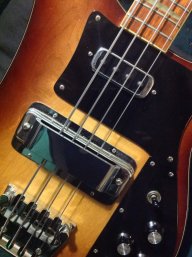
Follow up- During dinner last night we discussed the bass a bit further. It is now blue, which he hates, and all the routing has been expertly filled in. It was returned as just the body/neck with no hardware, and Prakash will have it rebuilt and probably repainted, but will not go on the road.
-Slightly off the subject- When Bernie Rico was building some basses for Prakash, it was Prakash who suggested the reverse P pickups, cause he claimed the D and G strings never had enough balls. (I just report 'em, don't shoot the messenger, it was a long time ago)
-Was the routing on the Ric really done with a twist drill bit and a drill press? "HaHa- Bernie didn't have no drill press, it was done with a regular electric drill".
- Prakash's usual Soul/RnB show is very well rehearsed and runs about the same every night. Last night he was with a pickup band playing blues and I've never seen him smile so much cause they were just having fun on stage. He didn't even wear a tux!!
-Slightly off the subject- When Bernie Rico was building some basses for Prakash, it was Prakash who suggested the reverse P pickups, cause he claimed the D and G strings never had enough balls. (I just report 'em, don't shoot the messenger, it was a long time ago)
-Was the routing on the Ric really done with a twist drill bit and a drill press? "HaHa- Bernie didn't have no drill press, it was done with a regular electric drill".
- Prakash's usual Soul/RnB show is very well rehearsed and runs about the same every night. Last night he was with a pickup band playing blues and I've never seen him smile so much cause they were just having fun on stage. He didn't even wear a tux!!
So, it's the same blue as right after I had it. I assumed after all this time it had been re-finished again.
Alec Berfield
Commercial User
- Oct 26, 2020
- 141
- 339
- 78
- Disclosures
- I'm in Entertainment Management, www.agapesoul.com www.jordanjohn.com
My good friend, and frequently my boss (I do FOH for him) told me a great story last night at dinner.
His ancient Ricky 4003 that was used on countless records and tours with Alice Cooper, Parliament/Funkadelic, Lou Reed, James Brown..........and was stolen 30 years ago has been returned!!
The highly modified Ric 4003 was in Neil Moser's shop awaiting repairs. The shop was broken into, and Prakash's bass, among other cool stuff was taken.
A few weeks ago, a reader on a Rickenbacker forum notified Prakash that his bass was in a post. Prakash's lawyer got in touch with the new 'owner' (NOT the thief), and it's return was arranged. Last week his son Jordan flew down and picked up the bass.
After the theft, Prakash briefly used Spector basses until Bernie Rico, and Neil Moser built the basses he currently uses. The returned bass needs some parts and will go on the road with him again.
Couldn't lift a good pic of the bass, but it's in the top picture of this post from the Welcome to my nightmare tour. Link Removed
Here's some footage from Rock and Roll Animal. Prakash joined the band 2 days before this was recorded. Good shots of the bass at about 7:20
Sometimes good things just happen out of thin air.
I just recently returned his Traynor Mono Block B to him.
I know the Catalyst in Santa Cruz! Great memories from those days.The "current owner" looses. It was never his to begin with. I won't buy anything used without complete "chain of custody" documentation for this reason. I don't buy much expensive used gear.
Something similar happened to me. A three way horn loaded PA cab of mine that I parked in the back stage area during a show was stolen from the "Catalyst" in Santa Cruz, California. It was quite valuable considering it had JBL 2482 and 2420 compression drivers and a Cerwin Vega 15" woofer that was custom made for us. A decade later somebody brought it to our sound company warehouse / shop for repair. It stayed there.
Alec Berfield
Commercial User
- Oct 26, 2020
- 141
- 339
- 78
- Disclosures
- I'm in Entertainment Management, www.agapesoul.com www.jordanjohn.com
So, I started to tell this story the other day, so here goes......
Prakash, as y
Prakash, as y
that is NOT Rock and Roll Animal. It is the Sally Can’t Dance band in Paris much laterI don't think that 2 week claim is entirely correct- on the Wolfgang's Vault website (Bill Graham Presents website) there are/were multiple recordings of that band on tour thru the summer, you can hear the intro develop into what it was by the time they recorded in NY in December. A staggering piece of music that changed my 13 year old life from the second I heard it on FM radio, but it didn't spring from the brow of Zeus fully developed like the version on the recording.
my .02
MJ
Alec Berfield
Commercial User
- Oct 26, 2020
- 141
- 339
- 78
- Disclosures
- I'm in Entertainment Management, www.agapesoul.com www.jordanjohn.com
Yes! But covid has them locked in at present. Jordan Johnnat The Orbit Room pretty regularly.Wow, what a great story. Always like Prakash’s playing.
@Paulabass does he still play with his son around Toronto? Had heard he was a few years back but can’t find any info on where to see him.
Alec Berfield
Commercial User
- Oct 26, 2020
- 141
- 339
- 78
- Disclosures
- I'm in Entertainment Management, www.agapesoul.com www.jordanjohn.com
So, I started to tell this story the other day, so here goes......
Prakash developed a Traynor Mono Block B with Pete Traynor then took it out on the road with Lou Reed. By the way, the above video with Danny Weis in the pic is from 1974 on the Sally Can't Dance Tour in Paris. That is NOT the RnR Animal Band. That was Dick Wagner (g)Steve Hunter (g) Pentti "Whitey" Glan (d) Prakash John (b) and Ray Colcord (k).
Anyway, Prakash took that amp and a reverse 18" with 2x10's (I think) and off he went to perform on RnR Animal and Sally Can't Dance. When he left to go with Alice for 5 1/2 years his gear was never returned to him and somehow I inherited it when the Tour couldn't pay anyone. I played them around the NYC area for a few years then moved to CA and had to sell them. Fast forward 45 years and one day I got curious looking around and just searched Traynor Mono Block B and POOF up popped one identical to mine and Prakash's. In the pic I could see it had tape residue from a sticker, so I got excited and asked my brother to go look at it. MUCH TO HIS SURPRISE, he said "remember that acid fueled etching someone did on the top of the amp? We'll it's there and it's your amp." Both of us damn near keeled over. So I contacted the guy and had it sent to me, plugged it in and it worked exactly as it did way back when. Now. FAST FORWARD AGAIN, and I engage in some business with Prakash and his uber talented son Jordan John. www.jordanjohn.com see for your self and witness the bass genius of Prakash. Meanwhile I asked him about it and he tells me the story (which I did not know) of how it was never returned to him, so I packed it back in the box and sent it to him. So, DO I LOSE? I don't think so. We need to look out for each other. STOLEN GEAR IS LIKE TAKING A LIFE. It is unacceptable! So, along with the Rickenbacker, Prakash is now in possession of his amp as well. Now that right there is a feel good story for all players.
Prakash developed a Traynor Mono Block B with Pete Traynor then took it out on the road with Lou Reed. By the way, the above video with Danny Weis in the pic is from 1974 on the Sally Can't Dance Tour in Paris. That is NOT the RnR Animal Band. That was Dick Wagner (g)Steve Hunter (g) Pentti "Whitey" Glan (d) Prakash John (b) and Ray Colcord (k).
Anyway, Prakash took that amp and a reverse 18" with 2x10's (I think) and off he went to perform on RnR Animal and Sally Can't Dance. When he left to go with Alice for 5 1/2 years his gear was never returned to him and somehow I inherited it when the Tour couldn't pay anyone. I played them around the NYC area for a few years then moved to CA and had to sell them. Fast forward 45 years and one day I got curious looking around and just searched Traynor Mono Block B and POOF up popped one identical to mine and Prakash's. In the pic I could see it had tape residue from a sticker, so I got excited and asked my brother to go look at it. MUCH TO HIS SURPRISE, he said "remember that acid fueled etching someone did on the top of the amp? We'll it's there and it's your amp." Both of us damn near keeled over. So I contacted the guy and had it sent to me, plugged it in and it worked exactly as it did way back when. Now. FAST FORWARD AGAIN, and I engage in some business with Prakash and his uber talented son Jordan John. www.jordanjohn.com see for your self and witness the bass genius of Prakash. Meanwhile I asked him about it and he tells me the story (which I did not know) of how it was never returned to him, so I packed it back in the box and sent it to him. So, DO I LOSE? I don't think so. We need to look out for each other. STOLEN GEAR IS LIKE TAKING A LIFE. It is unacceptable! So, along with the Rickenbacker, Prakash is now in possession of his amp as well. Now that right there is a feel good story for all players.

So, I started to tell this story the other day, so here goes......
Prakash developed a Traynor Mono Block B with Pete Traynor then took it out on the road with Lou Reed. By the way, the above video with Danny Weis in the pic is from 1974 on the Sally Can't Dance Tour in Paris. That is NOT the RnR Animal Band. That was Dick Wagner (g)Steve Hunter (g) Pentti "Whitey" Glan (d) Prakash John (b) and Ray Colcord (k).
Anyway, Prakash took that amp and a reverse 18" with 2x10's (I think) and off he went to perform on RnR Animal and Sally Can't Dance. When he left to go with Alice for 5 1/2 years his gear was never returned to him and somehow I inherited it when the Tour couldn't pay anyone. I played them around the NYC area for a few years then moved to CA and had to sell them. Fast forward 45 years and one day I got curious looking around and just searched Traynor Mono Block B and POOF up popped one identical to mine and Prakash's. In the pic I could see it had tape residue from a sticker, so I got excited and asked my brother to go look at it. MUCH TO HIS SURPRISE, he said "remember that acid fueled etching someone did on the top of the amp? We'll it's there and it's your amp." Both of us damn near keeled over. So I contacted the guy and had it sent to me, plugged it in and it worked exactly as it did way back when. Now. FAST FORWARD AGAIN, and I engage in some business with Prakash and his uber talented son Jordan John. www.jordanjohn.com see for your self and witness the bass genius of Prakash. Meanwhile I asked him about it and he tells me the story (which I did not know) of how it was never returned to him, so I packed it back in the box and sent it to him. So, DO I LOSE? I don't think so. We need to look out for each other. STOLEN GEAR IS LIKE TAKING A LIFE. It is unacceptable! So, along with the Rickenbacker, Prakash is now in possession of his amp as well. Now that right there is a feel good story for all players.
That's awesome, dude. And yes, we need to look out after one another!
What a great story this is.
I've been listening to Lou Reed's Rock 'n' Roll Animal steadily since I was a teenager in the 70's.
Prakash John's bass and the dueling guitars by Steve Hunter and Dick Wagner still give me chills every single time I crank it up. In my opinion it's one of the best live performances ever recorded.
It's an album you have to play loud. I'm sure it has contributed to the permanent ringing in my ears.
I've been listening to Lou Reed's Rock 'n' Roll Animal steadily since I was a teenager in the 70's.
Prakash John's bass and the dueling guitars by Steve Hunter and Dick Wagner still give me chills every single time I crank it up. In my opinion it's one of the best live performances ever recorded.
It's an album you have to play loud. I'm sure it has contributed to the permanent ringing in my ears.
Agreed all around except I have amazingly resilient ears.What a great story this is.
I've been listening to Lou Reed's Rock 'n' Roll Animal steadily since I was a teenager in the 70's.
Prakash John's bass and the dueling guitars by Steve Hunter and Dick Wagner still give me chills every single time I crank it up. In my opinion it's one of the best live performances ever recorded.
It's an album you have to play loud. I'm sure it has contributed to the permanent ringing in my ears.
Just to fill in a little history here, Canadian producer Bob Ezrin worked with Lou Reed on his 1973 album "Berlin" and says he brought in "His Guys" (Meaning Steve Hunter, Dick Wagner) from Alice Cooper's band - He had produced 4 Alice Cooper records at that point - (though Jack Bruce and Tony Levin played bass on that album). Prakash John joined Alice Cooper's band and played on the "Welcome to My Nightmare" album in 1975, considering how well the three of them played together on the Lou Reed tour it would seem inevitable..
Bob Ezrin-Part 1-This Week’s Podcast
Bob Ezrin-Part 1-This Week’s Podcast
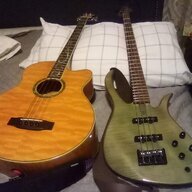
Incredible pic of John's modded bass!!
Borrowed it to paste in the Ric club... Will drum up a lot of discussion!!
Hey Paula...Follow up- During dinner last night we discussed the bass a bit further. It is now blue, which he hates, and all the routing has been expertly filled in. It was returned as just the body/neck with no hardware, and Prakash will have it rebuilt and probably repainted, but will not go on the road.
-Slightly off the subject- When Bernie Rico was building some basses for Prakash, it was Prakash who suggested the reverse P pickups, cause he claimed the D and G strings never had enough balls. (I just report 'em, don't shoot the messenger, it was a long time ago)
-Was the routing on the Ric really done with a twist drill bit and a drill press? "HaHa- Bernie didn't have no drill press, it was done with a regular electric drill".
- Prakash's usual Soul/RnB show is very well rehearsed and runs about the same every night. Last night he was with a pickup band playing blues and I've never seen him smile so much cause they were just having fun on stage. He didn't even wear a tux!!
I cut n pasted this narative of your in the Ric club ( i gave you full credit)... As i am a big fan of Prakash since RnR Animal came out in high school ( did Sweet Jane & Rock n Roll in my first band!)
I am sure there are many more in the Ric Club, who would be very intetested in the travels of a bass that we all listened to thousands of times... Also, I'm sure that we all feel the same about stolen gear, and are glad to see the bass back in the hands where it belongs!!
Best to you, and your BBQ'd strings


