
I'm a fan of vertical orientation as well, given the choice. For a versatile width from a marketing perspective, I'd recommend something you could set a rack on and be flush, so roughly 20" or so. I've given Duke the same recommendation. It's important to me since I'm running the PA from the stage half the time, usually some of it stacked atop the bass cab, and rack-width is still the PA standard. It's just one perspective, and a limiting one at that!

Enjoy the benefits of a premium membership!
Upgrade Account
-
TalkBass has been independent since 1998. Add your voice.
Create a free account to reply to discussions, view embedded media, and browse with fewer display ads.
Join free Log in
Want zero display ads or expanded classifieds tools? Compare plans.
You are using an out of date browser. It may not display this or other websites correctly.
You should upgrade or use an alternative browser.
You should upgrade or use an alternative browser.
More options
Who Replied?
- Jun 29, 2006
- 5,148
- 3,217
- Disclosures
- President, CEO, CFO, CIO, Chief Engineer, Technician, Janitor - Reiner Amplification
Wow, overwhelming support for the tall orientation! To address all the questions/comments above, It's 13" wide and 14.75" deep so the Studio 1200 fits on top quite nicely (which not counting feet/handles is roughly 12x12x4), as would most of today's micros. A 310 (and the alternate 210 config) would be wider, around 20", because the ports would have to be on the side due to the internals. The 310 would be ~ similar in height as the 210. For the vertical 210, I have some casters for the rear that stick out another inch or so on either side which makes it nice and stable for tilt and roll. In terms of sensitivity and output, the four ohm (can do eight ohm as well) will hang with any big cab - sounds like BS I know, but Ken can vouch. It's really, really, really loud. I was hammering the VHF700 through it this weekend and it got plenty stupid loud for anything.


Chef
In Memoriam
this is apropo of nothing, but if you're not following reiner amplification of The Facebook Machine; you may be missing some stuff here.
So. You maybe might want to do that.
Pretty cool.
So. You maybe might want to do that.
Pretty cool.

I don't have a Facebook account. I get enough "socializing" from TB.

I don't have a Facebook account. I get enough "socializing" from TB.
I don't either (and don't want one) but you don't need one to take a gander at the goodness.

I don't have a Facebook account. I get enough "socializing" from TB.
I envy you. I try to limit my Facebook visits to 3-4 per week, but to me it's a necessary evil.

The 310 would be ~In terms of sensitivity and output, the four ohm (can do eight ohm as well) will hang with any big cab - sounds like BS I know
It DOES sound like BS. That said, my experience with you has been that you don't spew BS, and you deliver on the claims you make about your products. Based on that I'm sure you're not lying, and that is an attractive prospect.
Would the ideal modular version of your cabs be the 210 at four ohms as a standalone small to medium volume capable rig, followed by the addition of the 110 at 8 ohms (to send equal power to all drivers) for those times you need a ton of volume? That would also let the 110 be used in the studio independently for great tone with no multi-driver phase issues. I hope I'm right and that my bank account will get emptier soon as a result.
- Jun 29, 2006
- 5,148
- 3,217
- Disclosures
- President, CEO, CFO, CIO, Chief Engineer, Technician, Janitor - Reiner Amplification
It DOES sound like BS. That said, my experience with you has been that you don't spew BS, and you deliver on the claims you make about your products. Based on that I'm sure you're not lying, and that is an attractive prospect.
Would the ideal modular version of your cabs be the 210 at four ohms as a standalone small to medium volume capable rig, followed by the addition of the 110 at 8 ohms (to send equal power to all drivers) for those times you need a ton of volume? That would also let the 110 be used in the studio independently for great tone with no multi-driver phase issues. I hope I'm right and that my bank account will get emptier soon as a result.
Yup, but I'd say the 210 will cover medium to large, and the additional 10 will get you Motorhead! 110 would be a great studio cab and even small gigs. For modular, I don't think the tall 210 is the way to go because it would get tippy putting another cab on top of it.
Recently I switched to new flatwound strings by Sadowsky. I really like how they sound! But I was curious how they would record with DI, dynamic and condenser microphones. The reference amp and DI was my Reiner Studio 1200. Here are the results, which may be educational from several perspectives so I’ll cross post as appropriate. The files are downloadable for easy comparison in your DAW. Or you may listen to them here one by one.
SIGNAL CHAIN
Room: home studio with hardwood floor, bright ambiance
Instrument: 1996 Fender American Jazz Deluxe 5 with Sadowsky preamp and Lindy Fralin pickups, J pup slightly rolled off, VTC preamp on full, bass & treble boost on about 25% (see photo)
Amp: Reiner Studio 1200 with all tube preamp (two 12au7s and one 12ax7); all EQ set flat. TalkBass discussion here.
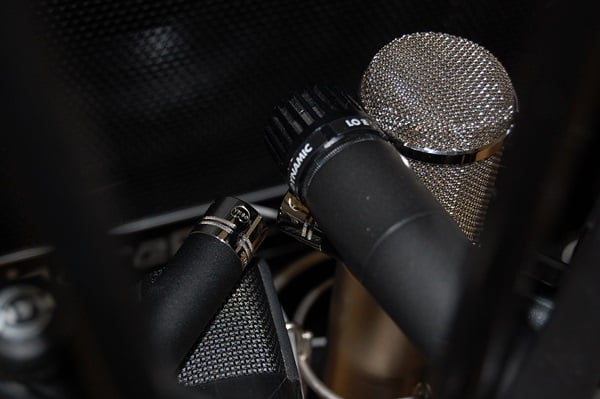
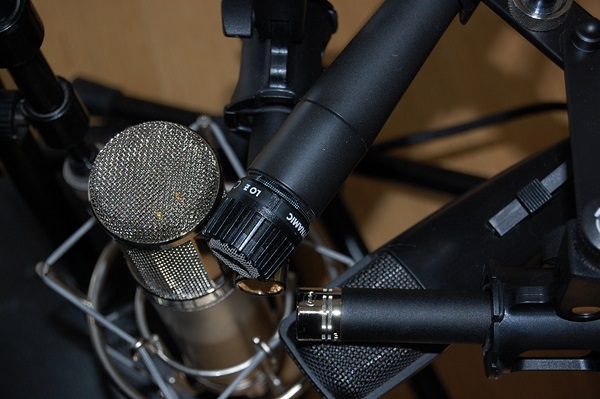
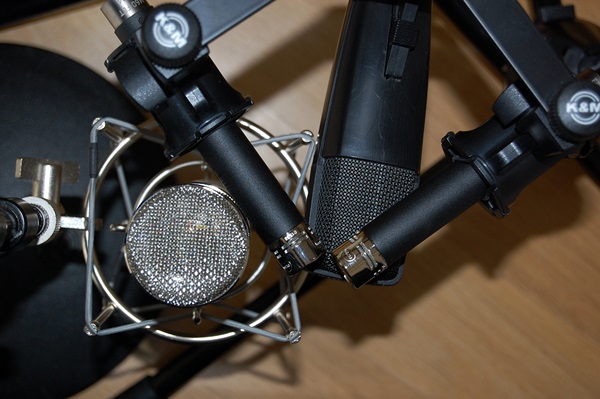
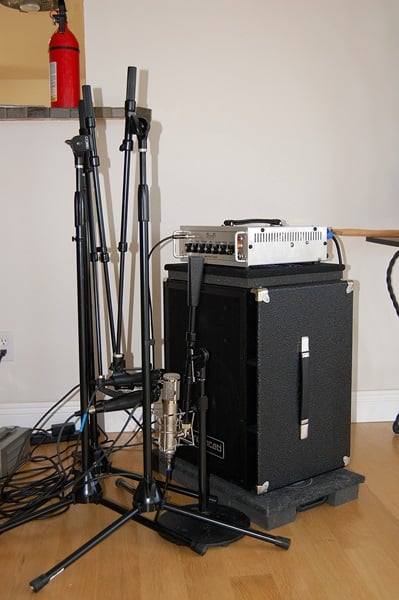
Cab: Barefaced Big Baby 2 (horn rolled off about 33%) with all mics in same area at midpoint of front grill about 5.5 inches from grill to allow a touch of air but minimize proximity effect and room noise (see photos); cab and amp physically cushioned with Auralex Gramma pads (see photos). TalkBass discussion here.
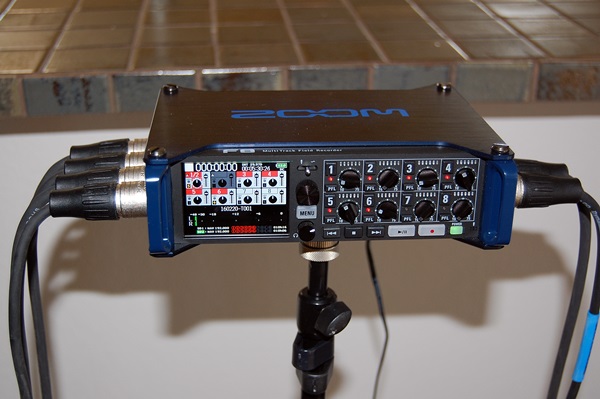
Recorder: here. The ultra quiet preamps sound great and have been compared as almost indistinguishable to the Sound Devices 744T. All inputs were simultaneously recorded to WAV files in 192kHz sample / 24-bit depth
THE MUSIC PATTERN
Played fingerstyle from bottom almost to top of neck starting with open B. Pattern was a two-octave chordal scale up and down, then repeat on C, etc. This pattern reveals string performance all over the fretboard and eases comparisons between mics.
RESULTS
All files are the raw recordings with no EQ or effects applied. All are the same volume level. Each has a playtime of 2:55
Download all files at once in compressed ZIP format from my Dropbox: WAV 192/24 (576MB) or WAV 44.1/16 (88.2MB)
Links below are WAV files @ 44.1kHz/16-bit
Direct Injection. Used the DI built into the Reiner Studio 1200. The signal went through the 3-tube preamp, which is coupled with the power amp by a Jensen transformer. The studio-grade DI uses a second Jensen transformer and provided a pre-EQ signal to the Zoom F8 recorder. CLICK TO PLAY
Shure SM57 cardioid dynamic microphone. The SM57 is the “workhorse” of live sound. Recording bass is not this mic’s forte. It demonstrates the quality of a low-end dynamic mic on bass. CLICK TO PLAY
Sennheiser MD421-II dynamic microphone. The MD421 is a better grade cardioid dynamic mic that is often used for bass guitar, toms and kick drum. CLICK TO PLAY
Telefunken M60 small diaphragm FET condenser microphones in X/Y stereo pattern. The [Invalid or Expired Link Removed] is Telefunken’s Field Effect Transistor version of the ELA M 260 small diaphragm tube microphone. Similar to the Neumann KM 184 as both are cardiod mics; I prefer the M60’s more even response. Used as a matched pair in 90 degree X/Y configuration, they provide a slightly bigger yet tightly focused sound. CLICK TO PLAY
Peluso 22 251 large diaphragm tube condenser. The Peluso 22 251 provides the harmonic richness and vintage vibe of the Telefunken ELA M 251, which is a close cousin to the AKG C12 (used on Sir Paul’s Abbey Road sessions with The Beatles). The Peluso was set to cardioid mode and its tube infusion provides a slightly rounder and sweeter tone than the M60s. It’s my personal favorite for recording the Sadowsky flatwounds. CLICK TO PLAY

SIGNAL CHAIN
Room: home studio with hardwood floor, bright ambiance
Instrument: 1996 Fender American Jazz Deluxe 5 with Sadowsky preamp and Lindy Fralin pickups, J pup slightly rolled off, VTC preamp on full, bass & treble boost on about 25% (see photo)
Amp: Reiner Studio 1200 with all tube preamp (two 12au7s and one 12ax7); all EQ set flat. TalkBass discussion here.
Cab: Barefaced Big Baby 2 (horn rolled off about 33%) with all mics in same area at midpoint of front grill about 5.5 inches from grill to allow a touch of air but minimize proximity effect and room noise (see photos); cab and amp physically cushioned with Auralex Gramma pads (see photos). TalkBass discussion here.
Recorder: here. The ultra quiet preamps sound great and have been compared as almost indistinguishable to the Sound Devices 744T. All inputs were simultaneously recorded to WAV files in 192kHz sample / 24-bit depth
THE MUSIC PATTERN
Played fingerstyle from bottom almost to top of neck starting with open B. Pattern was a two-octave chordal scale up and down, then repeat on C, etc. This pattern reveals string performance all over the fretboard and eases comparisons between mics.
RESULTS
All files are the raw recordings with no EQ or effects applied. All are the same volume level. Each has a playtime of 2:55
Download all files at once in compressed ZIP format from my Dropbox: WAV 192/24 (576MB) or WAV 44.1/16 (88.2MB)
Links below are WAV files @ 44.1kHz/16-bit
Direct Injection. Used the DI built into the Reiner Studio 1200. The signal went through the 3-tube preamp, which is coupled with the power amp by a Jensen transformer. The studio-grade DI uses a second Jensen transformer and provided a pre-EQ signal to the Zoom F8 recorder. CLICK TO PLAY
Shure SM57 cardioid dynamic microphone. The SM57 is the “workhorse” of live sound. Recording bass is not this mic’s forte. It demonstrates the quality of a low-end dynamic mic on bass. CLICK TO PLAY
Sennheiser MD421-II dynamic microphone. The MD421 is a better grade cardioid dynamic mic that is often used for bass guitar, toms and kick drum. CLICK TO PLAY
Telefunken M60 small diaphragm FET condenser microphones in X/Y stereo pattern. The [Invalid or Expired Link Removed] is Telefunken’s Field Effect Transistor version of the ELA M 260 small diaphragm tube microphone. Similar to the Neumann KM 184 as both are cardiod mics; I prefer the M60’s more even response. Used as a matched pair in 90 degree X/Y configuration, they provide a slightly bigger yet tightly focused sound. CLICK TO PLAY
Peluso 22 251 large diaphragm tube condenser. The Peluso 22 251 provides the harmonic richness and vintage vibe of the Telefunken ELA M 251, which is a close cousin to the AKG C12 (used on Sir Paul’s Abbey Road sessions with The Beatles). The Peluso was set to cardioid mode and its tube infusion provides a slightly rounder and sweeter tone than the M60s. It’s my personal favorite for recording the Sadowsky flatwounds. CLICK TO PLAY
Last edited:
Damn, dude. That post is amazing in every respect. 
- Apr 3, 2003
- 35,516
- 19,953
- Disclosures
- Editor-in-Chief, Bass Gear Magazine
I have been rather busy pushing the latest issue of BGM out the door, but now that that's done, I am looking forward to spending some more time with my Studio 1200. Initial thoughts are that it really brings more "life" and harmonic detail to the party than pretty much any other head I have tried. Certainly more than any other class-D head. I need to put it up against my SA200 and V-8... But I need to point out that the 1200 presents these harmonics in a very controllable way. You can hit a harmonic, face the cab, and let it ring almost forever, but it doesn't bloom and get out of control (though it might, if I really cranked it). Very solid throughout its range, as well. Low notes have massive authority, high notes feel very "supported," and the mids are just magical.
But, I was experiencing some weird noises as I turned it up a bit. I couldn't tell if they were coming from the amp, the cab, or the room, but they seemed to persist with different cabs and basses. My suspicion is that they were vibration-related, though I can tell you that the 1200 is definitely designed with vibration-resistance in mind. And keep in mind, this is at what I would call "full band volume" settings. So, to test my theory, I ordered a Mini GRAMMA Pad, and let me tell you, this was a game-changer! Not only did these noises go away entirely, it just made everything sound better from top to bottom. That's probably a side-effect from removing the vibration-related noise (which was probably affecting things in other regards, but not as obvious), but any way you slice it, I highly recommend the Mini GRAMMA for use with the Studio 1200.
More to come!
But, I was experiencing some weird noises as I turned it up a bit. I couldn't tell if they were coming from the amp, the cab, or the room, but they seemed to persist with different cabs and basses. My suspicion is that they were vibration-related, though I can tell you that the 1200 is definitely designed with vibration-resistance in mind. And keep in mind, this is at what I would call "full band volume" settings. So, to test my theory, I ordered a Mini GRAMMA Pad, and let me tell you, this was a game-changer! Not only did these noises go away entirely, it just made everything sound better from top to bottom. That's probably a side-effect from removing the vibration-related noise (which was probably affecting things in other regards, but not as obvious), but any way you slice it, I highly recommend the Mini GRAMMA for use with the Studio 1200.
More to come!
Are you using the Mini Gramma between the amp & cab or between the cab & floor? Inquiring minds want to know.
I have been rather busy pushing the latest issue of BGM out the door, but now that that's done, I am looking forward to spending some more time with my Studio 1200. Initial thoughts are that it really brings more "life" and harmonic detail to the party than pretty much any other head I have tried. Certainly more than any other class-D head. I need to put it up against my SA200 and V-8... But I need to point out that the 1200 presents these harmonics in a very controllable way. You can hit a harmonic, face the cab, and let it ring almost forever, but it doesn't bloom and get out of control (though it might, if I really cranked it). Very solid throughout its range, as well. Low notes have massive authority, high notes feel very "supported," and the mids are just magical.
But, I was experiencing some weird noises as I turned it up a bit. I couldn't tell if they were coming from the amp, the cab, or the room, but they seemed to persist with different cabs and basses. My suspicion is that they were vibration-related, though I can tell you that the 1200 is definitely designed with vibration-resistance in mind. And keep in mind, this is at what I would call "full band volume" settings. So, to test my theory, I ordered a Mini GRAMMA Pad, and let me tell you, this was a game-changer! Not only did these noises go away entirely, it just made everything sound better from top to bottom. That's probably a side-effect from removing the vibration-related noise (which was probably affecting things in other regards, but not as obvious), but any way you slice it, I highly recommend the Mini GRAMMA for use with the Studio 1200.
More to come!
I use both. One between amp / cab, one between cab / floor. Just like in this photo:Between head and cab I assume, but Tom can confirm.

The low end on those clips is just sick!! Even the DI track sounded amazing.
The low end on those clips is just sick!! Even the DI track sounded amazing.
Thanks. Yeah, the DI in the Studio 1200 continues to please me and surprise me with its quality. I do NOT miss my REDDI (especially having to carry that beast around!). In fact, I had two. Gone. No need.
And those tracks are raw without effects or EQ. Just like they say about cooking: good ingredients are the most important part of a great meal. A studio quality DI will always get you there.
I've had my Studio 1200 for a while now and still haven't used the DI. I'm not currently gigging on bass and my studio is still under construction. Once the studio is done I'll put it to use constantly.
Last night I was running late to a gig in a brand new room: new for my hard rock band Nitro Crush; I had played there before with a different band. I arrived with minutes to spare, so I went bare bones: Reiner head, one CN210 cab, one bass. No pedals! Turns out that was plenty. The room wasn't tiny, it was fairly wide, but shallow from stage to back. The bare bones rig was perfectly fine! No FOH for bass or guitar, but as I've been saying the CN210 has lots of low end.
Since the last time I'd played there a few years ago a hollow elevated stage was added: stable enough but slightly wobbly. It resulted in some wolf tones which made me wish I'd brought my Gramma pad, but it didn't take me long to tweak EQ to minimize them, and in the full band mix they were not noticeable. Anyway, the mini-rig sounded beautiful all night long, even in the 3rd set when volume crept closer to our normal gig volume.
Since the last time I'd played there a few years ago a hollow elevated stage was added: stable enough but slightly wobbly. It resulted in some wolf tones which made me wish I'd brought my Gramma pad, but it didn't take me long to tweak EQ to minimize them, and in the full band mix they were not noticeable. Anyway, the mini-rig sounded beautiful all night long, even in the 3rd set when volume crept closer to our normal gig volume.


