• TalkBass has been independent since 1998. Add your voice.
    Create a free account to reply to discussions, view embedded media, and browse with fewer display ads.
    Join freeLog in
    Want zero display ads or expanded classifieds tools? Compare plans.

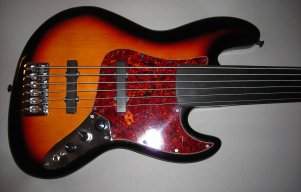
Ridiculous NBD- What do I do with a 6 string????

If ever there was a bass to play around with mods, this is it. If you can fit a pre into an Altoids lid, you can certainly pull off a preamp transplant.

I’d also suggest the lightest gauge DR Pure Blues six string set. Bassstringsonline.com.

My fear with swapping out the systems is that I'd have to drill another hole for the extra pot. And if I don't like it I can't go backwards. The new preamp comes with master volume, blender pot, and bass/mid/treble pots (5 in all). The Ibanez comes with two volumes, master tone and a bass boost. I'll probably play with it stock for awhile. I won't mod it for at lest the 45 day return period.

I like DR Pure Blues. I've got them on my Fender Jazz 5er and had them on my BTB and Yamaha 605. The BTB and 605 now have D'Addario NYXL's and I think I like those better on those basses. But the NYXL's are a little pricey so when I change I'll probably do the Pure Blues for this bass.
 
I'm probably going to play it for awhile. Who knows, maybe a 6er is my thing and I'll want a better one?

Thanks for getting me thinking... I don't want to pop for new strings just yet, so I think I'm going to boil these and try to bring some life back...

Ok... So I boiled the strings and OMG... a different bass entirely! I cleaned up the guitar while the strings were off. A ton of spooge came off the fingerboard and I rubbed in a little bore oil to put back the moisture that the Dunlop 01 cleaner took out. Got in the crevasses with Q tip. Aside from a bit more blending the boo-boos on the body this thing is starting to impress me. I never ever expected a "Gio class" bass to be this good. The fret finishing is as good as I've ever had on any guitar or bass. I never expected the fret ends to be round and smooth and flat. Action is about 5/64th's at the 16th fret with very little relief and still no buzz anywhere!

I found that if I back off the neck pickup just a touch it's got plenty of crispness. While it's got a bass boost control I've found very little if any bass boost is needed.

I'm thinking I'm going to be hanging onto this bass for awhile. While I could sell it for a small profit, what could I possibly buy that would be better that wouldn't cost me an additional $500 or more?
I have a couple of Ibanez basses and they compare favorably to my much more expensive ones.
 
  • Like
Reactions: retslock
Getting used to a 5er was a bit of a challenge. I've only been playing a 5 since March. I still have finger-farts from time to time, especially when reading and can't look at the fingerboard. But it's gotten a lot better. For some reason the high C isn't as much a stumbling block as the low B was. Some fellow was claiming that most people orient from the high string down. Not this fellow. Adding the high C seems much easier than adding a low B. And yes... I am a fingerstyle guitar player so never anchored my thumb anywhere on bass and have naturally adopted the floating thumb.

Thanks for posting the links. Lots of new stuff to learn.

What to do with a "free" nifty 6 string bass? Answer is easy. Play the daylights out of it and learn how 5 and 6 string basses work. I never quite got what a 5er was all about until I got a 6 string. It is NOT about a 4 string bass with a few added notes. (although the added notes are indeed there) Playing a 6 string FORCES you to learn to deal with all the issues of ERB playing. These include learning to play the wide necks (thumb on back) dealing with damping strings (floating thumb) and of course appreciating the joy of compact patterns across the neck and not having to shoot up and down it. You can play a 5 like a 4 with a few low notes, but a 6 string really makes you deal with these things properly. Once you "get it" then you notice that 5 and 6 string basses are essentially the same thing except that a 6 string has an extended upper range which is excellent for chords, double stops, and stratospheric solos. So if I"m in a musical situation where everyone in the band is getting pointed to for a solo then a 6 string is the answer. If it's straight groove then hey, a 5er gives you all the ease of patterns and transpositions if you don't need the solos. Some cool basses (like my G&L L2500) don't come in 6 string anyway.

Your "deal" 6 string is a great luck-out being nearly free "lessons" in what 5 and 6 string ERB playing is all about.
Enjoy!

Here's a freebie to get started: [Invalid or Expired Link Removed]
 
So here's the thing... I bought a cheap Chinese 3 band pre-amp for a Jaguar that I thought *might* need it. The Jaguar just needed a new pickup, so I fixed that bass up and sold it and still have the preamp, never having used it. For convenience I mounted the pots to an Altoids lid thinking I might create an external preamp, but gave up on the idea. Do you think this 3 band might be a good replacement for the existing preamp? I have an Audere in my Jazz 5er, but an Audere would cost me as much or more than I paid for the bass itself... and I already have the Chinese one. I'd have to drill one more hole to accommodate the extra pot. What do you think?
Is going passive out of the question?
 
Play with it occasionally for a month or two and then sell it. That's what I did with my 6 string, at least. The high C string was a complete waste of neck width for me.
I saw the bassist of Cephalic Carnage took all 5 of the strings he used, knocked out the bottom tuning peg and played with them "up". I find with low strings you can't really dig in too heavy without the string slapping back against the bottom of the fretboard, so there ya go.
 
I have a couple of Ibanez basses and they compare favorably to my much more expensive ones.

I think I'd have to agree. This particular bass has similar qualities to my Yamaha 605, except the body wood, like the SR505 is extremely prone to scratching to bare wood. The neck is as good as anything I own or played. In fact, it feels a bit more refined than my Ibanez BTB675 which is a $900 bass. It's not the beefiest sounding bass I own, but can do the job. Seems to have been a great find.

Playing a 6 string FORCES you to learn to deal with all the issues of ERB playing.

What is "ERB" playing?

These include learning to play the wide necks (thumb on back) dealing with damping strings (floating thumb) and of course appreciating the joy of compact patterns across the neck and not having to shoot up and down it. You can play a 5 like a 4 with a few low notes, but a 6 string really makes you deal with these things properly. Once you "get it" then you notice that 5 and 6 string basses are essentially the same thing except that a 6 string has an extended upper range which is excellent for chords, double stops, and stratospheric solos.Here's a freebie to get started: [Invalid or Expired Link Removed]

I think you're right. I already play with thumb on the back (most of the time) and floating thumb. Those things came naturally as I do a fair amount of fingerstyle guitar and never learned to anchor my right thumb and left thumb has to accommodate left hand gymnastics.

I had some initial difficulty going from 4 to 5, but 6 (as you say) is more related to 5 than 5 is to 4 (why is that????). There was one guy that was arguing with me that most bass players orient from the higher strings (G on a 5er). I argued that for most players this wasn't the case. I think this proves my position. Other than some string spacing (16.5mm) adaptation it is much easier to just pick it up and play it. Of course I have to learn the notes on the C string so it becomes a subconscious effort as to where the notes are, but from a feel standpoint it really isn't much different. I think if I had to I could gig this bass today with few issues. The first time I held a 5 on a gig I made so many mistakes it was embarrassing.

Thanks for the link. It's an interesting perspective. And while I already knew much of what was in it, it provided a few additional nuggets. Great for beginners and intermediates.


Is going passive out of the question?

There really isn't a point in going passive. I wouldn't gain anything. I've learned more about the controls and boiling the strings really helped the sound. While not new, the refreshed strings gave me a better picture of the sound, and I was pretty surprised at the amount of improvement. While I know there are much better pre-amp systems, this one isn't as bad as I initially thought. It wasn't the preamp that was the problem, it was mostly the strings!
 
ERB = Extended Range Bass. Usually reserved for 6s and up, but 5s qualify too I guess. But it's really the extended top range that lends itself to the techniques involved (hand movement across the board rather than up and down, chords and arpeggios, etc.).
 
  • Like
Reactions: Watchootognbout
What is "ERB" playing?

I think you're right. I already play with thumb on the back (most of the time) and floating thumb. Those things came naturally as I do a fair amount of fingerstyle guitar and never learned to anchor my right thumb and left thumb has to accommodate left hand gymnastics.

I had some initial difficulty going from 4 to 5, but 6 (as you say) is more related to 5 than 5 is to 4 (why is that????). There was one guy that was arguing with me that most bass players orient from the higher strings (G on a 5er). I argued that for most players this wasn't the case. I think this proves my position. Other than some string spacing (16.5mm) adaptation it is much easier to just pick it up and play it. Of course I have to learn the notes on the C string so it becomes a subconscious effort as to where the notes are, but from a feel standpoint it really isn't much different. I think if I had to I could gig this bass today with few issues. The first time I held a 5 on a gig I made so many mistakes it was embarrassing.

Thanks for the link. It's an interesting perspective. And while I already knew much of what was in it, it provided a few additional nuggets. Great for beginners and intermediates.

ERB = Extended Range Bass.

On a 4 string if you are plucking with 2 fingers one string is plucked while the other finger can be on another string minimizing damping problems. For five strings it's common to use B string as thumbrest and this tends to work. But once you move to a 6 or more now there are too many strings for your fingers. so the deal is to lay your thumb across several strings for damping. The practice comes in where you need to move your thumb back and forth picking strings to be muted. Obviously you've already figured this out because you weren't anchoring your thumb.

I don't really remember how I oriented when I played 4 strings only, but I do know that now I'm like you and orient from the B string. So that to me 5 , 6 and 7 strings are basically all the same sort of thing the only problem is (like you) just a matter of learning the notes on the extra strings (for me especially on my 7 string) that need some woodshed time to figure out what to do with them. I once did try a 7 string with a low F# string for a while. I was not impressed and decided that low string was nothing that interested me.
 
  • Like
Reactions: Watchootognbout
You could also get a fretwrap or a nordymute.

Nordstrand_Audio_NordyMute_walnut_maple_800x.jpg
 
I started out on guitar and still play a fair bit so I’d be tempted to tune with the two highest strings as F# and B so I could play all the chord shapes I’m used to. Who knows what that would bring out. It might be too weird playing an E chord where I would normally play an A but I’ve never owned a 6 so that’s just my crazy idea. Has anybody ever done that?

Your thought it not so strange. It makes sense. I also tune BEADF#B. It makes it much easier for me and you have even more chordal possibilities and open strings that you can use. I had this topic a few months ago: Tuning six string bass BEADF#B (like guitar)