• TalkBass has been independent since 1998. Add your voice.
    Create a free account to reply to discussions, view embedded media, and browse with fewer display ads.
    Join freeLog in
    Want zero display ads or expanded classifieds tools? Compare plans.

Roscoe Club

I don't know of anyone around here I'd trust to work on my basses.

I am originally from a small town in SW Minnesota, I was lucky to have an amazing small guitar shop in town when I was growing up.. Steve did amazing work and he always had quality gear. He really is the gold standard in my eyes. He unfortunately passed away several years ago, and I have never felt like I could really trust any shops work around Minneapolis or St. Paul because of my relationship with Steve over the years... There is always a bit a skeptism involved until I get a bass back from being worked on up here. I've worked with all of the "repected"shops here, and I still have the same feelings.

That being said, I feel pretty lucky that I can send my basses down to Keith if I need something done that I cannot take care of myself.
 
I don't agree, but ok

But you can't disagree with a fact. It doesn't work that way. Or rather, you saying that you don't agree, doesn't change the fact. Facts don't work that way.

What human has the precision and accuracy of a machine? None. That's why we build machines. When we need to steady cameras- we use gyrostabilization to remove the inaccuracies of the human. In the pilot world, we use autopilots and digital flight control systems to fly the airplane, not directly connected cables, pulleys, or hydraulic cylinders. Humans can't measure by hand the way a digital laser can. A human can't precisely apply even, equal, pressure with a file over an entire fret or fingerboard.

As humans, we use these tools to be better than ourselves and enhance our capabilities.
 
But you can't disagree with a fact. It doesn't work that way. Or rather, you saying that you don't agree, doesn't change the fact. Facts don't work that way.

What human has the precision and accuracy of a machine? None. That's why we build machines. When we need to steady cameras- we use gyrostabilization to remove the inaccuracies of the human. In the pilot world, we use autopilots and digital flight control systems to fly the airplane, not directly connected cables, pulleys, or hydraulic cylinders. Humans can't measure by hand the way a digital laser can. A human can't precisely apply even, equal, pressure with a file over an entire fret or fingerboard.

As humans, we use these tools to be better than ourselves and enhance our capabilities.

Ok. But humans can do a good fret job. Plek machines haven't been around forever and frets have been getting leveled anyway. That's what I'm saying and that's a fact too.
 
But you can't disagree with a fact. It doesn't work that way. Or rather, you saying that you don't agree, doesn't change the fact. Facts don't work that way.

What human has the precision and accuracy of a machine? None. That's why we build machines. When we need to steady cameras- we use gyrostabilization to remove the inaccuracies of the human. In the pilot world, we use autopilots and digital flight control systems to fly the airplane, not directly connected cables, pulleys, or hydraulic cylinders. Humans can't measure by hand the way a digital laser can. A human can't precisely apply even, equal, pressure with a file over an entire fret or fingerboard.

As humans, we use these tools to be better than ourselves and enhance our capabilities.

Ok. But humans can do a good fret job. Plek machines haven't been around forever and frets have been getting leveled anyway. That's what I'm saying and that's a fact too.


I think that you're both right. Pleks are far more precise (tolerance wise) but I've had some wonderful setups done (that included hand fret leveling) that left me feeling just as good (and my bass playing great). But as Skip implies, a fret leveling job done by a human can be a bit hit and miss. The Plek is super precise (and can provide a lot of great info on your neck for future Pleks). Not sure if everyone is aware but most (if not all) Pleks are connected to the internet and if you take your instrument to another shop that has a Plek they can access the previous Pleks done on your instrument to help in evaluating what's needed (or best) for your next Plek..:)
 
Last edited:
Ok. But humans can do a good fret job.
Of course. Humans use a variety of tools to perform fretwork. A Plek is just one of those tools.

I've sent several old Roscoes for Plek. They came back amazing. I have several new builds where Plek was used in production and final setup. They turned out amazing.

Imagine that the best luthier you know of, who does incredible hand fretwork, decides that Plek is better. That would be Keith Roscoe.
 
Last edited:
OK... what's your favorite body wood and why?

I have Roscoe's made of ash, myrtle, mahogany and one I'm not sure of. My favorite are my two ash bodied Basses. I've been an ash lover since my 70's Fender J's and Stingrays that I played and created the sound in my head.

I like the ash am curious about what you guys like and why.
 
Historically, as far as Roscoes go, mahogany has been my favorite. However, everything changes when you add different woods (top and neck).
My ash bodied Signature with exhibition flamed ash top and wenge/maple/wenge wedge neck (and Birdseye maple board) sounds awesome. Normally ash is too aggressive sounding to me but on that bass the sum of woods is perfect. I also think in the case of the maple board, the extra graphite reinforcements that Keith installs really adds to the phatness of the sound.
My Custom PJ has a mahogany body with an exhibition quilt top, maple/Purpleheart/maple neck with a pau ferro board and it's got a rounder lowend and a bit more polite and open sounding. It's also a few ounces heavier than my ash bass.
 
Last edited:
I wonder how Freddy_G would respond to the Spanish Cedar body bass. He has a very nice fretless with Roscoe Barts. :thumbsup:
I have a few Ash bodies and one Spanish Cedar one. However they all sound a little different. The Ash Body with Box Elder and Padauk board is my favorite. It's light, has that very distinct Roscoe Signature tone and I never EQ it. Remains set flat. The others I sometimes tweak the treble etc. All have Bart/Bart setups. So not sure why that one sounds so good, the Padauk? The weight? just the sum of all the ingredients who knows.
 
20210301_194724.jpg
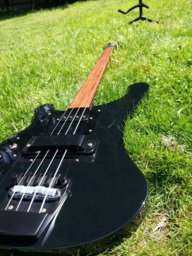
Got this SKB in a trade. It sounds great, especially the B string (it's 35'', but I think it sounds better than the B on a 37'' fan fret bass I had!)

Anyone know if there's a word for that specific pickup placement? I like it both ergonomically and tone wise!
 
Last edited:
View attachment 4191763Got this SKB in a trade. It sounds great, especially the B string (it's 35'', but I think it sounds better than the B on a 37'' fan fret bass I had!)

Anyone know if there's a word for that specific pickup placement? I like it both ergonomically and tone wise!

I think its "Roscoe" placement . :) The bridge looks like a Standard Plus setup which would lead me to believe those are Bart CB pickups.