• TalkBass has been independent since 1998. Add your voice.
    Create a free account to reply to discussions, view embedded media, and browse with fewer display ads.
    Join freeLog in
    Want zero display ads or expanded classifieds tools? Compare plans.

Sight-reading Aid....

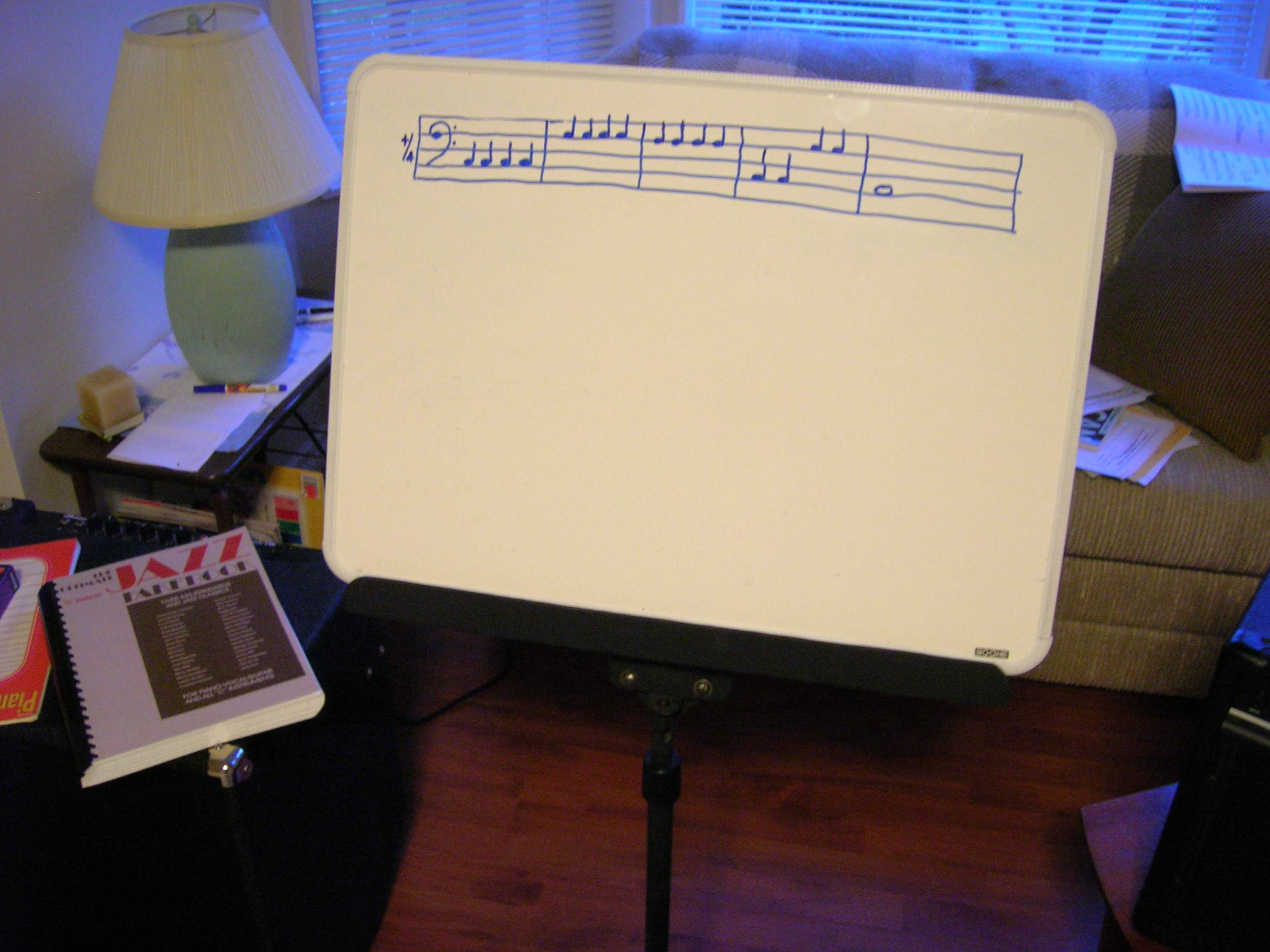
I use a dry-erase board for quickly writing out sight-read practise bass lines......

Easy to read because you can make the notes bigger than most sheet music.
This size fits very easy on the music stand and is light weight.....

Great for practise/learning music theory or sight-reading bass clefs......
001.JPG
 
  • Like
Reactions: zontar
THAT Sir is a really good idea!

especially for practicing that tricky part within a song where you know the rest of it.

I could write out bits out of the Standing in the Shadows of Motown transcriptions,coz I haven't sight read for years and need to go slowly.

Thanks for the idea!
 
Using the board is a great idea, but I'm not sure how much of it is actually sight-reading, because you're the one writing it down and then playing along. It's definitely helping you, because you're writing the rhythms and note choices down in bass clef, but that's not the same.

For true sight-reading, I'd grab the Jazz Fakebook in your pic, open a random page, look at it for about 10 seconds, and then start to play it at tempo.
 
If you don't know the alphabet.....you can't read a book.

I can clear my way through most "tabs" and "fakebooks'......if......a chord (or chords) they are using is shown above the staff in the style of, say, G7---Am---Dmaj etc etc etc ........because I am familiar with chords (on piano)..... ( If I already know how the song goes to start with)...

My ear is pretty good....

I've relied on my ear and sense of music to get me through a lot of situations....

Over the years I haven't been a complete stranger to theory ( I come from a somewhat musical family)

To be honest I was just too damn lazy and impatient to get into theory if I felt I could do a song without having to go down that path. 99% of the time it worked....

But nowadays I find there are a lot of times when knowing more theory-wise is a big help.
 
If you don't know the alphabet.....you can't read a book.

I think we're not talking the same language here. What you are doing is learning the bass clef and how it relates to the instrument, using the dry erase board to help you reinforce the knowledge as you're learning. This is great, and the dry erase board is an excellent tool for this. In your analogy, you're learning how to read a book and using visual tools to help. Again, this is great; I wish more people did it this way.

Sight-reading is NOT that. Someone that is really good at sight-reading in your book analogy would consider "War and Peace" a bit of light reading. It's walking into a musical theatre gig that you're subbing for, opening the score, and "reading the show down" without so much as a rehearsal or a real glance through the book. It's opening the Real Book and volunteering to play the melody with the sax player, even though you've never played the song before. Basically, sight-reading is what you do AFTER you learn to read.
 
  • Like
Reactions: Whousedtoplay
The Jazz fakebook contains zero notations in Bass clef. Everything is in the Treble Clef.....and of that only the melodic line is shown. The cords are listed above the staff.

I use this (pic below) also.........I run up through the normal scale (as shown with the fluo dots) in three different positions just to memorize where the major notes are .....not worrying about sharps or flats because if you know where the major notes are , you know where the sharps and flats are.

001.JPG


I also use these that I print too........if you use ink, you can't erase.....if you use pencil, you can erase but the dry-erase board is much more user friendly...
002.JPG
 
Just call me "Thread Killer".

Um, OK. "Thread Killer!" Do you need a sidekick? Because the tails bothered me almost as much as the notes not filling the entire space between lines. When I was but a young boy and had to write out piano sheet music, my teacher (a crotchety old English woman) would scold me something fierce if they didn't take all the space. G-d, what a nightmare.

I like the whiteboard idea. As someone else posted, putting the staff in with permanent marker would save the time/trouble of redrawing that each time; I like that idea, too.
 
As Inigo Montoya said, "I do not think it means what you think it means." The semantics here are important. "Sight read" is NOT the same as "reading music". "Sight reading" is as john moody and WhoUsedToPlay say- it's picking up a piece of written music, scanning through it for a few seconds, and executing it correctly the first time through as you read it. It's literally reading something and performing it musically the first time you see it. Working out something you've spent time copying from one written media to another and then playing it is reading, but not sight reading.

Now practicing reading is a part of learning to sight read, and this white board help is a great idea. I'd go for the pinstripe tape (we used this at work for scheduling on whiteboards) for the staff to save time when I erase and rewrite. Writing is a part of learning to read and learning the conventions helps create charts that are legible and communicate well to others.
 
The semantics can be argued ad infinitum...

As far as Power Tab goes.......I'm still going to use the dry-erase board because my computer room is a ways away......

and it's lightning fast......you simply rub out and rewrite...

One of the reasons I took up bass was because I was sick and tired of being rerouted to the computer with keyboards ( DAW's, mixes,recording, flash drives etc etc.).......I'm on hiatus from being a slave to software programs for awhile........(other than Talkbass).
 
The semantics can be argued ad infinitum...

And you'll still be incorrect. You are not sight-reading, you are learning to read and the dry erase board is an excellent tool. Knowing the correct terminology and definitions is as important as reading itself.

Take it from someone that's been reading for decades and has built a reputation in the area as someone who "can sight-read a show better than someone that's practiced it for months."


I'm still going to use the dry-erase board because my computer room is a ways away......
and it's lightning fast......you simply rub out and rewrite...

Personally, I find writing things down - instead of entering them into a computer - helps me solidify that information much more quickly and efficiently. Knowing how to write music is definitely a valuable skill; I've had to write in parts at the last minute into a score.