• TalkBass has been independent since 1998. Add your voice.
    Create a free account to reply to discussions, view embedded media, and browse with fewer display ads.
    Join freeLog in
    Want zero display ads or expanded classifieds tools? Compare plans.

Speakers Vertically Stacked

Seem to be a pretty sensible dude. I'm one of those guys who can end up sounding like me on pretty much whatever. Of course, playing nice stuff sounds like a better version of me and playing on hack stuff it takes more work, but I can sound "good" or "like me" on most any of it. So, I get into all this other intracacies of sound to try to get it to sound good to everybody else.:)

Well cool.
I've gotten into long discussions of the "intricacies" of sound and I must admit it makes my head spin and brings my worry meter up a notch. My old drummer who I played with in one band for almost 9 years is now the owner of one of the local sound companies and we've talked. My take on it is if it's a venue that needs special attention to the house sound, I'll hire him. I know I can work with him and we'll both be happy. Though he still keeps hocking me to go IEMs. Just can't bring myself to do that...yet. LOL
 
Well cool.
I've gotten into long discussions of the "intricacies" of sound and I must admit it makes my head spin and brings my worry meter up a notch. My old drummer who I played with in one band for almost 9 years is now the owner of one of the local sound companies and we've talked. My take on it is if it's a venue that needs special attention to the house sound, I'll hire him. I know I can work with him and we'll both be happy. Though he still keeps hocking me to go IEMs. Just can't bring myself to do that...yet. LOL

Me either.....I need a !#$%!+_^ amp.
 
My God, what have I started! :hiding:
Hee hee... go for it guys! :)
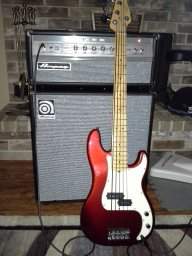
Show us your vertically stacked speakers!

attachment.jpg

[Invalid or Expired Link Removed]
 
  • Like
Reactions: DEMS854
on the "sound like me" subject. I got CC'd an email from a mgr of House of Blues, Houston last week per our question of the backline.

We were doing the one, opening set for a band coming in from Corpus Christi, so I let it be known myself and drummer really did not want to haul our rigs into downtown Houston for a single set.

The email stated they'd have a house drum kit and bass rig, a Ampeg head and 810 cab. I was like, awesome, haven't played thru one of those in a very long time. I've never owned one but used one as backline before.

So we get there and soundman says well the Corpus main act brought their gear they wanted to use so we let them set it all up. OK, whatever they had a awesome sound system in this ballroom. Some large speakers hanging so that I could not ID them, four 18" cabs sitting on floor in front of stage, nice.

The bassist rig was some Hartke head, never used Hartke so not sure what model. Next a Ampeg 410 cab over a SWR 18" cab; course it was lined out to the board. Cool as I wanted to run thru those 4 subs really bad. I rarely play thru a PA in my ohter bands.

Anyway, I brought my Am St P5 and just tweaked the stage rig a tiny bit for my ears. I felt like I sounded like me on my P5 as I do thru my own rigs. Course the FOH was doing most all the work and I could really only hear the 410 cab slightly. Just saying, I've played thru many others rigs and I gig 5-6 different basses, heads n cabs. 'Cept for the different basses built in tone, I usually sound like me live and on recordings.

Sorry for the long OT. As for vertically stacking cabs, I do that with my two TC-RS210 cabs+F1 head * the small-stack* and then my two GB Neox 212T cabs; sometimes with a Carvin B1500 on top. :eek: * the big-stack*
Will try to post pics of that. Peace Y'all.
 
In speaker design, etc. I don't see a whole lot that's a whole lot different than what was being done in the '80's. Advances in driver technology/performance obviously, but in terms of design layout, acoustic principles, proclaiming to the public why someone's designs are superior and explaining why.....not so much. It seems things are leaning more on marketing hoo hah and less on good design when in fact, good design could be leaned on a little more and "flair" a lot less.

I agree with you 100% on the marketing aspect (hey, I'm an engineer... I'm supposed to roll my eyes at the marketing folks right?).

I do think there have been some tremendous improvements in speaker design, some things that I can think of that have pushed performance (including size and weight) forward are:

Neo magnet materials
Dual voice coil, push-pull motors
Inside-outside wound voice coils
Kapton bobbin material
Nomex/glass/epoxy bobbin material
fiber reinforced cone material
tall aspect ratio VC wire
titanium diaphragms
new phase plug geometries
Advanced horn flairs (CD, quadratic throat, waveguide)
lighter weight composite cabinet materials
advanced cabinet finishes
greatly improved hardware options
 
Some say that horizontally stacked cabinets sound better than vertically stacked while others say vertically stacked sound better than horizontally. Me, I just stack them based on the stage so they fit in. Case solved. Less things to worry about in life.

My experience proved (is there was any need...) that this theory chapter is almost as important as everything else in the signal chain, in order to obtain a certain tonal result.
I go further in this regard. I almost consider vertical/horizontal like another tone control. Sometimes and with certain heads or basses I like non-vertical because the stage or anything else has a "biased" frequency response that, in some way, couples well with this setup.
But in the majority of cases I go vertical, and not only for dispersion. The tone is different, clearer and without that low-fidelity frequency coupling in the lows and lower mids that happens if you position many speakers near the floor and one above the other...just my experience
 
The tone is different, clearer and without that low-fidelity frequency coupling in the lows and lower mids that happens if you position many speakers near the floor and one above the other...just my experience
There's no difference in the low frequency coupling with the floor with vertical versus horizontal placement. The wavelengths of the coupled frequencies are far too long, ten feet and longer, for the cab/driver orientation to make any difference. What is different is the audibility of the shorter wavelengths of the mids and highs. You can't hear them as well when the source is down low, and that makes the low end seem more prominent, whereas in reality it isn't. This a classic example of where "I know what I'm hearing" is actually a case of no, you don't.
 
There's no difference in the low frequency coupling with the floor with vertical versus horizontal placement. The wavelengths of the coupled frequencies are far too long, ten feet and longer, for the cab/driver orientation to make any difference. What is different is the audibility of the shorter wavelengths of the mids and highs. You can't hear them as well when the source is down low, and that makes the low end seem more prominent, whereas in reality it isn't. This a classic example of where "I know what I'm hearing" is actually a case of no, you don't.

I was thinking that if you position not one, but two or multiple woofers near the floor (horizontal), it could be different from the situation that there is only one woofer so close to the coupling (and resonating surface). Every time I did a problematic gig, like hollow stages, I did notice a great difference when stacking cabs in different ways, and this even on-axis and at ear level. I do not know for sure about this, I'm not a loudspeaker designer like you, I just observed carefully an empirical (for me) phenomenon. But I can tell one thing for sure. I use two 2x10 cabs that I stack in one way or another. Because of the shape and measures of the cabs itself, placing them vertical or horizontal makes the whole combo almost as TALL, the difference is quite a few inches (or cm, if you like european). But the tone of the stack is dramatically, I mean dramatically different, in the way that I have described before. It obviously also depends on other factors, other than stacking mode (room, outdoor etc, but the trend is still there).
Therefore, you have to be patient and polite, english is a foreign language for me, and sometimes I do not understand well, maybe I'm confusing things and concepts...if the wavelenghts are so ample that, I say, 20-30 inches do not matter, obviously 8 inches even less, ok? (8 inches represents the exact difference in HEIGHT between horizontal and vertical, and the complete stack is 46 inches tall in vertical "mode", but I use a cart under it, so in reality is 48-49).
You can add to the case that my two cabs have a tweeter each, so there is always a source of highs at the very top of the system. Sure if you are in front and at ear level with a conventional 4x10 you WILL hear better those directional mids and highs, whereas the bass is omnidirectional (I'm a medical doctor, psychoacoustics matter when talking about hearing)
If I can learn something, I will listen to you very very gladly. Just I doubt that the difference in the tone, so evident that even a deaf could hear it, even just in front of the system, is caused only by a taller setup (8 inches, but this does not apply if you sit down on a chair in front of the cabs).
 
I was thinking that if you position not one, but two or multiple woofers near the floor (horizontal), it could be different from the situation that there is only one woofer so close to the coupling (and resonating surface).
Where the speakers are within 1/4 wavelength of each other they operate as a single low frequency source, so their positioning with respect to boundary coupling makes no difference.
I use two 2x10 cabs that I stack in one way or another. Because of the shape and measures of the cabs itself, placing them vertical or horizontal makes the whole combo almost as TALL, the difference is quite a few inches (or cm, if you like european). But the tone of the stack is dramatically, I mean dramatically different.
That has to do with constructive versus destructive coupling of the midrange and high frequency outputs, where the drivers are too far apart to operate as a single source. This site has a number of applets that you can use to see the effects of using multiple sources at different frequencies with various spacings and orientations, with and without boundaries. Caution: it's very addictive, you can spend hours fiddling with it.
3-D Wave Simulation
 
The wider the source the narrower the angle of dispersion. The ideal speaker would be about an inch wide and thirty feet high. That's not all that practical, though it has been done. The closer you can get to that ideal configuration the better. As soon as you put two drivers side by side you're headed in the wrong direction.

ok, I’ve searched everywhere and I can’t find any info about this speaker. How deep was it, was it a bass woofer, how many drivers, what drivers, etc - does anyone have a link?
 
ok, I’ve searched everywhere and I can’t find any info about this speaker. How deep was it, was it a bass woofer, how many drivers, what drivers, etc - does anyone have a link?

Don't know but it's likely a very tall array made up of dozens of 1" drivers. Impractical, yes, but not an overly complicated construct. And yes, you could get bass from 1" drivers, just very quiet bass, so you use lots of them.
 
Has anybody paid attention to boundery reflections with vertically stacked cabinets?

Standing out in the audience, with a hard stage, you will have multiple reflections and arrival times from the stage as the boundery. That's the big (potential) negative with vertical arrays.

The positive aspects of a horizontal array (on the deck) is better LF coupling and less interference from boundery reflections BUT the biggest negative is that the summing interference lobes are in the horizontal plane.

This topic is FULL of tradeoffs.

Interesting thing about the depth difference of the TCE 12" vs 10" cabs: if you are standing close to the front of your vertical 2x12 + 2x10 stack, you can stack the 2x10 toward the back of the 2x12 so the mids/highs reach you at the same time from each cab (more or less). Uffe even demonstrated this in the sales demo vids. Clever marketing "angle", even if it was realized after the cabs were designed. Acoustic tilt using Combo450 stacked with RS112 - YouTube

@johnsonabq: horizontal interference issues aside, try a 2x12 + 2x10 + 2x10 TCE stack with the RH450 at 2-3 Ohms. The coax tweeters are vertically aligned, the amp is super punchy, and the visual is impressive. Maybe you're not done with your TCE GAS!

IMG_0123.jpg

Mark