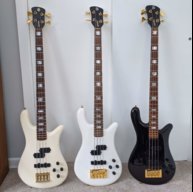
Me too. Really, what I need is some remedial tutoring on how properly light and photograph shiny objects like my Spectors. The glossy finish stymies me in all kinds of different light that I've tried.

It's tricky.
And I'd love to say that the $100,000 3-year experience I had in film school didn't make the difference between not knowing and being confident that I can shoot just about anything and shoot it well. But it was exactly what made the difference.
The good thing is that you don't have to go to film school or spend that sort of money on a college degree because I don't mind sharing what I've learned.
First. And MOST importantly, is you HAVE to control the light.
This means you need to shoot in a completely dark room.
The NS Bass doesn't have a flat surface on it (except for the face of the headstock, which is at a 15 degree angle from the main plane that the rest of the body sits on).
So think of the rules of a pool table. You want to bank a shot into a pocket. You have to hit the bumper at the right angle to hit the pocket. You have to take that angle, half it, and hit the bumper there.
This is called "Angle of Incidence" in photography. If you don't want a light reflected on the surface of what you are shooting, you need to move the angle of the light unless that reflection is minimal.
------------------------------------
WHAT YOU WILL NEED
------------------------------------
You need a tripod.
A good stand for your bass.
A measuring tape.
A dark room (with dark walls... I hang black sheets on the walls and ceiling of the room I am shooting. I also put the dark sheets on the floor.
--------------
Your bass needs to be floating in a sea of blackness. That way the ONLY thing reflecting off the surface of the bass is the lights you want to use to light it.
--------------
Use the timer on your camera for each shot. Pressing the shutter release with your finger can move the camera just slightly, and this can cause focus issues (shake) in the image. The timer is the way to go.
--------------
You DO NOT want to use a flash.
--------------
Go to Lowes or Home Depot and get two 250w clamp-style shop lights (for clamping to the hood of a car, etc...) and get a few "BALANCED" bulbs if you can. Bulbs will be either 3200K or 5600K balanced.
3200K is tungsten, or indoor light.
5600K is the color temperature of sunlight. So those are sometimes called daylight balanced.
This is important. Kevin is the COLOR of light. It's measured in temperature. So 3200K is sort of yellowish-orange. 5600K is whitish-blue.
And our eyes automatically adjust to it.
But cameras DO NOT. So there is a thing called "White Balance" You set this according to the environment you are shooting it. It then adjusts the camera to see that light as "normal".
So make sure whatever type of bulb you are using that you set your white balance on the camera to match it. Tungsten for indoors. Daylight for outdoors.
--------------
You're gonna want to use a 50mm lens if you are shooting with an SLR. If not, then look in your camera's manual and see what (if it gives you this info) the "normal vision" setting for your camera is.
In 35mm or SLR (Single Reflex Lens - means you can change the lenses out for different sizes), there are two types of millimeter measurements you need to understand.
In the 35mm format, 35mm is the size of the negative, or in Digital SLR terms, the size of the sensor inside of the camera. Smaller sensors will have a multiplication factor. Something like 1.4 or 1.6 or 1.7
This means that you have to take the millimeter focal length of the lens you are using and multiply it by that number to get the adjusted focal length.
The second millimeter measurement is the focal length of the lens.
There are two types of lenses: Zoom and Prime (fixed). A zoom has an adjustable focal length and a Prime does not.
Here's how it breaks down:
If you want a lens on a 35mm format camera (or current SLR - which are all based on the old 35mm film format platform) that is approximately what your eyes would see, you want a 50mm lens.
Anything smaller than 50 will distort the image on the corners. These are called Wide-Angle Lenses because they see more - wider - than the human eye. Wide angle lenses come in sizes from 4mm to 48mm - depends on the maker.
I own 16mm, 24mm, 28mm 35mm 40mm and 45mm lenses.
I have a zoom lens that goes from 35mm-70mm. So at 50mm this lens becomes a "normal vision" lens.
--------------
Lenses larger than 50mm are telephoto lenses. They make things far away look closer. Like a telescope.
--------------
VERY IMPORTANT!!!
If you are using a digital SLR with a smaller than 35mm sensor and it has a multiplication factor of 1.5 (for instance). Then the lenses you are using in standard millimeter measurement has to be multiplied by that factor to get to true focal length.
In other words a 50mm lens x 1.5 becomes a 75mm lens. That's telephoto and NOT what your eye sees.
Likewise a 35mm lens x 1.5 becomes a 52mm lens (approximately) and that's OK.
--------- The bottom line is that you want to take a photo that looks closest to what your eye sees.
-----------------
Always set your tripod's height at 1/2 the distance between the top and bottom of whatever part of the bass you are shooting.
You will need to angle the camera to keep the lens flat with the plane that the strings sit on to keep from having distortion at the top or bottom of the image. ---- this is because almost every stand you'll put a bass in will have a slight "lean" to it. Resting the headstock further back than the body so it doesn't "fall out". This angle has to be adjusted for.
-----------------
Measure the distance between the center of the body of the bass and the film plane of your camera.
There will be a little mark on your camera that looks like a circle with a line through it. THIS is the film plane. THIS is the actual spot where your camera takes the image. And this is where all measurements are made from. NOT the front of the lens.
Just make sure that you make a note of the distance so you can repeat the setup again if you want/need to take more photos (for whatever reason). It also helps that all of your photos will now turn out the same.
----------------------
Put your lights even with the lens of the camera on either side of the camera, 20-45 degrees on either side of the bass.
You'll note that you'll see the light reflection lines in the bass. It's by moving the lights further to the front or further to the back that those lines get thicker or thinner, or move position on your bass.
----------------------
To get the shots needed for a composite image, you ONLY move the lights. NEVER the camera or the bass.
Take a set of shots. Move the lights --- which moves where the high light is. Then more shots. And move again.
Eventually you'll have a bunch of photos, all the same size and angle which when put together will have full coverage of all of the grain (minus hot spots) and you simply edit them together to make sure those hot spots don't show.
-----------------------
Here is the deal.
I just gave you guys all of the knowledge you need to shoot great photos of your basses. So use it.
Takes TONS of killer Spector photos AND POST THEM HERE for everyone to see.
And I'll comment on them.
If you have specific questions, then ask me. And I'll answer them the best I can.
KNOWLEDGE IS FOR SHARING.
And so is great Spector-Porn.
So go and take some killer Spector photos and share them.
I can't wait to see what you come up with.







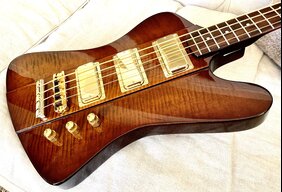

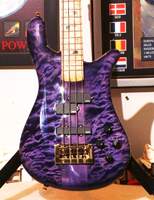




pretty excited