OK. EARLY NS-1 & NS-2 History...
The "regular" production of the NS-Bass started in the fall of 1977 with the NS-1.
The NS-1 was "1" because it had a single DiMarzio "P" pickup routed into the body.
The body dimensions are NO different than they are today. The placement of the bridge is NO different than it is today.
The bridge on the 1977 NS-1 from the second batch of 12 ever produced that I'm holding in the photo below is placed approx 3 inches from the bottom center of the guitar. My 2010 NS-4 has the bridge in the same position.
The NS-1, to be different than the other basses out there at the time, had a six-sided pickup route cut into it and Stuart melted, poured and formed the plastic cover for the pickups (this was a completely original NS-1, BTW) in the Brooklyn Woodwork's Co-Op. They decided it was dangerous to do so, fumes and the potential for fire, and the NS-2 was introduced with the standard routes that the NS-2 has today.
Back in the first days of the NS-Bass, Stuart used Rock Maple for the necks, solid black walnut for the wings and ebony for the fingerboards. Those were the three standard NS-Bass woods.
They have always been 34" scale.
They have always had 24 frets.
The NS-1 had two (2) control knobs.
The plug was on the front of the bass below the control knobs until late 1978 when Stuart moved it to the bottom. Eventually with the NS-2 it moved to the position it currently resides at.
Some early NS-2 models (such as the one Jack Bruce played for years) had pickup selector switches and three knobs.
The NS-Bass as we've come to know it, with the 4 control knobs was born with the creation of the USA 9v (Haz) circuit in late 1979.
The original NS-Bass up until the invention of the USA Spector Locking Bridge in late 1983, used the Leo Quan BadAss 1 Bridge (no longer made).
The serial numbers for these basses were always hand etched into the bottom of the bridge (see photo below).
Scott Smith played a 1978 NS-1. Single P pup.
Stuart experimented with many different tone-control solutions, thus some models had tone selector switches, coil tap switches, etc... And these could vary from guitar to guitar. There was no standard until the Haz Tone Circuit became "THE CIRCUIT".
The Abomination Bass - I just love the word "Abomination" honestly... is wrong. Scott didn't play an NS-2. And the bridge for the NS-2 was NEVER located in the position the poster of that ad claims.
The scale length has to be off or wonky, because there are 3 less frets and the bridge sits so far back.
In all, it looks well-made, but like this
MODIFIED ABOMINATION which is sadly an original NS-1 that some Douche-tard routed a "J" pup into and is trying to pass off as one of the first "NS-2" models. IT IS NOT. And Ed Roman knows this, I've told him personally. He was asking $10K for it. So at least he's knocked the price down. Sadly, there is no NS-2 Serial #11.
It would have had a dated serial number like the one in this picture. Also, Wenge has never been a wood that Stuart has cared too much for in the building of guitars. So the "Wenge" fingerboard is either marked as "Wenge" incorrectly - such as a dark stained Pau Ferro, or it's a replacement fingerboard. Which is even worse. Normally, this would be Ebony.
Now, we've all learned here hopefully that there are exceptions to every rule. And Stuart did experiment with a number of different wood combinations until he found the tonal mix that Rock Maple, Pau Ferro, and Quilt Maple bring forth. Add the Haz tone circuit and it's the combination that created the "Sting Bass" and the truest form of "The SPECTOR Tone". Todd Cooke and PJ Rubal have some of the earliest and best preserved examples of the coming together of equipment and woods that made the SPECTOR NS-Bass the instrument we've all come to love.
It's been 36 years. A lot of myth, incorrect assumptions and the lack of a large number of these rarest of collectable SPECTORs have been on the market for people to know the "411" on them.
Then you have guys like Ed who are trying to sell something that is simply NOT what he says it is. To my best knowledge, there has NEVER been an NS-2 built with the large 6-sided route for the "P" pup. This was an NS-1 design feature. You see an NS-2 with one of those large cut-outs and it's NOT an NS-2. It's a mod'd NS-1... which is sad beyond belief to someone who could love to have one of these "purist Spectors" in their collection.
Lastly, by the NS-2 Stuart was bonding the Rock Maple necks differently than he did with the NS-1. Look at the cross-section where the two pieces of wood meet at the body/neck junction. By the NS-2, Stuart was bonding the wood side-by-side for the neck sections (like it is done today) and not on top of one another (as seen in these photos).
What is a shame about the Ed Roman NS-1 is that we'll never know the truth about what batch it came from. Unless the original bridge is still on it and you can see the serial number, it's a fake NS-2. A destroyed NS-1. Sad to do this to a piece of history.
Oh. And as the Ed Roman site says, "One of Stuarts first instruments"... Hardly. Stuart had made a couple of hundred guitars by the time this one was made (if it was an NS-2).
Wrong answer... try again.
------------------------------------------------
Original 1977 NS-1 - Serial Number 110577 - Nov 05 1977
Link Removed
Link Removed
Link Removed
Link Removed
This is where the serial number should be. If it's not here, there's a problem.
Never buy an NS-1 or early NS-2 without checking this. If no serial can be found
It's probably been modified or at least had a bridge change-out.
Link Removed
For you Fodera lovers out there... this is some of Vinny's earliest work.
He was 17 when he apprenticed with Stuart. And these headstock inlays were Vinny's first job.
Link Removed
Ebony!
Link Removed
Unscrew this cover and under it should sit a single DiMarzio "P" pickup.
You can tell it's a DiMarzio from the way the magnets are done at the top of the pup.
You'll also notice the thumb support. This was original to this bass and probably done at the request
of the owner who ordered it. Stuart sometimes would place custom thumb rests for people if they
requested it.
Link Removed
Sadly this baby's original tone circuit had finally died. So it was getting a new circuit installed.
I believe they went with the Aguilar OBP-1. There is a circular plastic cover that fits over this control cavity.

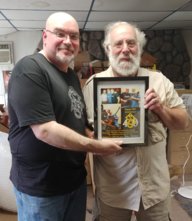


 lol.
lol.
 )? Maybe.