• TalkBass has been independent since 1998. Add your voice.
    Create a free account to reply to discussions, view embedded media, and browse with fewer display ads.
    Join freeLog in
    Want zero display ads or expanded classifieds tools? Compare plans.

Spector Club - Part 11

Status
Not open for further replies.
Looks like my "Spector Story" is getting postponed. I came down with the worst case of rotavirus ever! The last three days have been the worst of my life. If i have the strength and energy i'll finish it tonight.
Dude, sorry to hear you're ill. Take your time, recuperate first...
THEN, do your "My SPECTOR Story"... we will wait.:cool:
 
Tracebassplayer said:
Dude, sorry to hear you're ill. Take your time, recuperate first...
THEN, do your "My SPECTOR Story"... we will wait.:cool:

Thanks Trace.
This is the worst I've felt in my life! I've been through 2 brain surgeries and this is almost as bad.
 
It looks to me as if a luthier liked the NS-Body design and wanted to try building one for himself.

It does look like an early NS-1 - NS-2... with the bridge, body materials, etc... And I give this luthier props for not doing the one thing that would have created trouble for him, which is copy the SPECTOR headstock.

Which brings me to... the Coda bass doesn't have a "version" of the Fender headstock. It has a SPECTOR version of an in-line (as opposed to side by side) headstock.

See the only part of a stringed instrument that can be protected under US Patent law is the actual headstock shape.

No one should ever make a copy of a Fender, Gibson, Spector, or any other bass and try to make a copy of that bass's headstock. That'll get you into big trouble.

I'm sure this bass is a nice bass. It has some interesting materials. And if the luthier is good, he could make a near identical copy of an NS if he had one to go by and had the right machinery, skill and time.

As a SPECTOR purist, I'm not a big fan of mods. Although I myself have a heavily modified NS-2A. So I'm not casting stones.

But this isn't a mod... it's a copy. And as a one-of-a-kind "homage" or "tribute" to Stuart and Ned, cool. But make more than one and you're ripping off Stuart and Ned. And that's not cool. Now you're making money selling something that is based on a design you didn't create and you don't have the legal rights to.

And something like that is an abomination to someone like me who cares about his friends, their hard work and the integrity that they build every instrument with.

I got the feeling this may be one of several "Tribute" basses. And honestly, if you're gonna make money that way, find another line of work or come up with something original on your own. Stuart and Ned have come up with dozens of original designs. It can be done.

The copycat, rip-off, unoriginal, "make money from someone else's innovative thinking" sort of mentality makes me a little more than ill. Which is why I'll never own a Warwick.

It's just my personal opinion... nothing wrong with you if you like it. I'll just file it away with the Streamer as an abomination that would make great firewood or better yet, if I ever wanted to smash a guitar on stage for theatrics... one of these would do just well.

I am pretty sure that the guy who built this bass made this as a one off thing for someone here in Van a long time ago and it's seen quite a few hands... He has a shop where he does repairs and such, he's also a local musician.

I was going to check out that dude's NS-2 he also has for sale, so I will definitely check the sound of the other bass too and give a report:) I will ask more about its origins...

There's also a guy in Maple Ridge that does very similar models to the Carl Thompson basses, not sure about sound and quality, but they sometimes pop up on CL here. They go for over 2G's!

I agree with the rip-off vs one off homage argument and I feel exactly the same way about the Warwick thing...
 
It looks to me as if a luthier liked the NS-Body design and wanted to try building one for himself.

It does look like an early NS-1 - NS-2... with the bridge, body materials, etc... And I give this luthier props for not doing the one thing that would have created trouble for him, which is copy the SPECTOR headstock.

Which brings me to... the Coda bass doesn't have a "version" of the Fender headstock. It has a SPECTOR version of an in-line (as opposed to side by side) headstock.

See the only part of a stringed instrument that can be protected under US Patent law is the actual headstock shape.

No one should ever make a copy of a Fender, Gibson, Spector, or any other bass and try to make a copy of that bass's headstock. That'll get you into big trouble.

I'm sure this bass is a nice bass. It has some interesting materials. And if the luthier is good, he could make a near identical copy of an NS if he had one to go by and had the right machinery, skill and time.

As a SPECTOR purist, I'm not a big fan of mods. Although I myself have a heavily modified NS-2A. So I'm not casting stones.

But this isn't a mod... it's a copy. And as a one-of-a-kind "homage" or "tribute" to Stuart and Ned, cool. But make more than one and you're ripping off Stuart and Ned. And that's not cool. Now you're making money selling something that is based on a design you didn't create and you don't have the legal rights to.

And something like that is an abomination to someone like me who cares about his friends, their hard work and the integrity that they build every instrument with.

I got the feeling this may be one of several "Tribute" basses. And honestly, if you're gonna make money that way, find another line of work or come up with something original on your own. Stuart and Ned have come up with dozens of original designs. It can be done.

The copycat, rip-off, unoriginal, "make money from someone else's innovative thinking" sort of mentality makes me a little more than ill. Which is why I'll never own a Warwick.

It's just my personal opinion... nothing wrong with you if you like it. I'll just file it away with the Streamer as an abomination that would make great firewood or better yet, if I ever wanted to smash a guitar on stage for theatrics... one of these would do just well.

The same could be said for a lot of basses ... given the introduction of Spectors new Coda series a Fender Jazz comes to mind :p

People will often copy things they like or things that are deemed successful. You can take it as flattery or theft. I guess it just depends on what side you look at it from. Based on the good job the builder did on the body, I think if he really wanted to he could have copied the headstock without too much trouble, but he didn't (which was the right thing to do). If there were thousands of these basses on the market taking away from Spectors sales I might feel a little differently, but I honestly don't think it's that big of a deal.

Misrepresenting the bass as a Spector would be wrong, but it happens all the time. Look at all of the mistakes that GC makes on their listings. Unless you spend a lot of time on sites like TB, it can be hard to keep things straight given all of the different manufactures and models out there.
 
Basically I think the guy built a vintage Spector copy for someone who couldn't afford a real vintage Spector ....

I admire the guys work , talent and ability to copy the Spector sculpted body . Only the original owner knows why the woods that were used were the woods chosen for the build . Prolly specked out by the original owner for his own preference . Headstock shape I dint care for , but could live with . I would give him 5-700 if it looked played and sounds good in hand . Problem is we know nothing about the neck / truss rod construction . Looks good , but I wouldn't pay and have it shipped to me .....

On the Warwick note , they are fine built instruments from a great company . But I wouldn't care if they ever made another streamer ....
 
OK. EARLY NS-1 & NS-2 History...

The body dimensions are NO different than they are today. The placement of the bridge is NO different than it is today.
Something has to be different. The NS1 clearly has access to the 24th fret, something current NS bodies do not have. :eyebrow:
Why did this get changed? Seems like a step backwards.
This is something many Spector lovers have been puzzled about for years (why have 24 frets but restrict access?).

The bridge on the 1977 NS-1 from the second batch of 12 ever produced that I'm holding in the photo below is placed approx 3 inches from the bottom center of the guitar. My 2010 NS-4 has the bridge in the same position.

The Abomination Bass - I just love the word "Abomination" honestly... is wrong. Scott didn't play an NS-2. And the bridge for the NS-2 was NEVER located in the position the poster of that ad claims.
The scale length has to be off or wonky, because there are 3 less frets and the bridge sits so far back.
This kind of goes along with the above comment.
The NS1 bridge looks to me like it's farther forward, which, if moving everything up a bit in relation to the body wings, would allow the full 24 fret access the NS1 has while keeping the proper 34" scale intact.

As Trace pointed out, the "abombination" bass' neck seems deeper set (by fret location) than a real (current) NS bass. Thusly, to keep the scale length proper he would have to have the bridge moved farther back, assuming that body is actually the same dimensions as a current NS body.
The three less frets are irrelevant. This is based on the comparable positions of the 21st frets.

Original 1977 NS-1 - Serial Number 110577 - Nov 05 1977

Link Removed

Link Removed[/QUOTE]
 
PhatBasstard said:
Something has to be different. The NS1 clearly has access to the 24th fret, something current NS bodies do not have. :eyebrow:
Why did this get changed? Seems like a step backwards.
This is something many Spector lovers have been puzzled about for years (why have 24 frets but restrict access?).

This kind of goes along with the above comment.
The NS1 bridge looks to me like it's farther forward, which, if moving everything up a bit in relation to the body wings, would allow the full 24 fret access the NS1 has while keeping the proper 34" scale intact.

As Trace pointed out, the "abombination" bass' neck seems deeper set (by fret location) than a real (current) NS bass. Thusly, to keep the scale length proper he would have to have the bridge moved farther back, assuming that body is actually the same dimensions as a current NS body.
The three less frets are irrelevant. This is based on the comparable positions of the 21st frets.

Original 1977 NS-1 - Serial Number 110577 - Nov 05 1977
[/QUOTE]


Dude you nailed that one . It's different . Bridge placement , and bout cut outs start at different places . So that ns1 would be really long in length to play , even if it is a 34 scale it moved out ... Great catch between u two guys on that one .

And the custom
Build being a 21 fret is the key to the bridge placement ? . Good catch again .
 
Looks like my "Spector Story" is getting postponed. I came down with the worst case of rotavirus ever! The last three days have been the worst of my life. If i have the strength and energy i'll finish it tonight.


Dude. Rotavirus is really dangerous. Make sure you drink plenty of fluids. Dehydration is a major concern with any intestinal virus like that.

Next to RSV (a respiratory virus), the Rotavirus is a major cause of hospitalization of infants and toddlers.

I hope you feel better soon. Take your time on your video. I'm not going anywhere and neither is SPECTORCentral. It's all good.

Do it when you feel up to it. I appreciate the effort.
 
Something has to be different. The NS1 clearly has access to the 24th fret, something current NS bodies do not have. :eyebrow:
Why did this get changed? Seems like a step backwards.
This is something many Spector lovers have been puzzled about for years (why have 24 frets but restrict access?).

Over the years the positioning of some things has changed. But if you look at the photo below... you'll see that the majority of the "variations" that most people attribute these differences to has to do with camera angle, etc... a 5-10 degree position change alters the appearance of the position of elements of the bass dramatically.

I deal with this all day long in Hollywood. Want to know why it can take hours to get a single shot? Everything has to be measured, camera angle, distance, lens focal length, everything.

To get shots to match, this is vitally important. Otherwise, they won't.

If you look at the unedited photos, lined up, end-to-end. The VERY FIRST NS... the one that all others have been made from... this was the template that Ned made in late 1976 that would go into production in 1977 as the NS-1.

The next, the modified NS-1 from Ed Roman. That bass, the 12th and 24th frets match up almost perfectly with the 2011 model. And even the NS-4, which they should because the only difference with the NS-4 is the pups... as far as the outside of the bass.

Yes, the placement of the "P" pup has changed over the years.

The bridges are in the SAME position.

I've measured ALL of these basses... I used the Ed Roman bass because the angle matched the others whereas the shots I took of the NS-1 I shared earlier didn't. It wasn't shot in my studio.

I did, however, have my NS-4 there to do a side-by-side comparison. And it's unreal how similar they are. The bodies are practically the same, although the newer bodies are even more smoothly rounded... especially the horns.


This kind of goes along with the above comment.
The NS1 bridge looks to me like it's farther forward, which, if moving everything up a bit in relation to the body wings, would allow the full 24 fret access the NS1 has while keeping the proper 34" scale intact.

True. But they aren't. I've held one side-by-side with a new one. And the differences in bridge placement has more to do with the shape of the bridge. The Badass is almost square whereas the Spector Bridge is a rectangle (2"x4").

It's an optical illusion I'm telling you.

Stuart has added the gradual "lip" to the fingerboard, curved it into the body for a more streamlined look. So it didn't end in a square cut right after the 24th fret. So this MAKES the fingerboard look like it extends further into the body... and it does. But fret placement is determined by a mathematical formula. Change the fret position, you no longer can get tuning... The frets are in the same place.

As Trace pointed out, the "abombination" bass' neck seems deeper set (by fret location) than a real (current) NS bass. Thusly, to keep the scale length proper he would have to have the bridge moved farther back, assuming that body is actually the same dimensions as a current NS body.

Again, it could be the angle at which this was taken. Move the camera up 6 inches and the 3 inch space behind the bridge compresses to look like 1 inch.

It was in his description that it mentioned a different pup and bridge placement. Which could be total horse-patootie... for all we know when asked why he put things where he did, the luthier said, it's what the original NS-Basses had. And so FEW people have held one of the first year basses side-by-side with the modern ones like I have.

The three less frets are irrelevant. This is based on the comparable positions of the 21st frets.

True. But if his 21 fret version ends deeper into the body than Stuart's 24 fret version, his neck is a lot shorter. Which would absolutely explain why the bridge is near the back of the bass. To keep scale it would have to be.

Someone said it was a one-off. Totally cool. And I'm sure it's a great bass. But it's a copy. And the more I look at it, it looks like an NS... but has some major differences... things that Stuart spent months and years working out... that tell me you'd be better trying to locate an original NS-1 or first gen (pre-1982) NS-2 if you want something this flavor that isn't a total experiment.

And as for the Streamer... don't get me started. I can list the "borrowed" designs that HP Wilfer has made money off over the years. And honestly it's OK. Warwicks are well-made, nice instruments. And if you want something with that sort of build and a totally different sound... cool. WW has had issues with Status, BC Rich, Gibson, Spector and Steinberger over "borrowed" designs. HP isn't an innovator. He's just really good at taking someone else's ideas and tweaking them, adjusting them, and coming up with something slightly different, then calling it his own.

I personally feel sorry for the man. You know he has to look in the mirror sometimes and have trouble looking himself in the eyes knowing what men like Ned Steinberger (who won the industrial design of the decade for his headless bass in the 1980's) think of him.

Just sayin'. A copy is a copy. And yes, the Coda is a copy. But according to Abe Millett who just did a 60 city world-wide tour with both an original 1962 Fender Jazz and the Coda, it's a vast improvement over the original. His words, not mine.

And Stuart has never claimed the Coda was an original design. He just wanted to do it so there was another great SPECTOR option for people who might not want anything but a traditional looking bass.

As hard as it is for me to understand... some people aren't excited by the NS-Body.

To each their own.

Link Removed
 
Sorry JPS,
While I don't doubt there is some truth to your angle and shadows arguement, I take those things into account when looking at this stuff. And I'm sorry, but the pix of the particular NS1 you are holding are straight on and very clear.

That bass clearly has access to just a hair shy of the 24th fret. None of my NS's, nor any others I've seen, go past the 22nd fret.

Plus, we don't know that the neck is "shorter" on the abombination bass, nor do we know the scale length between the witness points of the nut and bridge saddles.
We just know that the neck is deeper set into the body than a real Spector NS and thus, might be the reason for the bridge having to be set farther back than a normal NS.

Without bass in hand we know nothing else.
 
Sorry JPS,
While I don't doubt there is some truth to your angle and shadows arguement, I take those things into account when looking at this stuff. And I'm sorry, but the pix of the particular NS1 you are holding are straight on and very clear.

That bass clearly has access to just a hair shy of the 24th fret. None of my NS's, nor any others I've seen, go past the 22nd fret.

Plus, we don't know that the neck is "shorter" on the abombination bass, nor do we know the scale length between the witness points of the nut and bridge saddles.
We just know that the neck is deeper set into the body than a real Spector NS and thus, might be the reason for the bridge having to be set farther back than a normal NS.

Without bass in hand we know nothing else.

+1

Even in this pic you can see that the early models had better access to the upper frets even though the bridges and frets are aligned. Looks like the original design had a little more wood carved out of that area.
Link Removed

Personally, I like the idea of setting the bridge back further towards the end of the body to make the first few frets easier to get too (i.e. less of a stretch). However, this would make upper fret access even more of an issue and would have to be addressed.
 
+1

Even in this pic you can see that the early models had better access to the upper frets even though the bridges and frets are aligned. Looks like the original design had a little more wood carved out of that area.
Link Removed

Personally, I like the idea of setting the bridge back further towards the end of the body to make the first few frets easier to get too (i.e. less of a stretch). However, this would make upper fret access even more of an issue and would have to be addressed.
Yes, and the only bass in those pix of the later models that looks like it could have the same greater upper fret access is the 2011 model, but, because it is not nearly as well lighted, it has a lot of shadowing (notice how thin the lower horn looks and it's flat butt) around its edges causing it to "look" like it has more access than the others. Thusly, supporting JPS's theory but contradicting the conclusion as the two NS1's clearly have a bare minimum of 1 or more upper fret access. I would like to see this same graph with a pic of the NS1 Patrick is holding.

Another possible point: Although the back ends of the two different bridges line up, the saddle/witness points do not. The BadAss clearly has a slightly longer span from the back end to the saddle/witness points than the Spector bridge. Given this, the whole speaking length of the string, meaning neck, headstock, etc. would have to be moved out/elongated slightly to maintain a 34" scale.
Given what we know about the NS design being right on the edge of being neck heavy, could the early NS1's and prototypes been a little too long in the neck, affecting balance slightly (but giving a slightly better upper fret access) and the whole speaking length was moved in a little?
Physically it would all add up.
 
PhatBasstard said:
Given what we know about the NS design being right on the edge of being neck heavy, could the early NS1's and prototypes been a little too long in the neck, affecting balance slightly (but giving a slightly better upper fret access) and the whole speaking length was moved in a little?
Physically it would all add up.

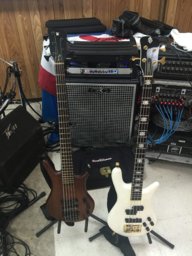
Could be. I think that's why the Rebops tend to have a neck dive issue. The bridge was moved forward (compared to the bridge placement on the neck thru's) so the higher frets are easier to reach, but the headstock is that much farther away.
 
It's here!
legend 5 classic bough right here on the classifieds. big tip of the hat to fellow TBer cyclomatic. Great guy to work with.

Unfortunately, something happened to the finish on the neck. It wasn't present when the seller had it, which leads me to believe the bass sustained an injury during shipping (although how I don't know, he packed it REALLY well).
There's a rough patch on the G string side between frets 2 and 4. I don't notice it while playing, but I don't want it to become an issue.
So my question is; what kind of finish is used on the necks of the legend series? I'm taking the bass to a friend to get it set up soon and I'm gonna have him take a look at the neck.
Thanks in advance.
Edit: just realized the pic of the neck is a tad blurry. Sorry about that.
 
Status
Not open for further replies.