I used Allen keys as feeler gauges to adjust to Fender spec. It took very little tweaking after that.
Hey Steve, would you mind elaborating on what your mean by that?
Thanks.

TalkBass has been independent since 1998. Add your voice.
Create a free account to reply to discussions, view embedded media, and browse with fewer display ads.
Join free Log in
Want zero display ads or expanded classifieds tools? Compare plans.
I used Allen keys as feeler gauges to adjust to Fender spec. It took very little tweaking after that.

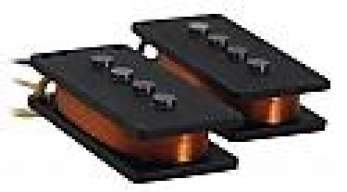
Fender specs in the bass setup manual call for various pickup heights, depending on whether you have vintage, noiseless or modern pickups. The suggested heights vary between 5 and 6/64ths on the treble side, and 7 to 8/64ths on the bass side.Hey Steve, would you mind elaborating on what your mean by that?
Thanks.

The truss rod operates by pulling the headstock back when tightened, countering string tension. If string tension is bowing the neck forward, tighten the rod.just one question: My bass neck is slightly to bowed, do i turn the trussrod clockwise or counter-clockwise to flatten it?
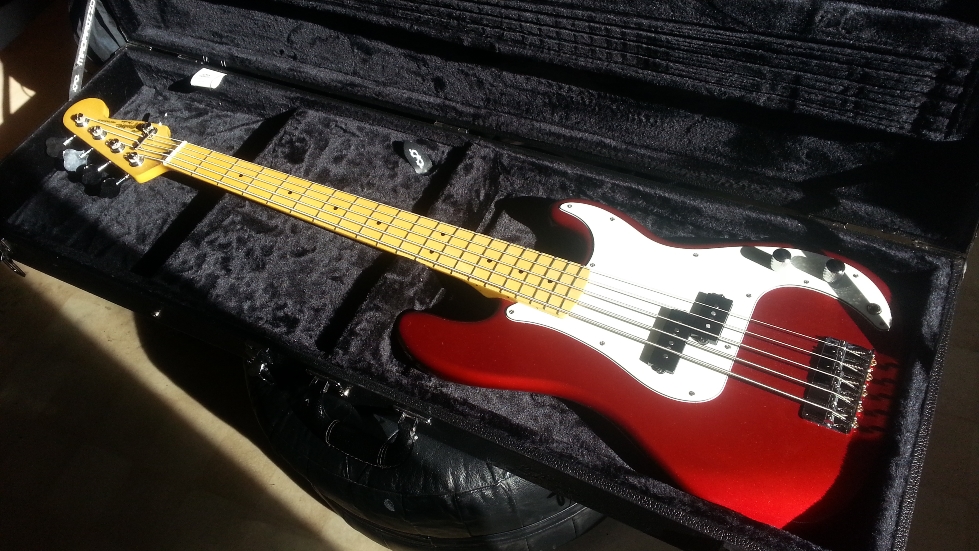
If the pickguard on the CAR models had been a bright white like it looks in your photo, I would have bought one in a heartbeat.I saw mine sitting in the sun and she's so pretty I had to take a few pics. Her first spring <3
If the pickguard on the CAR models had been a bright white like it looks in your photo, I would have bought one in a heartbeat.
Unfortunately, I don't like mint over CAR...
My bad, I meant parchment. I've edited my original post accordingly.Mint, huh? I can't really see that, but then again my experience with whitish pickguards is extremely limited.

Fender specs in the bass setup manual call for various pickup heights, depending on whether you have vintage, noiseless or modern pickups. The suggested heights vary between 5 and 6/64ths on the treble side, and 7 to 8/64ths on the bass side.
You're supposed to measure by fretting the string at the the last fret, and then measuring between the underside of the string and the pickup poles.
Measurement geeks probably use automotive feeler gauges, but I find a get a pretty nice approximation by using a hex key set. I also use them to measure the action height, although I usually break down and bring out a feeler gauge for setting the neck relief.
The process is pretty simple. I lay a hex key (Allen wrench) across the top of the pole pieces. The I fret the string at the last fret with my left hand, and use my right hand to tap on the string, directly over the hex key.
If there's enough play that the string clicks as I press it down, then I need to raise the pickup on that side. If it stays down because of the magnetic attraction of the pickup, then I'm pretty close. If the key is trying to push the string up off the fretboard, then the pickup is too high.
Once I have the instrument to factory spec, I plug it into my audio interface, and use the VU meters in my DAW to check the relative levels of each string. I may run the pickups closer or further away on a given bass, depending on the tone I'm after, but I always want them as balanced as possible from string to string.
That way, if I plug into my amp and now the G string sounds thin, then I know it's a rig or EQ issue, because I've already proven that the pickup output is well balanced.
I think I made it sound more complex than it is in practice.I usually just set the pick-ups so that I have adequate but even volume across all strings.
My bad, I meant parchment. I've edited my original post accordingly.
That slight off-white cast spoils it for me.
Thanks guys!
My neck needed a quarter of turn to ne perfect!
It wasn't a back bow so i turn de truss rod clockwise.
Tomorrow i'll change de cap for a 0.1
Anyone here things the pickup is a little too bright?
 But I personally think it is good, I like brighter pickups, they give more tonal possibilities I believe. The strings will wear out and loose the brightness anyway.
I saw mine sitting in the sun and she's so pretty I had to take a few pics. Her first spring <3


Mine is on a bright side, yes
Mine is on a bright side, yes