
I just swapped the LM4250 for LT1128. Tonally they seem to be pretty close to me ears. The LT1128 is slightly hotter and seems to have slightly less highs. Other than that, it's hard for me to tell them apart.

TalkBass has been independent since 1998. Add your voice.
Create a free account to reply to discussions, view embedded media, and browse with fewer display ads.
Join free Log in
Want zero display ads or expanded classifieds tools? Compare plans.

I just swapped the LM4250 for LT1128. Tonally they seem to be pretty close to me ears. The LT1128 is slightly hotter and seems to have slightly less highs. Other than that, it's hard for me to tell them apart.
Yes, it's running at 18V. I definitely noticed a small dip in hi-mids compared to the LM4250. I recorded both so I could A-B the recordings. I can post them if anybody's interested.

I haven't seen the previous threads you referred to. What's the purpose of swapping the 2M2 resistors for 220K resistors? I haven't done this so that's probably the difference.
I haven't seen the previous threads you referred to. What's the purpose of swapping the 2M2 resistors for 220K resistors? I haven't done this so that's probably the difference.

As far as I can tell, it's not wired in the same way as normal volume pot so it'll behave differently in the circuit.
As it is, it sets the output impedance of the amp and the higher it gets the higher the potential for noise problems. Can't hurt to experiment though.
gonna try a 100K and see what I get. also I think the 220K pickup input resistor can be bumped up. gonna try a variable resistor to see what it sounds like at different values - 324K, 500K, 750K, 1M
As far as I can tell, it's not wired in the same way as normal volume pot so it'll behave differently in the circuit.
As it is, it sets the output impedance of the amp and the higher it gets the higher the potential for noise problems. Can't hurt to experiment though.
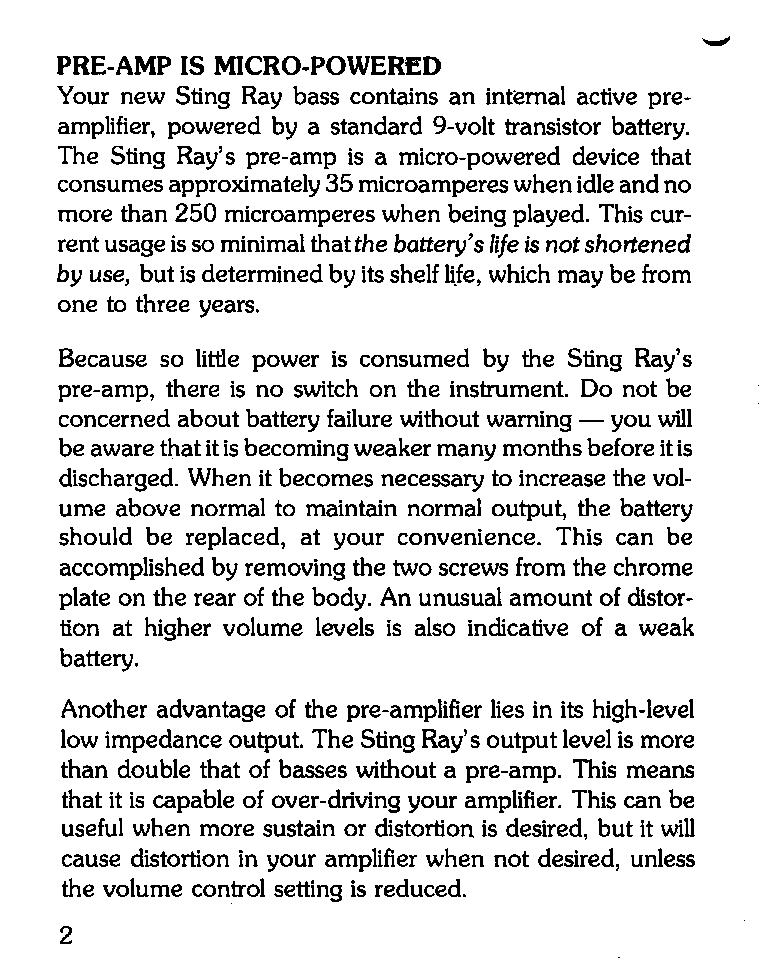
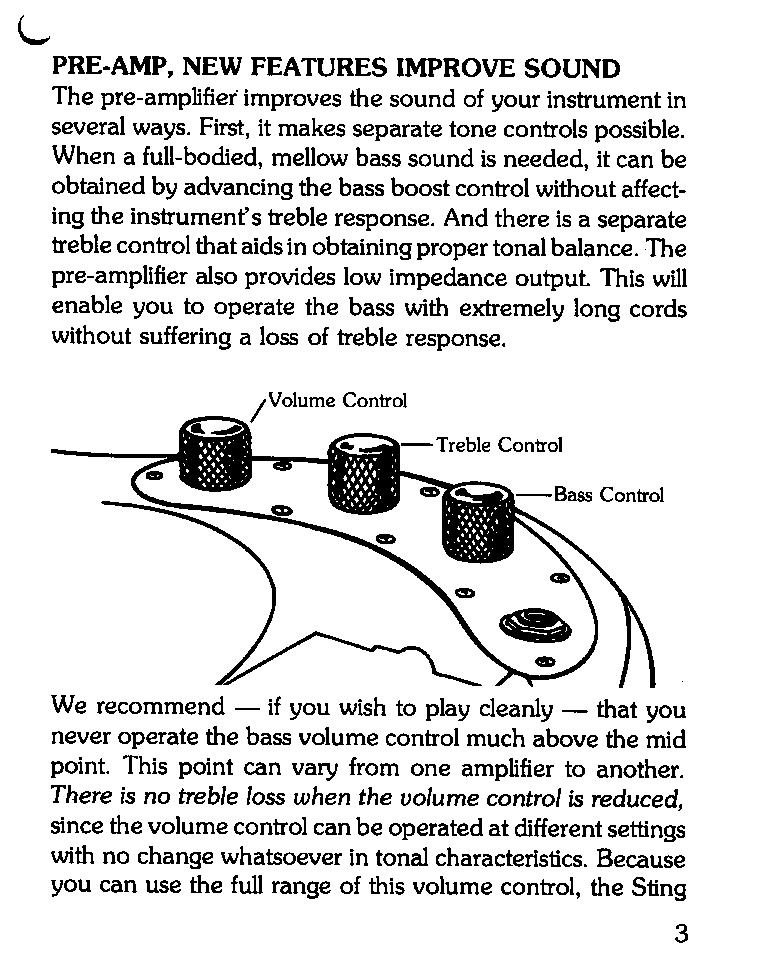
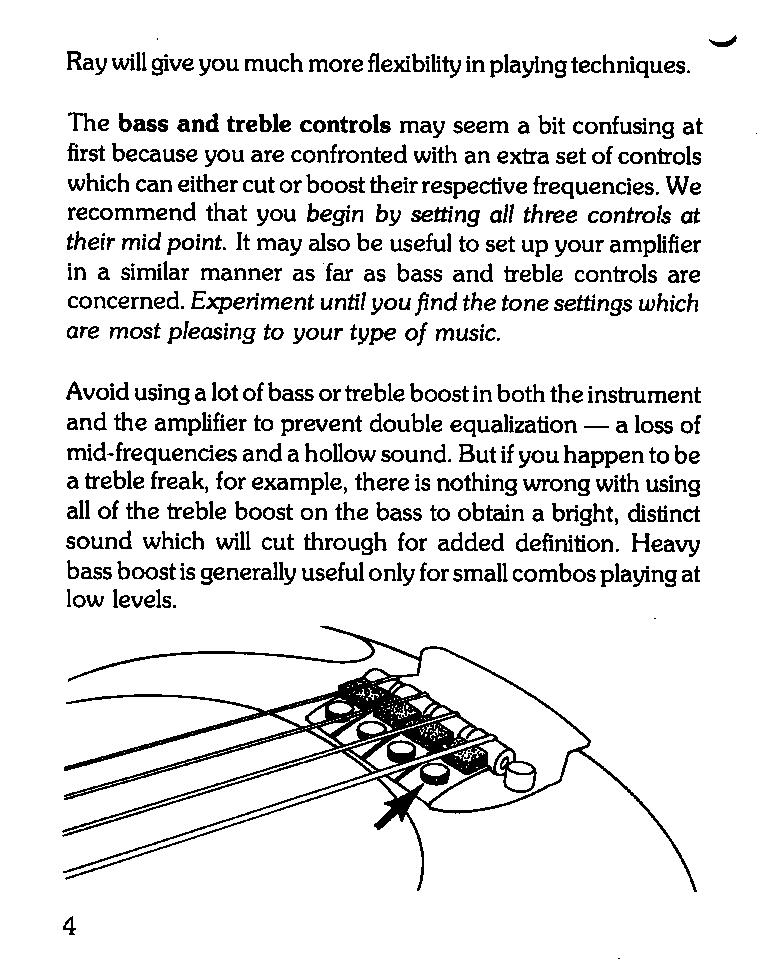
the original owner's manual is interesting. It suggested not to turn the volume past halfway if you want a clean signal. that must have been the days before padded amp inputs
chnaged the onboard volume pot to a 100K linear and a lot more signal is coming through. didn't notice any noise, might be due to the LT opamps I'm using. the signal is VERY hot. found a nice spot on the volume and it reads 35K on the DMM. anything above that would be way too much signal. decided to leave the 220K pickup input alone to keep the original design. sounds great!
Barry Klein:
You guys talk about the preamp and who designed it. I worked at Music Man in the 70's as Leo Fender's and Tom Walker's electronic technician. I worked in both the Music Man and CLF facilities. Leo was using an LM4250 op amp in a way it was not really intended for - but it did the job. He designed it by plugging in parts and strumming the 6 strings of his test bed neck. He spend DAYS doing that, driving everyone nuts.
It was never portrayed to me that Tom did the original preamp designs - but it would make sense as I could not believe Leo was designing with an op amp. But I suspect that Tom designed the ORIGINAL preamp, as since I started with Leo who was the one tweaking the guitar/bass preamps - not Tom. The use of the LM4250 for that preamp was kind of mindblowing too - everyone thought it was junk and not worthy of an instrument preamp. And God - he was using tantalum capacitors in the audio circuit!
Leo knew that circuit better than anyone, knew what component did what and tweaked that damn circuit until both Tom and I just about went nuts. Tom sent me over there to work with Leo to try and finalize a design one time. I tried to suggest a totally different circuit. He didn't like it much. Leo didn't hear too well (after years of playing "ding dong ding" full blast in his closed lab) and he boosted treble to really high levels. Leo wasn't very current at that time. That is why the Strat is so bright and the stingray guitars ungodly bright. I would not get all religious with the LM4250 op amp that Leo used. It has really lousy specs other than supply current. the op amp was replaced with an LF441 later on - which has much better specs. Maybe there is even something better available now... I haven't kept track of op amp improvements. I would think that the boost in slew rate with the LF441 would result in a better sound with less distortion artifacts. Even when we were just starting out guys would replace the opamp circuit with a JFET circuit that someone was selling at the time.

Finally got around to building one of these guys and it came out pretty good. I stuck it in an OLP to test it out and it sounds great.
Invalid Link Removed


The Rockfield MM5 says 4k. I don't have much knowledge about alnico vs ceramic or pickup wrapping. I'm still teaching myself, learning curve.
NSoldering is fun and easy when you have the [Invalid or Expired Link Removed] and the [Invalid or Expired Link Removed].


