• TalkBass has been independent since 1998. Add your voice.
    Create a free account to reply to discussions, view embedded media, and browse with fewer display ads.
    Join freeLog in
    Want zero display ads or expanded classifieds tools? Compare plans.

Stingray Classic Returns

Are you accounting for inflation? I'm to young to know the original prices as I would I've been ~7 years old. But do you remember what the retail price was for a new one back in 78?

Thank-you Mr. Sterling Ball! Wow! So much for trying for a little humor with a TB post.

Over the years, I've owned 7 Stingrays and USA Sterlings. Past tense verb, "owned". Now I play a 3 tone '62 Fender P Bass with a tort guard and carrot fretboard.

On the positive side. Congratulation to Music Man for introducing a very near exact replica of the original Stingray. This bass should make a lot of bass players happy.
 
I like the modern Stingray's truss rod adjust at the bottom of the neck.


Me too (great invention), but I much prefer the aesthetic of the Music Man bullet truss rod, and they're perfectly simple to adjust.

I've seen some luthiers question the logic of moving the point of adjustment further away from the part of the neck that the truss rod affects, writing the spoke wheel off as a gimmick - I probably don't understand the engineering concerns well enough to be concerned; if you're manually assisting the flex of the neck, and using the bullet / spoke wheel to hold it in place, I'm not sure it matters which end turns???

I like vintage features when they were actually the better solution, and only replaced over time for cost cutting reasons (the original mute bridge is a good example), or for re-branding / aesthetic reasons (the original / transition era MM logo vs the modern logo).

One of the major reasons I didn't buy a Fender Vintera 50's Precision recently, was the adherence to silly, inconvenient, and infuriating vintage features, such as a neck needs to be unbolted to adjust the truss rod, and reverse thread tuners.

I otherwise loved the bass, but those things annoyed me so much I ponied up for an American Professional II, which isn't afraid to acknowledge earlier design quirks, and improve the user experience, with a truss rod that can easily be adjusted in situ (with the supplied tool), a contoured neck heel, lightweight tuners, and a decent bridge.

There's still room for improvement (take a leaf out of Music Man's book, by adding a spoke wheel, and fully shaped contoured neck heel), but it's taken this long for them to make those kinds of subtle improvements to the P-bass, much like Ernie Ball did with the 1985 - 1987/8 StingRay.
 
  • Like
Reactions: bassdude51
Are you accounting for inflation? I'm to young to know the original prices as I would I've been ~7 years old. But do you remember what the retail price was for a new one back in 78?

I bought mine new in 1982 for £415 without a case (although I found the cardboard box in my parents attic a couple of months ago; Mum threw NOTHING away, EVER!) According to the Bank of England inflation calculator that equates to roughly £1,500 today.
 
Are you accounting for inflation? I'm to young to know the original prices as I would I've been ~7 years old. But do you remember what the retail price was for a new one back in 78?

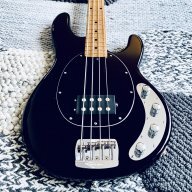
I recall getting my bass in the spring of ‘77 (it could have been ‘78, though). I’m not sure what the retail prices were back then; I got my bass at (or close to) wholesale. So that skews things, a bit. I recall paying $439 (maybe $479) for the bass with a hard case (probably a G&G case). I wish that I knew what I know now…….when I was younger!

I didn’t bond with that bass, though. The neck never felt comfortable in my left hand. Also, I don’t think the bass was ever set up properly; the action was too high. But, when I first put the Sabre bass into my left hand I was in heaven! The nut width on the Sabre was/is 1.5” and is where my comfort zone still is for my left hand. Leo must have used his Jazz Bass neck specs for the Sabre.
 
$3,200 seems a lot for something that reincarnates a number of the original design flaws and outdated features that have been consigned to the 'fixed' list over the years:
  • Original bridge geometry where the strings have to bend past the intonation screws;
  • Bullet truss adjustment;
  • 3-bolt neck joint;
  • 7.5" fingerboard radius.
Maybe these are features I have a personal dislike for, but IME they are all objectively inferior to later incarnations of the StingRay, up to and including the Special. I will concede it is nice to see the 2-band back on the cards but that is a more subjective preference - there is nothing objectively 'better' or 'worse' over the 3-band or the revoiced 'Special'. It is also nice to see the compensated nut being dropped, but again that is a personal preference.

But with all that said, is it my eyes or does the control plate here look out of alignment. I don't remember any StingRay model where the curves of the plate and body don't conform to each other:
upload_2023-11-1_16-58-25.png

I'd like to think it is part of the website 'mockup', but it also looks that way in these captures from the promo video. Maybe these are also CGI but I find it hard to believe such an obvious thing would get past any technical review. If this is an actual instrument, at $3,200 it is inexcusable, IMHO:
upload_2023-11-1_17-3-41.png

upload_2023-11-1_17-3-12.png
 
But with all that said, is it my eyes or does the control plate here look out of alignment. I don't remember any StingRay model where the curves of the plate and body don't conform to each other:
View attachment 5237550
I'd like to think it is part of the website 'mockup', but it also looks that way in these captures from the promo video. Maybe these are also CGI but I find it hard to believe such an obvious thing would get past any technical review. If this is an actual instrument, at $3,200 it is inexcusable, IMHO:
View attachment 5237553
View attachment 5237552
That’s really interesting, yes the control plate alignment does look off on all of these, is that how they were in the 70s?
 
I have both, and I'd say you did well for a straight trade!
In todays world you can find another 79 StingRay at a much lower price than a 64 Jazz is (~2.5 times lower).
My only issue is that the Ray was pristine, the 64 Jazz was paint stripped and I didn't get all the covers etc. BUT! It played and sounded great. More of a workhorse bass so I really have no idea of its value.
 
I have no issue with EBMM and own more than one of their guitars but they pay very low wages for the area on a whole. I have seen career postings on their site before and the Indeed salary page shows an average of $17 a hour for most of the production work.

I don't think this point is brought up often enough in the EBMM pricing discussions. It seems like the high costs of these instruments often gets almost exclusively attributed to the "living wage" in SLO we hear so much about.

...If EBMM needs to raise prices so their skilled craftsmen living in an expensive part of the country (median sold home price in San Luis Obispo County is around $825k) can make a living wage, I totally get it...
Think that's true? Because I'll definitely agree that it's expensive to run a business these days (in CA no doubt) and it's expensive to have employees. Make no mistake though, the Balls are running a for-profit business. They're not paying people assembling Stringrays the salaries sufficient to buy houses in SLO, are they?
 
Both the Sabre and the StingRay came standard with the same 1-5/8 neck, same profile. The 1.5" was an option, but it seems that way more Sabres were ordered with it, and very few Rays.

If I spitball a normal retail of $525 in 1977, that equates to $2700. Which is a little more than a standard StingRay Special and little less than a Retro today.
 
I wonder why interest in Musicman instruments, particularly the Stingray have declined in recent years.

When they came out in the 70s, they were sliced bread. The fact that Leo Fender designed them helped a lot.

Yet, here at Talkbass, Stingrays are either loved or hated.

And as I mentioned in another thread, you really don’t see bass players in new and current bands using them.

I wonder why.

Mike

they are mostly loved here. They are. Bass la
$3,200 seems a lot for something that reincarnates a number of the original design flaws and outdated features that have been consigned to the 'fixed' list over the years:
  • Original bridge geometry where the strings have to bend past the intonation screws;
  • Bullet truss adjustment;
  • 3-bolt neck joint;
  • 7.5" fingerboard radius.
Maybe these are features I have a personal dislike for, but IME they are all objectively inferior to later incarnations of the StingRay, up to and including the Special. I will concede it is nice to see the 2-band back on the cards but that is a more subjective preference - there is nothing objectively 'better' or 'worse' over the 3-band or the revoiced 'Special'. It is also nice to see the compensated nut being dropped, but again that is a personal preference.

But with all that said, is it my eyes or does the control plate here look out of alignment. I don't remember any StingRay model where the curves of the plate and body don't conform to each other:
View attachment 5237550
I'd like to think it is part of the website 'mockup', but it also looks that way in these captures from the promo video. Maybe these are also CGI but I find it hard to believe such an obvious thing would get past any technical review. If this is an actual instrument, at $3,200 it is inexcusable, IMHO:
View attachment 5237553
View attachment 5237552

Definitely looks off. The real ones on Sweetwater also have this "flaw." Real 70s Stingrays on reverb do not have this. I can't unsee it now!

zgztxix9xcspndvujyqy.jpg
 
Last edited:
  • Like
Reactions: LadyLoveStingRay5
Just wanted to add that it makes all the sense in the world to just look for a used Classic Stingray, which can be had in mint condition for under $2000 if you look for a month or two. Also comes in like 20 colors. If you must have a 100% accurate 70s recreation in full, than you have to pay this amount. This thread can go for 5000 pages and the price won't change. There's not much to debate.
 
I don't think this point is brought up often enough in the EBMM pricing discussions. It seems like the high costs of these instruments often gets almost exclusively attributed to the "living wage" in SLO we hear so much about.

Think that's true? Because I'll definitely agree that it's expensive to run a business these days (in CA no doubt) and it's expensive to have employees. Make no mistake though, the Balls are running a for-profit business. They're not paying people assembling Stringrays the salaries sufficient to buy houses in SLO, are they?

*does research*
I hesitate to use Glassdoor as a source of accurate salary information, but if it's even ballpark accurate then EBMM employees are chronically underpaid for their geographic region. That said, I have no idea what these types of jobs pay elsewhere. They're still a for-profit business and have other expenses that have likely increased. I'm not an economist, I was just quoting a point that someone made earlier and optimistically and perhaps naïvely hoping that the musical instrument manufacturing industry was more employee-centric than the industry I work in. :)
 
  • Like
Reactions: stockplus
Think that's true? Because I'll definitely agree that it's expensive to run a business these days (in CA no doubt) and it's expensive to have employees. Make no mistake though, the Balls are running a for-profit business. They're not paying people assembling Stringrays the salaries sufficient to buy houses in SLO, are they?

Based on what I see as the living wage in that area, EBMM pays well under it and much closer to the minimum wage. I am not trying to talk bad about their business practice because I know nothing about other perks they might offer. I also won't fault the cost of their instruments because I have no knowledge on the cost of manufacturing instruments. But based on the figures that are publicly available they pay well under what would be considered a living wage in that area and less then most advertised regional cashier jobs.
 
Sorry if it seemed like I was going after you specifically @TimBosby! Your original quoted point is a sentiment that I've seen echoed in many EBMM threads - and I think there is definitely a true component to it (i.e., higher wages = higher costs). Same goes for materials, supply chain, shipping, taxes, regulation...the list goes on and on and we're all living that reality. Basically, basses cost more because everything is more. And it sucks because, well, who doesn't want a less expensive bass?

But I do take issue with the idea, even if it's just a feeling or a casual belief, that EBMM is somehow doing people in their region a solid, bucking the trend of...well, by implication, other people not paying a living wage, or other musical instrument manufacturers not paying a living wage, or that it's harder to make a living in SLO unless you work at the Ball plant because they pay "well". Until somebody who works making instruments at EBMM steps forward and voices their opinion on their compensation, I reluctant to just take Big Poppa's word for it.

Full disclosure - I'm a huge Ernie Ball Music Man fan. I own several of the guitars and basses, EBMM and Sterling. I'm drooling over this new bass like most of you.

*does research*
I hesitate to use Glassdoor as a source of accurate salary information, but if it's even ballpark accurate then EBMM employees are chronically underpaid for their geographic region. That said, I have no idea what these types of jobs pay elsewhere. They're still a for-profit business and have other expenses that have likely increased. I'm not an economist, I was just quoting a point that someone made earlier and optimistically and perhaps naïvely hoping that the musical instrument manufacturing industry was more employee-centric than the industry I work in. :)
 
The Musicman Sterling 4 Classic was almost what you're describing. It had the through body mute bridge, 2 band preamp, plain nut, slab body, old style chrome battery cover and clip (more robust than the plastic flip out), but included the modern 6 bolt neck plate (not as good as the 5 bolt IMO), truss rod wheel and ceramic pickup.
TB member Bibby's Classics below:-
View attachment 5237187
(Talking of the plastic flip out battery boxes, has anyone else had a problem with getting brands other than Duracell to fit reliably?)
Yep. I have one.
 
I have no issue with EBMM and own more than one of their guitars but they pay very low wages for the area on a whole. I have seen career postings on their site before and the Indeed salary page shows an average of $17 a hour for most of the production work.

I don't think this point is brought up often enough in the EBMM pricing discussions. It seems like the high costs of these instruments often gets almost exclusively attributed to the "living wage" in SLO we hear so much about.


Think that's true? Because I'll definitely agree that it's expensive to run a business these days (in CA no doubt) and it's expensive to have employees. Make no mistake though, the Balls are running a for-profit business. They're not paying people assembling Stringrays the salaries sufficient to buy houses in SLO, are they?
I searched production jobs at EBMM. I found two listing wages: An “entry level” production position that pays $17/ hour and a “wood miller” position that pays up to $28/hour. This suggests that the mentioned average of $17/hour is not correct.