• TalkBass has been independent since 1998. Add your voice.
    Create a free account to reply to discussions, view embedded media, and browse with fewer display ads.
    Join freeLog in
    Want zero display ads or expanded classifieds tools? Compare plans.

Sunn 4x15 cab

I don't think the crossfire design is that bad . One of the only things wrong is that by the time you angle the baffles that much is that it doesn't leave much air behind the woofers for to tune for low end . The mids could be ok and the crossfire design would increase the dispersion from side to side but without any usable bottom end for bass guitar . But when you have a cabinet that big with four fifteen inch speakers you would think it would thunder and that one just won't . The Acoustic earlier in the thread was much more conservativly designed and worked way better .
Just my opinion .
A few people earlier alluded to the same thing but weren't given much credit .

This makes sense to me - it also explains why the 115BH, which is similarly angled, has decent bass response. A lot more room behind the woofer!

sfuw4mqhoc5xaqfaknnj.jpg

Sunn 115bh Black | Reverb
 
So I was looking at 4x12s at Reverb a when I found this old one from the 70's with a kind-of wedge or V shaped speaker baffle.
It makes a lot of sense to me, since it would have a more compact footprint (and would be easier to move, since you'd actually get your arms around it).
The question is how does that effect the sonic qualities? Does the sound waves get spread out when they cross, are they "funneled" straight out from the cab or do they "crash" into each other, making the cabinet less loud for the audience?

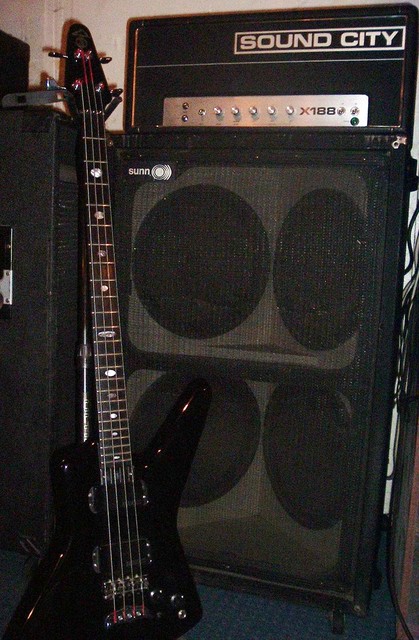
If this is the cab referred to, I have about 15 years first hand experience with it.
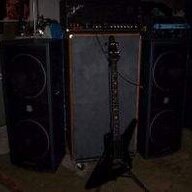
22395FF9-F450-4C70-A0AC-BC3F74BC835E.jpeg.jpg
D58EF3A4-8F1B-4DC2-A8C0-8B2A1A2321AB.jpeg.jpg

I purchased this new mid 70's with a Sunn Model T 150W head as a package.
For the remainder of the 70's, I used this Sunn amp for smaller pubs and paired with with a Marshall double stack for larger clubs.

In the early 80's, I used this cab with a Marshall model 2001 375W RMS Bass head as the cab was 400W at 4Ohms and reverted to the Sunn head after Marshall bought the 2001 back and discontinued the line.

In the 70's I used Gibsons with Picato black nylons exclusively. In the 80's I used Alembics exclusively.

I loved the sound of it and only down sized when my tours incorproated flights so the gear was all scaled back for size and weight. Would likely still be playing it today if I never sold it. It was a great amp for note definition when playing in the busy style of the day. Never boomy or loosing clarity with notes played up hight or low on the E string, including low power chords.
 
I still haven’t seen a clear answer regarding the cross-fire effect. Most all of you are lumping the cross-fire and the reduced cabinet volume together, and arriving at a negative assessment.

I think we all understand the effect of reduced cabinet volume. But if we set that aside, and concentrate solely on the cross-firing, what are the effects?

My layman’s belief is that the intersecting sound waves mingle and emerge intact. If so, the net effect is simply increased horizontal dispersion. But I’m not the expert. Who is?
 
They're fine, if all you want is something big with a wide spread of just presence in the room.

No low end, not much low mids. Plenty of mids, and upper mids.

A better cabinet in the Sunn line would be the 200s bottom. If you need something big and heavy to carry. At least it sounds better.

View attachment 5306862 View attachment 5306863

:)

A clone of this worked for me but, I was younger and stronger ;)! Today, a Rumble 100C is about all I can handle :help:...
 
  • Like
Reactions: DJ Bebop
I think many young people actually are taught to think for themselves -- but they're taught to think using their emotions rather than their intellect. And emotional thinking isn't exactly thinking, it's something else.
Well put.

I still haven’t seen a clear answer regarding the cross-fire effect. Most all of you are lumping the cross-fire and the reduced cabinet volume together, and arriving at a negative assessment.

I think we all understand the effect of reduced cabinet volume. But if we set that aside, and concentrate solely on the cross-firing, what are the effects?

My layman’s belief is that the intersecting sound waves mingle and emerge intact. If so, the net effect is simply increased horizontal dispersion. But I’m not the expert. Who is?
No, it’s the tradeoff of greatly reduced internal volume which I addressed when I described the trade offs. Also, the drivers of the day were pretty poor.
 
No, it’s the tradeoff of greatly reduced internal volume which I addressed when I described the trade offs. Also, the drivers of the day were pretty poor.

Okay then. So if we were to construct a cab with the correct internal volume, and using modern drivers arranged in the same cross-firing pattern, what are the physics behind the intersecting waves?
 
  • Like
Reactions: DJ Bebop
I seem to remember hearing one of these before.
QbF2TrS.jpg


Last week! Weather permitting, again tomorrow.

There's no disputing the science, but when it comes to what I think sounds good I tend to believe me over Internet strangers. Not much bass, but I wouldn't call it muddy. As used above, the sound is bright, twangy, and, like, totally gnarly.

I replaced the speakers with cheap Fenders when one of the originals blew. Higher power handling, and no significant difference in sound. No doubt you wouldn't get away with this in a modern cab, intelligently designed using T/S parameters and such.
 
I started with a Kustom 100 with a CTS 212 cabinet in 1970. But moved up to an Acoustic 370 with a 408 cabinet when I joined a band that was louder than my poor little Kustom could handle, that was around 1978.
I never tried all the other that are mentioned because...why? That Acoustic set up was as good as it gets...for me. But then I joined a very busy band where the band leader though the huge Acoustic foot print was too intimidating. After constant cajoling I relented and bought an Eden WT400/410xlt. But kept and occasionally played the Acoustic set up.

I sold the Acoustic set up along with a whole bunch of glorious and outdated band stuff in 2020 when I retired.

So what about that 408 design with two 15's points out and two opposing each other in a port? Man that thing was a beast but was it efficient?
 
Me too, since I was really into Sunn gear and still have some. The 415M was not Sunn's finest hour. IMO, from distant memory, it didn't sound nearly as good as any of the Sunn 215 cabinets. Possibly louder, but crummy.
I agree. I still have my Sunn Sorado cab that I loaded with EVM's. I still used it from time to time. I sounds great powered with my Ampeg pf500.
 
Okay then. So if we were to construct a cab with the correct internal volume, and using modern drivers arranged in the same cross-firing pattern, what are the physics behind the intersecting waves?

Nothing of great concern or impact, sound waves intersect all the time. As long as the path lengths and arrival times are coherent where the signal sums, there’s no negative impact.

FWIW, I think the Genzler Bass Array is much more efficient way to achieve the same objective.

A far more elegant solution without the LF penalties and much lower distortion in the upper midrange. This is an extreme example of evolution.
 
Cool, so to summarizes 5 pages of faff, no one should ever bother using old funky stuff, and anyone in the market for a new cabinet should just buy whatever the latest offerings from Mesa Boogie or Genzler are.

Maybe we should just close the forum and sticky a post that says that? Oh, and it should also have links to college level courses in acoustic physics and electrical engineering.

I mean, no other topic warrants discussion, right? (Although apparently they do warrant plenty of bickering...)