• TalkBass has been independent since 1998. Add your voice.
    Create a free account to reply to discussions, view embedded media, and browse with fewer display ads.
    Join freeLog in
    Want zero display ads or expanded classifieds tools? Compare plans.

Double Bass The Alsatian Queen Rises from the Dead

I love that maple. I almost went that maple route but decided for a toned down matching the fingerboard look kind of thing.

Oh I also noticed a significant difference in tone and note length with my bow quiver hanging there now where before it didn't make any difference. Now I have to make a bow stand and carry yet another thing to my gigs.

Phil, I was digging your cherry ...you know what I mean.

Yep, blessing and a curse. I have a really hard time using a bow quiver now that I know how a bass can sound when unencumbered. I might put it on for a show or something if I know that I need it for the night, but I don't keep it on there normally any more. And I'm in the process of replacing my full circle for the same reason (hopefully). I just don't want to be committed to having anything hanging on there that doesn't absolutely belong. I never cared before and it didn't matter before my set up was what it is because the bass wasn't really singing anyway.

On picking the wood, I'll let Jake answer his own question, but here's how it went for me.

Me: I want ebony.
Jake: Okay, come on up and look at everything I have, I've got lots of woods.
Me: ...including ebony, right? Because I want ebony.
Jake: Yep, I've got ebony, we'll check a few things out when you're here.
Me: Great. Ebony.

Then I went up and we played my bass a bit and told Jake what was making me unhappy. He did his witchdoctor thing where he danced around it barefoot thumping on various places and saying things like "Your C-bout if a semi-tone flat! Can you hear that?" (no, I can't) then he starting pulling wood down and we starting whacking it with a drum stick. Turns out that wood has musical qualities to it and hitting ebony is similar to hitting a piece of concrete wrapped in a quilt. Every variety and every piece of wood has it's own character. Then through the process of shaping it just so, that character and the tone get refined to what is right for your bass. The result for me was staggering.

 
Way into string dork now. Oliv D/G, Spiro Mittel A Stark E. Sounds great at home. I played a last minute pickup gig last night...(I know, I can't leave it alone). Acoustic only with a guitarist (woos had an amp I kept having him turn down). Great sounding old tin ceiling room. My bass carried great. The Oliv G was a stud so I thought I'd go with the D too.

I'm doing a couple more of those all acoustic gigs in the next couple months. I'll see how this mix works for that. I may just try to make my amp sound work with that if it's good. I love the feel of the Oliv strings. Gutty but they bow better than gut with only a slight loss of power from the steel under the bow. Loosing the Mittel D drops the tension back well below a Mittel set even with the Stark E which the bass seems to like a little better, as do my hands.
 
That Olive G is really something. I've tried to replace it but other strings but they just pale in comparison. The tuning issues are manageable as I've gotten into a routine of correcting it midway through the first set and it holds the rest of the gig. Please share your thoughts on the D when you can.
 
That Olive G is really something. I've tried to replace it but other strings but they just pale in comparison. The tuning issues are manageable as I've gotten into a routine of correcting it midway through the first set and it holds the rest of the gig. Please share your thoughts on the D when you can.
I wrote quite a bit about it early this year. Here. In a nutshell I found it thunky like a Gut D but easier for arco. I had tuning problems with them. It doesn't cut like a spirocore but doesn't buzz like one either. It doesn't get as loud on my bass as a spirocore but in other ways it projects into the room better because of the gut core. The lower tension is nice on my hands.

I bailed on it before to try to make my amplified sound easier to deal with. Spiros have a really great punch to the front of a note that amplifies well. Spirocores are easy for me to amp going in and out of lots of different gigs. Lately I'm doing way less of that so I'm experimenting. I found the Oliv and the Spiros out of balance through the amp. Off the bass they are pretty good.

I'll keep posting about that as I mess around with them.

This is my half step into gut again. I'm not really ready to go all the way back there just now but its been eating at me a bit.
 
That is elegant. Beautifully done!

Jake, how did you go about picking the wood? What were your thoughts on the component's mass/density, if any?

Uncletoad, congratulations! Talk about a cloud with a silver lining...

Well as you know I believe in mode matching, making the tailpiece assembly and the fingerboard extension vibrate at the same frequency. That almost always involves lightening the tailpiece to lower its frequency and as I go through the on-the-bass/off-the-bass routine the sound of the instrument changes. The Queen's tailpiece ended up at 116 grams.

When I remove a 350 gram ebony tailpiece and replace it with my 125 gram maple test tailpiece there is an instant improvement in tone - more detail and definition, a broader overtone series, more 'air' in the sound, more presence. Although I've never installed one, I'd think the Marvin is an extension of this idea though you couldn't mode match with one.

With Troy's bass and Al's too, I was able to mode match completely and the basses really found their true voices. With Phil's bass being so far away, I did some guessing based on the previous after-lengths, the dimensions of the instrument and maybe a little 'witch doctoring'! ;)
 
Well as you know I believe in mode matching, making the tailpiece assembly and the fingerboard extension vibrate at the same frequency. That almost always involves lightening the tailpiece to lower its frequency and as I go through the on-the-bass/off-the-bass routine the sound of the instrument changes. The Queen's tailpiece ended up at 116 grams.

When I remove a 350 gram ebony tailpiece and replace it with my 125 gram maple test tailpiece there is an instant improvement in tone - more detail and definition, a broader overtone series, more 'air' in the sound, more presence. Although I've never installed one, I'd think the Marvin is an extension of this idea though you couldn't mode match with one.

Just curious: what advantages (if any) in your opinion might be gained by adding a heavier tailpiece to a bass that feels a bit too resonant?
 
Just curious: what advantages (if any) in your opinion might be gained by adding a heavier tailpiece to a bass that feels a bit too resonant?

Nobody's ever asked me to 'restrain' their bass except for some rockabilly/blues players who perform at crazy volumes.

Do you have a specific problem/bass in mind? If you want to describe the situation to me I'd be happy to speculate! ;)
 
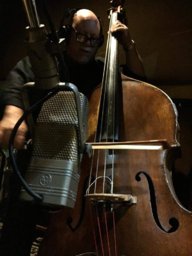
Maybe it's time to mess with using a mic too! The Sennheiser 441 might be interesting......;) Just a suggestion from the peanut gallery over here.:)
Not a bad idea. Do you put that fat heavy thing on a stand in front of the bass? I use an old Sennheiser MD409 that sounds ok but not great. It suspends between the bridge though in a way that is very easy to use.

In fact now that you mention it, that solves my output jack problem!

Pics to come...
 
Well, it's contraindicated here in terms of the discussion about tailpiece materials/density......but gently placing it underneath the tailpiece wrapped in the lightest foam possible works very well. When you are done amplifying the bass, it's easily gone.
 
Not a bad idea. Do you put that fat heavy thing on a stand in front of the bass? I use an old Sennheiser MD409 that sounds ok but not great. It suspends between the bridge though in a way that is very easy to use.

In fact now that you mention it, that solves my output jack problem!

Pics to come...

The ATM350 clips into the f-hole and does a very good job. I have to say that I've only ever used it into the PA, never into an amplifier. That being said, an ATM350 into a Mackie SRM450 would work very well...
 
Doesn't removing mass raise the resonant frequency?


Please explain, because perhaps I'm missing something here. According to this (quoted below), every other source I could find, and my own education, increasing mass lowers the resonant frequency of an object while removing mass raises the resonant frequency.

The resonant frequency of an object (or system) is the frequency at which the system will vibrate if it is excited by a single pulse. As an example, consider a diving board. When a diver bounces on the end of the board and commences a dive, the board will continue to vibrate up and down after the diver has left it. The frequency at which the board vibrates is it’s resonant frequency, also known as it’s natural frequency. Another example is a tuning fork. When struck, a tuning fork "rings" at it’s resonant frequency. The legs of the fork have been carefully manufactured so as to locate their resonant frequency at exactly the acoustic frequency at which the fork should ring.

The resonant frequency of a system (symbolized "ω n", pronounced "omega-sub-n") is determined by both the mass properties and the elasticity properties of the system.

If you increase the mass property or decrease the elasticity property of a system, the resonant frequency will decrease according to the relationship:
ωn = √(k/m)

where "k" is the appropriate elasticity value (spring rate) and "m" is the appropriate mass value.
 
When I carve wood off the tailpiece, the note of the assembly goes lower - when I carve wood off a bassbar, the note goes lower - when I carve wood off a top or back brace on a guitar, the note goes lower. That's all the explanation I've got. ;)

What happens when you file material off the legs of your tuning fork or your diving board?
 
When I carve wood off the tailpiece, the note of the assembly goes lower - when I carve wood off a bassbar, the note goes lower - when I carve wood off a top or back brace on a guitar, the note goes lower. That's all the explanation I've got. ;)

What happens when you file material off the legs of your tuning fork or your diving board?

Thanks. When you file material off the diving board or tuning fork, the resonant frequency goes up. Maybe it's in the "note of assembly." What exactly is that? Just trying to understand how it works. :)
 
sorry to turn this thread into a tailpiece duscussion, but... i have a bass with a weaker upper register. the tone is nice but the volume of the upper register on the g string is weak. the bass has one of those overbuilt kolstein tailpiece contraptions. would getting a lighter tailpiece help the situation?
 

Latest posts