
Enjoy the benefits of a premium membership!
Upgrade Account
-
TalkBass has been independent since 1998. Add your voice.
Create a free account to reply to discussions, view embedded media, and browse with fewer display ads.
Join free Log in
Want zero display ads or expanded classifieds tools? Compare plans.
You are using an out of date browser. It may not display this or other websites correctly.
You should upgrade or use an alternative browser.
You should upgrade or use an alternative browser.
The basic flaw in the p-bass
- Thread starter Ric5
- Start date
More options
Who Replied?
My P doesn't have a treble knob. Problem solved.
This is how I roll as well.
Anybody have L and R values of a typical series connected P pickup pair? Then I can do a detail sim with the typical 47nF of P tone control later. Otherwise I'll just use my measured values of a G&L MFD. At any rate the hump will be moderate (low Q from the series connection) and rather high in freq, in the mids or lower mids at best.

- Feb 16, 2008
- 21,240
- 23,633
- Disclosures
- John K Custom Basses
Anybody have L and R values of a typical series connected P pickup pair? Then I can do a detail sim with the typical 47nF of P tone control later. Otherwise I'll just use my measured values of a G&L MFD. At any rate the hump will be moderate (low Q from the series connection) and rather high in freq, in the mids or lower mids at best.
they're typically:
DC resistance: 10.5k -11k ohms
Inductance: 6.4 henries
It's the whole circuit working together. It probably varies if you change any component of the circuit. The cap is retuning the pickup within the rest of the circuit.
This. I got woken up and reading this now.. Much more accurate than what I wrote. Good job.
I'm learning something, this thread took a turn for the better.
I'll be driving through Maple Ridge in about 8 hours on my way to play golf at Sandpiper in Harrison Mills.
Dude! What time you coming by? I'm awake again... Wife dealing with kid who won't sleep... I have to get up for work in an hour and a half... LoL.
Don

Or grown bored & moved on with their lives?Seriously, this thread entered dead horse territory pages ago.
This thread turned interesting and informative.

I don't like hamburgers because when you put ketchup on them there's less beef.
+1
that actually handles this tone knob debate quite nicely.
(im on pg 9, but I just had to comment..cuz that was a pretty good analogy)

k..off to get popcorn, & finish the read.

.
The basic flaw in the p-bass
Quote from John Entwistle ... “Once you turn up the treble on a Precision, the bottom drops out.” “In big arenas, I wasn’t getting enough bottom end from the P-Basses when I had the treble all the way up.”
I re-discovered this last weekend ... I went to an outdoor party and our band played and some others as well. In my band one of the guitar players is also a bass player. I brought 3 basses and he brought a guitar and a bass. So at the end I plug in his p-bass with flats. He has always bragged about the low end from this bass. So I plug it into my Rig. An Ampeg with 2 2x10 cabs and a line out into the PA, and I turn up both knobs and to my surprise the was very little low end, just a lot of midrange plunky noise and clicks and fret buzz.
The basses that I had were a 5 string Rickenbacker a 5 string jazz with a stingray pickup in the bridge and a frankensteined 2 pickup SG bass also with 5 strings. All 3 of these basses had more bottom than the Fender p-bass with flats.
Looks like someone doesn't know how to work a Precision. Too bad for you, dude.

Hopkins
Commercial User
Hm, the critics have gone silent
No, I just went to bed.
I listened to your recording with headphones, and I hear what you are saying. I will still contend that its not a boost. That frequency is cut during all points of the sweep instead of that one. It is also very subtle, and would make little difference to me in a live setting.

I tried really hard to hear it. I even tried it myself this morning.
IF there's a slight peak at a certain frequency, I still don't know if it's a boost. And I'm still not convinced it would actually be useable when playing.
I dunno though.. I could be wrong. Wouldn't be the first time.
IF there's a slight peak at a certain frequency, I still don't know if it's a boost. And I'm still not convinced it would actually be useable when playing.
I dunno though.. I could be wrong. Wouldn't be the first time.

ASK NOT FOR WHOM THE BELL TROLLS
IT TROLLS FOR P
omg, I just died of laughter now
The Precision bass flaw? The neck being too long. Fender should offer a P bass with a Rickenbacker 4001 scale length. Dead spots be gone.
You could always get your hands on an E-series 32" Precision (MIJ, 84-87). They're pretty cool.
Lowbrow said:ASK NOT FOR WHOM THE BELL TROLLS
IT TROLLS FOR P
Almost spit out my morning coffee! Hilarious!

there's a slight to moderate bump at the pickup's resonant frequency. this chart shows what generally happens with a passive tone control with passive pickups (with different cap values rolled off). of course, each pickup's wind and resonant frequency will differ.:
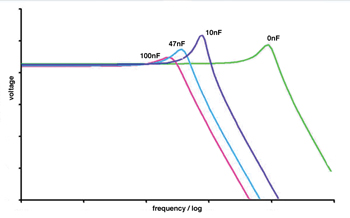
THIS is the best part of this long, quite ridiculous thread. Science!
Honestly, anything that can be said about the bottom "dropping out" is mostly psychoacoustics - and that goes for really any passive bass, not just a P. Furthermore, I've never played a P (or at least a Fender P) that was weak on the low end at any point. I've played ones with different midrange and treble qualities, but they've all had a really solid & powerful low end, even with the tone on fully.
Ric5 has expressed opinions on Ps (and pretty much everything else I've seen, including Js, MMs, Rics, Peaveys...) pretty often and concisely. That's fine that he doesn't like Ps (and perhaps he played a lousy one that his friend had), but I'm pretty sure we all knew this was a troll/flame thread once he said this:
Hell no ... Playing a 4 string p-bass with flats for me is like having to clean the bathroom floor in the bar with my tongue and then eating chards of broken glass ...
Way to go, Ric5.
 Plus for the record, I haven't seen any P fan here act nearly as crazy as the diehard "us against the world" Ric fans, or haters for that matter. The P bass does have a dead spot on the 7th fret of the G string. I still love mine though, and that's the only thing I've found wrong with my Ps thus far.
No, I just went to bed.
I listened to your recording with headphones, and I hear what you are saying. I will still contend that its not a boost. That frequency is cut during all points of the sweep instead of that one. It is also very subtle, and would make little difference to me in a live setting.
It's a perfectly audible difference and only happens at the last portion of the sweep (I was not using the whole range of the knob). Anyway, when did I say it was useful live? I think it is but my point was IT HAPPENS, you all said no it can't. Johnk's chart shows it can indeed be called a boost of certain frequencies.
I tried really hard to hear it. I even tried it myself this morning.
IF there's a slight peak at a certain frequency, I still don't know if it's a boost. And I'm still not convinced it would actually be useable when playing.
I dunno though.. I could be wrong. Wouldn't be the first time.
If you can't hear it on my recording you should get your ears checked. Your bass could be more or less subtle than mine. Anyway as I said in the last post when did I ever say how vital this is live? My point was merely that it does happen. I do use it live rarely but I hardly think everyone should. The main point is the dogma that tone controls ONLY remove treble and do nothing more is wrong.
No, I heard what you're talking about. It's just so subtle, to the point where I don't know if I'd even consider significant enough to use while jamming alone, let alone to add any kind of lower/mid boost while playing with a band.

This could be as simple to fix as a tone pot replacement. The Greasebucket tone circuit gives the illusion of less bass being "added" when you roll it off. It's okay to Mod a bass for a tonal range that suits your taste. Either way the P-Bass is a great place to start for Great Booming Low end. You always have to change EQ from Bass to Bass. You cannot judge one compared to another with the same EQ settings. It just doesn't work that way. Although My Hartke LH1000 gets pretty much the same EQ setting for all my basses and I can get "MY" tone with minor tweaking of the tone knobs.
Hopkins
Commercial User
It's a perfectly audible difference and only happens at the last portion of the sweep (I was not using the whole range of the knob). Anyway, when did I say it was useful live? I think it is but my point was IT HAPPENS, you all said no it can't. Johnk's chart shows it can indeed be called a boost of certain frequencies.
I still cant call it a "boost." maybe at that one position of that knob that certain mid frequency is un choaked, giving a slight bump in percived volume.
I trust the chart JohnK posted and I dont doubt it is possible. But its something I never notice because I never roll my highs off that much, and its very subtle.


