• TalkBass has been independent since 1998. Add your voice.
    Create a free account to reply to discussions, view embedded media, and browse with fewer display ads.
    Join freeLog in
    Want zero display ads or expanded classifieds tools? Compare plans.

The Rickenbacker Club Part Five

Status
Not open for further replies.
you might be surprised...I was but it does not come up much here. Now back to Rickenbackers... :)

Back to Ricks: My 1975 has a couple of dull/dead frets on the D and G strings. Any easy fix here? I'm using flatwounds. I had a similar problem on my 1971 Fender Jazz and the tech said he "glued" the frets - and it did seem to work.
Thoughts anyone?
 
Back to Ricks: My 1975 has a couple of dull/dead frets on the D and G strings. Any easy fix here? I'm using flatwounds. I had a similar problem on my 1971 Fender Jazz and the tech said he "glued" the frets - and it did seem to work.
Thoughts anyone?


If I had a dollar for every post like this. ALL wood products, (yes, even Music Man) has "dead spots". Rickenbacker are no different, although they far exceed other brands in quality. Over on the Ric forum they have discussions on this. Mr. Hall recommends a tweaking of the truss rods.

There is a great "resonance" study on guitars and the wood properties on the internet. Try a search on this. It shows a Strat guitar and all the different strong notes and weaker ones as well.
 
If I had a dollar for every post like this. ALL wood products, (yes, even Music Man) has "dead spots". Rickenbacker are no different, although they far exceed other brands in quality. Over on the Ric forum they have discussions on this. Mr. Hall recommends a tweaking of the truss rods.

There is a great "resonance" study on guitars and the wood properties on the internet. Try a search on this. It shows a Strat guitar and all the different strong notes and weaker ones as well.

Agreed. That's why you play/buy instruments made of wood - because each one is different. No two pieces of wood will be the same. No hand laid fret will be exactly the same. No density will be exactly the same. And, the old saying: "You take the good with the bad" is totally true. If the good outweighs the bad, you are ahead.

I also believe in the Jack White approach and learn my instruments' strengths and weaknesses. On my Jazz bass, the first fret on the A string has a little buzz. So, I tend to play my Bb on the E string. I shouldn't have to, and frankly it's barely noticable (the buzz) but I've adjusted.
 
If we're talking about dead spots the best thing I have found is to give the instrument a good setup and see if that helps... that's about all you can do besides change the string. My 2008 4003FL had a bad one for a year and a half and now...? It's gone.

I have found that a neck that is more stable is less prone to dead spots, i.e. multi-laminate, thicker, or having those old school truss rods that lock the neck in place instead of adjusting it directly. My two-piece neck 4003 and three-piece neck/old style truss rods 4001FL do not have any dead spots I can hear. My 2007 4003 doesn't either and it's got the biggest neck of the bunch ("medium" size, similar to a modern P Bass I guess).
 
I had "dead" notes on my 71 Fender Jazz bass: the 2nd, 3rd, and 4th frets on the G string. A tech "glued" (so he said) the frets and it seems to have greatly improved the sound. Has anyone heard of this before?

I wonder how many dead spot thread are on here?...Hmmmm...a research project for me.

I have never heard of a tech "gluing" a fingerboard to rid a bass of dead spots....then again, I was once a Republican and now I am a die hard Democrat.....so, stranger things have happened I guess?:hmm:
 
^^^ great points. My 08 MIA P and my 2010 Ric 4003 don't have buzz or deadspots.

All wood instruments have "dead spots" of some sort. You may not notice them as you may have very low output in these spots, but your basses do have them. I have probably owned over 20 basses of all kinds of brands and played hundreds over my career. Every one, when I checked, had some sort of dead spot....a better way to describe this to you would be.....say you play fourth fret down from nut, on the "a" string. Then you do the octave, on the "G" string, at the sixth fret on the "G" string.

There will be a noticeably "Dead" or "shortness" of tone or volume on the "G" string. This is not true on all basses, but this is a common area on most. Other basses will have different areas of tonality difference.

Now the difference of string mass also comes into play, however I have owned basses that the "E" string would have a matching shorter output depending on the resonance spot that would coincide with a smaller gauge string.

It is something that I have learned to accept and "play around" with. The majority of the noticeable dead spots are from the "G" string. I could "walk" up and down the neck of any bass, and quickly discover the dead spots.

I still am somewhat amazed at how often I see this topic discussed as it is such a common phenomena...but then I remember...I'm getting older and new bassists are just discovering this.

It sucks getting old......:bawl:
 
Jaymi,

Can I get a member number? I finally cured my RIC GAS!
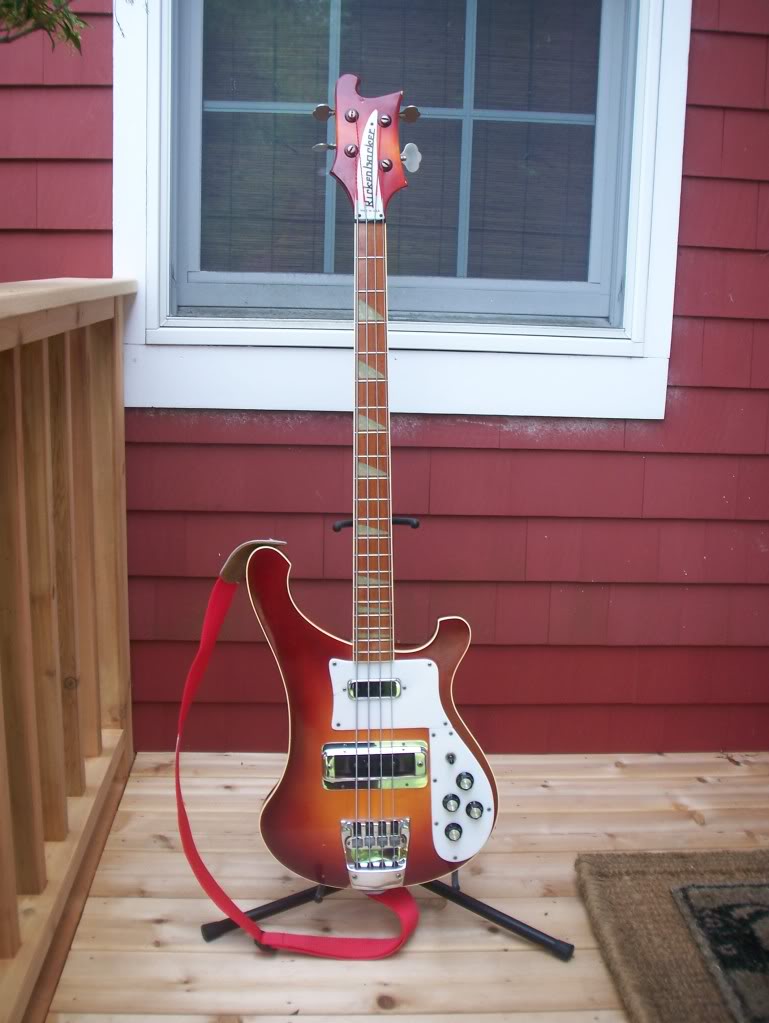
100_0915.jpg


Snagged my "new" 1981 4003 on CL yesterday for $700 and change!:D
 
Status
Not open for further replies.