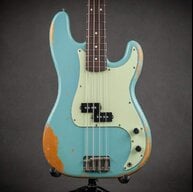
Keep us posted. When we identify an actual affordable source they can have my money for two pickguards.

TalkBass has been independent since 1998. Add your voice.
Create a free account to reply to discussions, view embedded media, and browse with fewer display ads.
Join free Log in
Want zero display ads or expanded classifieds tools? Compare plans.

Yes. See The Squier Mini Precision Bass Club.#aggravated
Just tried to put EB Slinky Nickel 100-45 on one of mine, and, the 100 came apart after starting to wind it on the post. Argh.
I just ordered a set of Mikro strings. I believe Volker has said that the first 3 strings fit.
Argh.

The short scale Chromes arrived this morning. The low E has a half wrap around the post and there's silk on the saddles but that doesn't seem to be a problem. They're definitely lower tension than the Fenders of the same gauge but finally this is a bass I can play. I hope I never have to touch roundwounds again, ewww.
With so many people playing Mustangs it's strange that there are so few short scale gauges. Even a 30" bass would benefit from thicker strings. Fender doesn't even make flats for short scales.
Still haven't pulled the trigger on nut files. On the one hand it's silly to spend so much money on tools I'll use maybe 5 times in my life. On the other hand I can't find a decent tech worth a dime over here. I know more from watching videos. My friends pay money to have their instrument set up (after I offered to do it for free and teach them too) and then I check it and something is off. Off my high horse now
~....With so many people playing Mustangs [etc], it's strange that there are so few short scale gauges.
Even a 30" bass would benefit from thicker strings.
Fender doesn't even make flats for short scales....
~I used Ibanez Mikro strings, which fit perfectly, except for the G, which was cut too short. For the G, I used a Stagg full size .045 nickel roundwound cut to length. This balances well with the Mikro strings.
View attachment 4037595
Note that Ibanez Mikro strings are NOT the same strings that come stock on a Mikro!
~
What strings DO come on an Ibanez Mikro bass, and how are they different from the a la carte ones ?
~

No one knows! All we know is that the strings sold as Ibanez Mikro brand are not the same as what Mikro basses are strung with at the factory.~
What strings DO come on an Ibanez Mikro bass, and how are they different from the a la carte ones ?
~
You're right about setting up. I want total control over my instrument and I can "have it back" right away. Techs have also tried to change my set up because they think they know better. Like the guy who told me Stratocaster bridges are not supposed to float...I told him "dude, I set it up and it stays in tune perfectly. I know more than you!"The ability to take total control over the setup of your bass, independently, is, IMHO, worth the investment in the nut files.
There are lots of hacks out there who would love to hack your bass while taking your money.
If you can find someone who will actually take the job in, and then, actually give you your bass back in the same year.
Or, you can enjoy doing it yourself, anytime, with instant results.
I'm not a traditionally handy guy. Lots of stuff in the house I pay someone else to do because it's generally outside of my comfort and knowledge zone. But I have really enjoyed learning about and setting up my basses myself. If I can do it, anyone can.
The ability to take total control over the setup of your bass, independently, is, IMHO, worth the investment in the nut files.
There are lots of hacks out there who would love to hack your bass while taking your money.
If you can find someone who will actually take the job in, and then, actually give you your bass back in the same year.
Or, you can enjoy doing it yourself, anytime, with instant results.
I'm not a traditionally handy guy. Lots of stuff in the house I pay someone else to do because it's generally outside of my comfort and knowledge zone. But I have really enjoyed learning about and setting up my basses myself. If I can do it, anyone can.
I bought the Mini thinking I might have to do extensive work to make it playable. Turns out it was good to go but it's a great learning platform before you mess up your nice guitarsYou convinced me to get nut files. Remembering your wiring issues, I do also recommend anyone to get some heatshrink tubing, good pliers/cutters a soldering iron and to learn a bit about instrument electronics. For starters, this short lesson on StewMac is pretty cool for the newbie.

Have you noticed a difference after shielding it with copper tape? Mine is totally silent as it is with the (I guess) shielding paint. Another job I thought would be necessary but isn't.
Later my Mikro strings will arrive and I will Volkerize one of my Basses.
Great job.
Later my Mikro strings will arrive and I will Volkerize one of my Basses.
Will report results tonight.
*facepalm*“Volkerize” - the process needed a proper name.
Have you noticed a difference after shielding it with copper tape? Mine is totally silent as it is with the (I guess) shielding paint. Another job I thought would be necessary but isn't.