• TalkBass has been independent since 1998. Add your voice.
    Create a free account to reply to discussions, view embedded media, and browse with fewer display ads.
    Join freeLog in
    Want zero display ads or expanded classifieds tools? Compare plans.

The Trace Elliot V-type Club!!

There's no rule that says tube amps work "better" through sealed cabs. If anything, you're losing low end using a sealed cab since ports allow for more air flow.

You might want to investigate damping factors and the design of loudspeakers before you rush to conclusions. The frequency response of a loudspeaker system hasn’t got anything to do with “more air flow”. Ported cabinets are not superior to infinite baffle designs, they just have different design goals.

But, sealed cabinets indisputably work better with tube amps, because of the inherent low damping factor of transformer output topology. Given the choice between a tube amp and a solid state amp on a ported cabinet, a solid state amp will be my first choice everytime. There are actual technical reasons why transient response is better, namely because an amplifier with a high damping factor will be able to control the movement of the driver motor assembly better.

A tube amp benefits from the air spring of a sealed cabinet to help control the cone. This is not to say that a tube amp and ported cab cannot sound great together. I’ve gigged that combination many times in the 25 years I’ve been playing bass on stage.
 
Last edited:
  • Like
Reactions: Bigbri
What's that you were saying? This is the cover of the 1995 Trace Elliot Catalogue:
View attachment 2766223
That's awesome pic, thanks. I'm so glad I found my V6. The msg had a pic of the back of one of those TE 4x12 cabs and had 8 ohm hand written as they always do for the serial #'s etc. My amp and every one I've seen has a 2 or 4 ohm switch. So, why the 8 ohm cab?
You might want to investigate damping factors and the design of loudspeakers before you rush to conclusions. The frequency response of a loudspeaker system hasn’t got anything to do with “more air flow”. Ported cabinets are not superior to infinite baffle designs, they just have different design goals.

But, sealed cabinets indisputably work better with tube amps, because of the inherent low damping factor of transformer output topology. Given the choice between a tube amp and a solid state amp on a ported cabinet, a solid state amp will be my first choice everytime. There are actual technical reasons why transient response is better, namely because an amplifier with a high damping factor will be able to control the movement of the driver motor assembly better.

A tube amp benefits from the air spring of a sealed cabinet to help control the cone. This is not to say that a tube amp and ported cab cannot sound great together. I’ve gigged that combination many times in the 25 years I’ve been playing bass on stage.
Maby that's why the Ampeg SVT 810 comes with a sealed cab. I had always wondered why that was. Is the Stock 4x12 with the v4,6,8 a sealed cab? Let me know if you want to sell yours.
My comment about the ohms was on the back of one of the 4
20170916_180245[1].jpg
x12 was labelled 8 ohms and the V amps only seem to run 2 or 4 ohms. So I commented that to run the v4-8 series amps one would need two of the 4x12's to get to 4 ohms, just as the girl in the add... and four of them to get to 2 ohms. Of course everything without a tube power amp would be ok.
Thanks for posting that add, do you have any more? This is my V6 I bought at an auction for pennies.
 
  • Like
Reactions: Devils playgrou
You might want to investigate damping factors and the design of loudspeakers before you rush to conclusions. The frequency response of a loudspeaker system hasn’t got anything to do with “more air flow”. Ported cabinets are not superior to infinite baffle designs, they just have different design goals.

But, sealed cabinets indisputably work better with tube amps, because of the inherent low damping factor of transformer output topology. Given the choice between a tube amp and a solid state amp on a ported cabinet, a solid state amp will be my first choice everytime. There are actual technical reasons why transient response is better, namely because an amplifier with a high damping factor will be able to control the movement of the driver motor assembly better.

A tube amp benefits from the air spring of a sealed cabinet to help control the cone. This is not to say that a tube amp and ported cab cannot sound great together. I’ve gigged that combination many times in the 25 years I’ve been playing bass on stage.

Do you own a V6 or a 600H or both?
 
My Trace Elliot bi-amped Rig Of Doom - V6 for low mids and up, 600H V-type driving the lows through my Accurgroove Whappo Grande 21" sub. ;) Excuse the mess, haven't been using the room much lately.
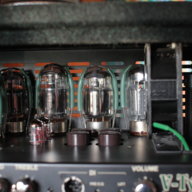
View attachment 2767666

Haven't taken any castles out with it, yet, but the neighbors do complain when their windows rattle in the frames!
I didn't realize there was such a size difference in the two heads. I've noticed that the earliest heads have the pointed black knobs. Then later the round silver ones which carried over to the MK II's. from what I've noticed, the first heads were the green vinyl V4's. These ran 8 ohms as the stock cabs were 8 ohms. When we first discussed the ohmage people were worried about using an 8 ohm cab because there is only a switch for 4 or 2 ohm on the back. Why no 8 option? People were actually calling in and asking about it not wanting to ruin their amps. Fact is it doesn't matter, it's just not ideal. I knew guys that swore by using their SVT's at 2 ohms. I found in small clubs using my SVT with a single EV15b at 8 ohms sounded fine. It was a very early blueline 1970 and never had a single problem. I replaced the tubes with GT's even though it wasn't necessary, and it still sounded the same. I sold it in 95 , so it ran everything btwn 2-8 ohms for 25 years and was still 100% original. I can't say the same for my 1969 B15N it's finally bit the dust and needs a rebuild. When I turn it on, and turn the volume up, I just get screaming feedback. Anyone know what that is? Caps, transformer?
 
I couldn't disagree more. Yes you're correct, on paper, the 600H is 600 watts and the V6 is rated at 400 watts. But 400 tube watts is going to be insanely louder and more powerful than a 600 watt mosfet amp. I also owned a V6 for many years and it was not only the loudest amp I've ever heard in my life, but it sounds insane through both ported and sealed cabs. Before that, I used a V type pre into a 2500 watt power amp and the V6 STILL destroyed it in both tone and volume. There's no rule that says tube amps work "better" through sealed cabs. If anything, you're losing low end using a sealed cab since ports allow for more air flow. I mean, I love how tube amps sound through sealed cabs, especially if I'm going for some super old school vibe, but my Epifani 2x15 (ported) sounded better than anything else with my V6 and I still use it in conjunction with my '63 B-15 top. If you're living your life under the assumption that tube amps don't sound amazing with ported cabs, you're missing out bro!
Considering the power output from 6-8 power tubes maybe the sealed cabs limit excessive excursion. Are the stock 4x12 cabs with the v's a sealed cab?. I think just about every other TE cab is ported. The b15's have always come with a ported 15 and is fairly loud for the wattage. I love mine, I want to find a matching one to use the two single ported 15 cabs with the V6.
SCAN0001.JPG
 
I would definitely put the 600H on the sub, since solid-state amps have a much higher damping factor. Tube amps do not really work as well with ported cabs as they do with sealed cabs. And the 600H is a 600 W power amp, whereas the V6 is rated for 300 W, if I recall correctly?
The V6 is rated at 400W, 800 peak. It's odd because the V8 is rated at 400 watts as well. 200W for the V4, you would think the v6 would be in between the two at 300W similar to the SVT with 6 power tubes.
 
Considering the power output from 6-8 power tubes maybe the sealed cabs limit excessive excursion. Are the stock 4x12 cabs with the v's a sealed cab?. I think just about every other TE cab is ported. The b15's have always come with a ported 15 and is fairly loud for the wattage. I love mine, I want to find a matching one to use the two single ported 15 cabs with the V6.

The 1248 and 1248H cabinets which were released with the V-Type 220 W Head in 1995 are sealed cabinets capable of handling 800 W of power.

I am not certain if later versions were wired as 4 Ohm cabinets, which you can get by running four 16 Ohm drivers in parallel, but the 1995 versions are four 8 Ohm drivers wired series/parallel like most guitar cabs, and are therefore 8 Ohms. I don't have the later catalogues that would show specifications after the V6, V8, and V4 were released, and I don't remember at this point what other cabinets were offered other than the standard Trace Elliot ported cabinets.

Incidentally, the original head is not the V4 Mk I, it is the "V-Type 220 W Head". The name V4 didn't exist until the V8 was released. British Audio Service has the PDF manual for the original V-Type series, which gives the proper names and specifications.
 
The V6 is rated at 400W, 800 peak. It's odd because the V8 is rated at 400 watts as well. 200W for the V4, you would think the v6 would be in between the two at 300W similar to the SVT with 6 power tubes.

There is some question as to whether or not the V6 actually puts out 400 W. In order to get to that level of power, you'd have to push each pair of KT88s to 133W each, which would require an extremely high B+ voltage. A pair of KT88s, according to the data sheets, can output 100 W in Class AB1, operating at 560 V.

They can output 150 W per pair in Class B, so I suppose if the V6 is actually driving the tubes into Class AB2 territory, it might be theoretically possible that the V6 is actually pushing 400 W, but I highly doubt it. The Genelex spec sheets say that KT88s are able to handle up to 800 V, and there are designs out there that specify 860 V or more, but I'm not so sure I'd trust those.

The only V6 schematic I've seen doesn't show the design B+ voltage level, but it can probably be calculated if I dropped the power supply design into a modeller. The transformer puts out 485 V, which is marked on the schematic.

The power supply designs for the QuattraValve, V-Type, V4, and V6 are all the same. Only the V8 is different, and it feeds 685 V or 690 V (it's given in two different places in the documentation) to the center tap of the output transformer, which seems sort of excessive for an amp that is only rated at 100 W per pair of tubes.

If we accept that the V-Type puts out 220 W, then it seems reasonable to suggest with the same power supply design that the V6 actually ought to be rated at 330 W.
 
Last edited:
  • Like
Reactions: Bigbri
There is some question as to whether or not the V6 actually puts out 400 W. In order to get to that level of power, you'd have to push each pair of KT88s to 133W each, which would require an extremely high B+ voltage. A pair of KT88s, according to the data sheets, can output 100 W in Class AB1, operating at 560 V.

They can output 150 W per pair in Class B, so I suppose if the V6 is actually driving the tubes into Class AB2 territory, it might be theoretically possible that the V6 is actually pushing 400 W, but I highly doubt it. The Genelex spec sheets say that KT88s are able to handle up to 800 V, and there are designs out there that specify 860 V or more, but I'm not so sure I'd trust those.

The only V6 schematic I've seen doesn't show the design B+ voltage level, but it can probably be calculated if I dropped the power supply design into a modeller. The transformer puts out 485 V, which is marked on the schematic.

The power supply designs for the QuattraValve, V-Type, V4, and V6 are all the same. Only the V8 is different, and it feeds 685 V or 690 V (it's given in two different places in the documentation) to the center tap of the output transformer, which seems sort of excessive for an amp that is only rated at 100 W per pair of tubes.

If we accept that the V-Type puts out 220 W, then it seems reasonable to suggest with the same power supply design that the V6 actually ought to be rated at 330 W.

I agree. Just the fact that both the V6 and V8 are labelled at 400w, something's off. Maybe they had all the chassis painted and labelled and couldn't be bothered spending money correcting that number. I used to lug around SVT's and I hear they put out more than 300w. At 2ohm I think it's atleast 350. Peak headroom, is around 1000W. To be honest, with the tone of this V6, the power is no issue. I see you already have a 4x12? are they sealed? and your wanted add for another, If you find one for yourself, let me know if you find another.
 
The 1248 and 1248H cabinets which were released with the V-Type 220 W Head in 1995 are sealed cabinets capable of handling 800 W of power.

I am not certain if later versions were wired as 4 Ohm cabinets, which you can get by running four 16 Ohm drivers in parallel, but the 1995 versions are four 8 Ohm drivers wired series/parallel like most guitar cabs, and are therefore 8 Ohms. I don't have the later catalogues that would show specifications after the V6, V8, and V4 were released, and I don't remember at this point what other cabinets were offered other than the standard Trace Elliot ported cabinets.

Incidentally, the original head is not the V4 Mk I, it is the "V-Type 220 W Head". The name V4 didn't exist until the V8 was released. British Audio Service has the PDF manual for the original V-Type series, which gives the proper names and specifications.
I'm glad they decided to do the V6 especially as a high quality alternative to the SVT. V8's and the 4x12 cabs are so hard to come by and when they do it goes to the highest of high bidders.
 
  • Like
Reactions: amper
It's a real shame my 1248H is cracked from being dropped in shipping, although it plays just fine with no buzzing and anything. If it were in undamaged shape, I'd have sold it long ago. But since it is damaged, I'm at least going to reuse the drivers.

I'm sure the V8 is nice, but these days, I prefer simplicity, and the original V-Type head was nothing if not simple. Nor did I ever feel the need for more power. It did a fine job at the House of Blues in Atlantic City, a venue with a capacity of 2380 people. Of course, the HoB has a monster PA system, as well, biggest I ever played through.
 
  • Like
Reactions: Bigbri and murphy