
Large Fender headstocks and manly tuners gives your audience a clue that you are playing bass and not another whimpy guitar.

Enjoy the benefits of a premium membership!
Upgrade Account
-
TalkBass has been independent since 1998. Add your voice.
Create a free account to reply to discussions, view embedded media, and browse with fewer display ads.
Join free Log in
Want zero display ads or expanded classifieds tools? Compare plans.
You are using an out of date browser. It may not display this or other websites correctly.
You should upgrade or use an alternative browser.
You should upgrade or use an alternative browser.
Those GIANT Fender tuning keys!
- Thread starter Ekulati
- Start date
More options
Who Replied?

Maybe the head stock is so large BECAUSE of the big upright bass-style tuners Leo felt he needed to use? Just a pondering over here, but there's some serious mass on the back where a smaller headstock just wouldn't work.Well, the fender bass and headstock are quite large . Tiny tuners would probably look odd

To my eyes, those crazy backplates on the Fender tuners are the obnoxious part. That's just a bunch of metal there with no purpose.Maybe the head stock is so large BECAUSE of the big upright bass-style tuners Leo felt he needed to use? Just a pondering over here, but there's some serious mass on the back where a smaller headstock just wouldn't work.
View attachment 3141100
Hipshot ultralite tuners. Same utility, less metal:
View attachment 3141110
Large Fender headstocks and manly tuners gives your audience a clue that you are playing bass and not another whimpy guitar.
Fix this violation of rule #2 before someone sees it.

People! Leo designed the tuning keys so that lecherous right-handed bass players could surreptitiously ogle women dancing on the stage right side of the floor. That's why they originally only came in shiny mirror-like chrome. I thought this was common knowledge.

yamaha also had heart shaped tuners in the late 70s and 80s but ibanez's were more obvious heart shapes.I like the heart-shaped tuners that Ibanez used to use.
Since Fender has the clovers and Ibanez has the hearts, that leaves spades and diamonds up for grabs...
don't know if it's been said, but, the larger the key, the easier rotation needed for micro adjustments; like how the outside edge of a record spins at a faster speed than the center of it
I think it the shaft diameter and gearing of the tuner may play a role here as well.don't know if it's been said, but, the larger the key, the easier rotation needed for micro adjustments; like how the outside edge of a record spins at a faster speed than the center of it

You're talking mechanical / I'm talking bio-ergonomicI think it the shaft diameter and gearing of the tuner may play a role here as well.
I love them
Bigger is better
Well, it’s hard for me not to appreciate a design that’s basically remained the same for 60+ years and is still effective.
Gotcha, true that!You're talking mechanical / I'm talking bio-ergonomic

After starting with a Fender back in the 80s, then switching for years to other basses (Carvin, Yamaha, Hofner), then grabbing another Fender a couple years ago, I finally figured out what feels weird to me: it's the giant tuning keys.
Likely of course these are a carry over, when Leo first did his thing, from the double bass, which the P etc. was designed as an alternative.
But they just seem, to me anyway, so...I dunno... unnecessarily big!
YMMV. Just commenting. No response required.
Well, you put it out here, you’re going to get a comment, maybe 2.
The reason they are big is for leverage purposes. Back in the day, guys used telegraph wire gaged strings, and mostly flat wounds.... Seriously, because of the gear ratio would be my guess. Frankly, I don't mind them being that big, even though my Warwick has much smaller keys, as well as the gearing on the back of the head stock. I will agree by today’s standards, they do seam large.

Yeah this. Had a bass with guitar tuners, finally felt like a bass player when I bought my first P.I love them
Bigger is better

I think it the shaft diameter and gearing of the tuner may play a role here as well.
Shaft diameter always plays a role.

I like the big tuners on 4 strings. I think it helps fill out the headstock. But I prefer the smaller hipshot tuners and more compact headstocks on extended range basses. Putting 5 or 6 big tuners on a headstock requires having a neck that could be used as a boat paddle because the headstock it so big.
Last edited:

I know people who've accidentally removed a dead spot from their fender basses by installing lighter tuners. Apparently it works. It seems that it's the mass change that helps, not additional mass or reduction of it necessarily. Of course since we don't absolutely understand the mechanics of the issue or all the peculiarities of every piece of wood and the overall construction, theorizing past that is unnecessary, it just comes down to practice.
True story! A few years ago I installed some hipshot ultralites to fix the neck dive on a Fender Jaguar bass and the dead spot on the G string was gone for good.
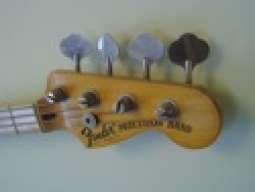
I love the huge Fender headstock and the tuners look perfect with it.


