
Question for the flockmasters here - what's the scoop on the 90s-00s era Studio T-birds? Are they decent sounding/quality instruments in general?

Enjoy the benefits of a premium membership!
Upgrade Account
-
TalkBass has been independent since 1998. Add your voice.
Create a free account to reply to discussions, view embedded media, and browse with fewer display ads.
Join free Log in
Want zero display ads or expanded classifieds tools? Compare plans.
You are using an out of date browser. It may not display this or other websites correctly.
You should upgrade or use an alternative browser.
You should upgrade or use an alternative browser.
Thunderbird Club
- Thread starter TBird1958
- Start date
-
- Tags
- club thunderbird
More options
Who Replied?


- Jun 30, 2010
- 49,588
- 221,962
- Disclosures
- musician/artist/owner - Gildaxe
Slapped together for a sound check…
View attachment 4983311
A shot of the very tight control cavity, preliminary wiring test…
View attachment 4983312
Next steps - take it all apart, fill in the fender bridge holes and ground wire route in the body; trace out a custom pickguard template; finish dressing the frets near the heel; ship the body off to either Pat Wilkins or another finisher for a metallic gold mist poly finish (is that the same as shoreline gold???); contact Irv to make a custom cream or parchment pickguard from the template.
Looks good - very tidy control cavity.
 You don't mean Firemist Gold Metallic do you?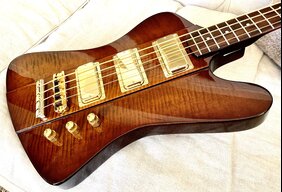
Apparently Gibson Gold Mist Poly (poly was used as the term for metallic back in the day) and Fender Shoreline Gold are the exact same color. In looking at pictures of the two colors I noticed that Shoreline Gold looked almost Silver in some photos and close to Fire Mist Gold in other photos. Digging deeper I found that vintage builds that used Shoreline Gold with a clear top coat have in fact turned more Gold in color over the years as the clear topcoat turned amber with age, thus approaching Fire mist gold in color.Looks good - very tidy control cavity.
View attachment 4983582
Recall, the wife was the one that selected Gold Mist Poly as the finish for the new VP NR, but I don’t know if she was looking at aged examples or new stuff. So I’ve decided to get a rattle can of Shoreline Gold to use on a test piece of mahogany to see if it’s still the color she wants. I do like Fire Mist Gold but feel it might be too gold for chrome hardware.

- Mar 13, 2008
- 18,894
- 142,211
- Disclosures
- Endorsing Artist Mike Lull T Bass pickups, The Bass Shop, Seattle WA.
Question for the flockmasters here - what's the scoop on the 90s-00s era Studio T-birds? Are they decent sounding/quality instruments in general?
I don't have my Gibson bass Book handy but IIRC Studio Birds are post 2000 production, they are a single piece slab body with rounded edges, no raised center section, set neck. They have a modern bridge and a smaller headstock, the neck is beefier than a standard multi laminated Bird, but not objectionably so. Pickups are the plastic coated TB Plus and on this specific bass I think they sound fantastic, it may have to do with the construction, bridge - whatever, they sound great and I wouldn't think of replacing them.
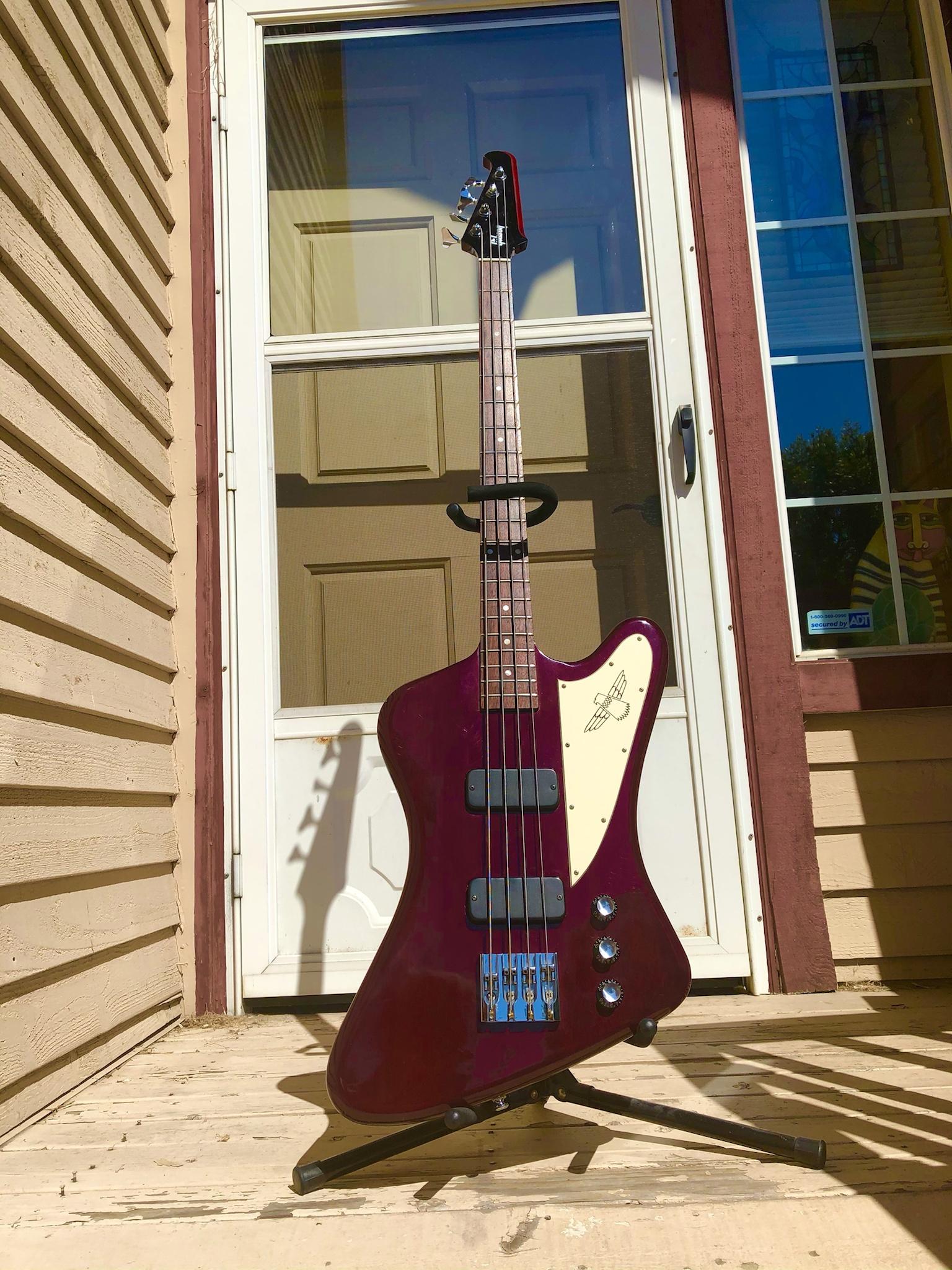
Tiny headstock.

Me wrecking some Deep Purple on mine.......
Just say no to Gold on Gold crimeApparently Gibson Gold Mist Poly (poly was used as the term for metallic back in the day) and Fender Shoreline Gold are the exact same color. In looking at pictures of the two colors I noticed that Shoreline Gold looked almost Silver in some photos and close to Fire Mist Gold in other photos. Digging deeper I found that vintage builds that used Shoreline Gold with a clear top coat have in fact turned more Gold in color over the years as the clear topcoat turned amber with age, thus approaching Fire mist gold in color.
Recall, the wife was the one that selected Gold Mist Poly as the finish for the new VP NR, but I don’t know if she was looking at aged examples or new stuff. So I’ve decided to get a rattle can of Shoreline Gold to use on a test piece of mahogany to see if it’s still the color she wants. I do like Fire Mist Gold but feel it might be too gold for chrome hardware.
- Jun 30, 2010
- 49,588
- 221,962
- Disclosures
- musician/artist/owner - Gildaxe
Apparently Gibson Gold Mist Poly (poly was used as the term for metallic back in the day) and Fender Shoreline Gold are the exact same color. In looking at pictures of the two colors I noticed that Shoreline Gold looked almost Silver in some photos and close to Fire Mist Gold in other photos. Digging deeper I found that vintage builds that used Shoreline Gold with a clear top coat have in fact turned more Gold in color over the years as the clear topcoat turned amber with age, thus approaching Fire mist gold in color.
Recall, the wife was the one that selected Gold Mist Poly as the finish for the new VP NR, but I don’t know if she was looking at aged examples or new stuff. So I’ve decided to get a rattle can of Shoreline Gold to use on a test piece of mahogany to see if it’s still the color she wants. I do like Fire Mist Gold but feel it might be too gold for chrome hardware.
Yep, the '60s nitro always amber's, the level depending on heat and UV rays. An example of that is the early '80s Fender International colour Sahara Taupe. Both are from the early '80s. From chocolate malt brown to golden brown.
Last edited:
LOL - it’s a cuffs and collar thing for me. I love gold hardware, and chrome and nickel and black. But a Gold finish just needs gold hardware to complete the picture. Even Gibson thinks so, sometimes…Just say no to Gold on Gold crime
Pay the fee. No ads. I prefer it to the other streaming services out there.Going to have to stop listening to Spotify for a while. I'm really tired of the endless ads for "K-Y Date Night"...and their coupon at Walgreens....
Yes.Question for the flockmasters here - what's the scoop on the 90s-00s era Studio T-birds? Are they decent sounding/quality instruments in general?

I’m really pumped!
Just got done with a temporary proof of concept wiring job for the VP NR WiP (that Epiphone won’t build). To be true to the VP design I used the same pickups, pot and cap values as the Eppi. I also used the vintage neck pup location but chose to use the modern bridge pup location to thicken up that pup a bit. But the real unknown was the control layout I designed. It’s a dedicated vol/tone stack for each pickup (like my BlingBird build) except this one now goes through a master volume control.
It works phenomenally good and is exactly what the VP needed to get to the next level. I played it back to back with my stock VP for a couple of hours and found the NR WiP has a much broader tonal palette than the Eppi VP (thanks to the dedicated tone control for each pickup). The addition of a master volume makes working with a two volume bass a breeze.
The Wenge/Wenge neck (which required quite a bit of fret leveling, crowning and sprout work) seems to add a good degree of clarity to the sound and really boosts the low and high mids for an awesome punch with presence effect, no mush in this one. Overall it’s every bit as deep as the VP, but even more aggressive and yet a cleaner sound.
Some progress pics:
Slapped together for a sound check…
View attachment 4983311
A shot of the very tight control cavity, preliminary wiring test…
View attachment 4983312
Next steps - take it all apart, fill in the fender bridge holes and ground wire route in the body; trace out a custom pickguard template; finish dressing the frets near the heel; ship the body off to either Pat Wilkins or another finisher for a metallic gold mist poly finish (is that the same as shoreline gold???); contact Irv to make a custom cream or parchment pickguard from the template.
Are you using stack knobs then for the Vol/tone Vol/tone Master set-up? Did you put in caps like the old stack knob jazzes to minimize interaction? I had stacks on my '62 RI Jazz, but since the 80s Fender eliminated the caps to allow more high end, but the side effect was the tone knobs then interacted so they were never fully independent. Eventually I just routed each pickup to its own output to make it so each tone control could be set without interfering with the other. Same happens on my Grecobacker when playing in mono.
Yes, I’m using three stacked 500/500K ohm Audio taper concentric pots and .068 caps (same values as the VP, so sound is very similar). The master stack is volume on the top knob and a dummy on the bottom knob. I might find a use for the dummy knob, maybe a dimmer for some on board lighting - ha.Are you using stack knobs then for the Vol/tone Vol/tone Master set-up? Did you put in caps like the old stack knob jazzes to minimize interaction? I had stacks on my '62 RI Jazz, but since the 80s Fender eliminated the caps to allow more high end, but the side effect was the tone knobs then interacted so they were never fully independent. Eventually I just routed each pickup to its own output to make it so each tone control could be set without interfering with the other. Same happens on my Grecobacker when playing in mono.
Fender had a great idea but less than ideal execution. They used low resistance pots which muddied up the sound quite a bit and they didn’t do anything to eliminate the tone knob bleed over between pickups. I’m using 500k pots, so there’s ample top end available and I installed a 250k ohm resistor on the output of each tone knob to completely eliminate bleed over between the two tone knobs. The result is a drastically increased sound spectrum, zero bleed over between the pups and a near hifi quality to the output when both pups are played.
I wasn’t able to find any schematics for a dual pickup, dual volume, dual tone layout WITH a master volume. So I designed the circuit myself, but wasn’t sure if the additional pot would noticeably load the output signal and change the tone of the bass. Much to my relief it didn’t, and in fact works wonderfully. Every dual volume bass should have a master volume in my opinion. It’s just too klunky to adjust two different volume knobs on the fly during a performance or recording. Hence a volume pedal or kill switch or pickup toggle is frequently used instead.
One of the extra unexpected benefits of the master volume - ever notice the sometimes subtle (sometimes not) change in tone on a given bass when you dime your volume knob vs having the volume at 8 or under, you’ll usually hear a boost in the upper mids. I like that sound sometimes (not always) but don’t like that I have to set the on board volume at full on to get it and then back down the volume on the rig to maintain proper overall sound levels. So now I can dime either or both pup volumes for that more aggressive tone but I can dial back the on board master volume to maintain the right sound level. A huge unanticipated plus for me.
Last edited:

OK folks, no more posting for 24 hours. I do not want to end up in Koramangala reading 100 pages of new posts. 

Just look at the pictures..It goes faster.OK folks, no more posting for 24 hours. I do not want to end up in Koramangala reading 100 pages of new posts.


Gaolee
Official leathers tester and crash dummy
I wouldn't use Duratex for a floor. They have another couple coatings for floors. One has a bit of cushioning to it. I'm not sure how that works. The other has an abrasive suspended in it. That's what I'll be using on the stairs. I used white Duratex for the plywood ceiling in the shop and plywood walls in the shop except for one wall I haven't redone yet. Concrete walls and the floor were coated with a Sherwin Williams paint that's intended for concrete surfaces. White on the walls, gray on the floor. It looks industrial, which is what it's supposed to look like because it's a shop.G
Thanks for this Will. The main area of the basement in the mountain place will finally be repaired (there was a water leak from before we bought the place) and with new carpet within the next two or three months, weather permitting (It’s snowing up there today and the power went out. Again.). This will be the basement where great things will happen.
There is a separate area with a raised plywood floor that’ll be a little guitar and whatnot repair shop where Duratex sounds like the perfect solution for the floor. When the time comes, I’ll be asking for application advice.
This is a link to the floor coatings.
Anti-Slip Coatings Archives • Acry-Tech Coatings
I have no affiliation. But I sure have spent a lot of money on their coatings over the years.
Gaolee
Official leathers tester and crash dummy
It was an unpowered 2 ohm cabinet. It was indeed a beast, especially with a 320 head. Given unlimited room and no need for cash flow, I would still have that stack. I halfway wonder if it was a mistake to let that one go and keep the 360 stack. That's how good those are.hadn’t heard of the 408…..did it have the integrated power amp? sounds like a beast….
Gaolee
Official leathers tester and crash dummy
KY Date Night sounds pretty kinky. Not like fried chicken, though.Going to have to stop listening to Spotify for a while. I'm really tired of the endless ads for "K-Y Date Night"...and their coupon at Walgreens....

You can have the jelly with the fried chicken.KY Date Night sounds pretty kinky. Not like fried chicken, though.

Gibson is certainly pulling out all the stops for the wealthy collectors. Other than basses, of course. I suppose if they find one they think they can sell for $50k tor more, they'll include that.
Gibson - Certified Vintage
Gibson - Certified Vintage


