• TalkBass has been independent since 1998. Add your voice.
    Create a free account to reply to discussions, view embedded media, and browse with fewer display ads.
    Join freeLog in
    Want zero display ads or expanded classifieds tools? Compare plans.

Thunderbird Club

You probably know this but '65s are usually known as transition year basses, CBS bought them on Jan 4th 1965. '64s are really the last pre-CBS Fenders. I'm sure nothing much changed for a while though.

Yes, I'm aware. Fender's calendar (at least then) began in July. The dot & bound J introduced in January '66 changed to block & bound in July '66, and why it is more sought after as it was only made for 6 months. CBS also introduced the in-house produced "lollypop" tuners on it which turned up on a few late '65 J's. So regardless of the sale to CBS, July of '65 is when Fender/CBS officially changed in terms of production.

Another detail/indication of that transition was the "Offset Contoured Body" decal which moved from next to the Fender decal to the top of the hs. This started to be seen in late '65, after CBS officially took over at Fender.

upload_2023-5-3_10-23-25.jpeg
 
Last edited:
Yes, I'm aware. Fender's calendar (at least then) began in July. The dot & bound J introduced in January '66 changed to block & bound in July '66, and why it is more sought after as it was only made for 6 months. CBS also introduced the in-house produced "lollypop" tuners on it which turned up on a few late '65 J's. So regardless of the sale to CBS, July of '65 is when Fender/CBS officially changed in terms of production.

Another detail/indication of that transition was the "Offset Contoured Body" decal which moved from next to the Fender decal to the top of the hs. This started to be seen in late '65, after CBS officially took over at Fender.

View attachment 5050894
Lollypop tuners was one of the great things CBS got right. Binding and inlays can be cool as well.
 
NBD !!!! Just opened it. First impressions, typical Epi thick poly finish. The color is almost TV yellow-ish for being "natural". Idk since I've never had a Korina instrument . That being said I think it's badass ! Love the shape, finish is immaculate, neck joint is clean , action is great with no buzz anywhere, frets feel even. And best of all... The resonance is spectacular. It sings loudly for not being plugged in. Can't wait to get it home to plug in and see if the pups are decent.View attachment 5050135 View attachment 5050135 View attachment 5050136 View attachment 5050137 View attachment 5050138 View attachment 5050143 View attachment 5050139 View attachment 5050137 View attachment 5050141
P/u covers look like Tbird iv (e1).
 
You probably know this but '65s are usually known as transition year basses, CBS bought them on Jan 4th 1965. '64s are really the last pre-CBS Fenders. I'm sure nothing much changed for a while though.
Absolutely correct from a collectors perspective.
From a builders perspective it’s interesting to see the many parts that were stocked up in inventory when CBS acquired the company. Apparently pre CBS Fender had years of bass bodies in 3TSB that CBS decided to just paint over with whatever color was needed to burn through the inventory. My all original 1968 is clearly a 3TSB under the Olympic White. I think the necks held pretty true to to date (give or take a few months) not much excess inventory there - but bodies, pickguards, neck plates, electronics, hardware and pickups apparently had varying degrees of over stock that CBS burned through in the few years that followed the takeover. I think I read somewhere that by 1970 most of the preCBS employees responsible for building the basses had moved on as well. Basically, the closer you get to the takeover date the higher the likelihood there is of your bass being identical to a pre CBS bass, including right down to who built the components, assembled and inspected it. @JIO bass is close enough to the cutover it’s probably nearly identical to a preCBS in every way except collector value.
 
Ok - that's a very illustrative pic. It does save wood - if cut from one piece of wood, the whole length would have to be the depth of the angle and all the rest removed. As there are various set-back angles minimal to maximal, it could waste a lot of wood. If my Supersonic was cut from one piece - it would waist 1.5" the length of the 34"scale neck.

View attachment 5050859
My '68 Coral Deluxe bass has a grafted piece of solid rosewood to the poplar neck. Somewhat similar to the Epi, but yet another way to join two pieces for a set-back hs.
View attachment 5050860
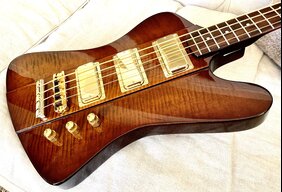
My Eagle:
62DC7EDD-283C-4D00-BF6C-F6253F91954F.jpeg
 
I’m me. I’ve been a better player than I am now. I’m relearning the theory that I used to know when I was a kid. But who cares. I play for my enjoyment. I want to get a gig when I retire. If it happens, fantastic. If not, I’m ok with it.
Same on gig when I retire. Ideally the band name will reference birds.
 
Lollypop tuners was one of the great things CBS got right. Binding and inlays can be cool as well.

It's funny, maybe because it was 'change', many players didn't like the pops and didn't for many years. Now, everybody loves pops! :) What's not to like?

upload_2023-5-3_10-57-1.jpeg
 
Not him alone. There were many of his contemporaries going that direction; he just gets the bulk of the credit.

Probably because he has a knighthood. I maintain that until he slays a dragon, his knighthood is meaningless...

well, he also got the bulk of the air time and record sales.

ugh. I have no truck with dragon-hating knightists!