• TalkBass has been independent since 1998. Add your voice.
    Create a free account to reply to discussions, view embedded media, and browse with fewer display ads.
    Join freeLog in
    Want zero display ads or expanded classifieds tools? Compare plans.

Thunderbird Club

Well, from 50 into 53 I felt mostly the same as the rest of my adult life, but 53 was where I really realized I’m getting older. About to be 57, so not the same as you but my work has always been pretty physical and now stuff (hands mostly) is just hurting more and longer. Plus the energy to keep doing the physical part of the work is getting harder to find.
 
hogwash…..what he doesn’t mention is that if you flick the standby switch on (off standby) prematurely (before the electron cloud fully forms around the cathode) the suddenly impressed HV on the plates will yank chunks of the electron rich thoriated tungsten lining off the cathode most definitely shortening tube life……you think experienced amp companies like Fender, Ampeg, Marshall would erode their margins with an expensive unnecessary switch?….
I picked this as the summary; there’s more out there. As the article points out, the cathode stripping concept came from a different arena (in the Radiotron handbook, mainly referring to high wattage transmitter tubes). I learned a ton from Radiotron, BTW- highly recommended for anyone wanting to in depth in tubes).

The article claims (it’s very plausible) that Leo added it (at least in part) to keep costs down because it let him get by with cheaper electrolytics. And of course the others followed Leo. Today’s caps tend to be higher quality (so long as you buy good brands from reputable sources).

I’ve added standby switches to amps, and those I built always had them. Were I building today, I wouldn’t add one. I know lots of guitar/bass players who never bothered with standby switches. They didn’t seem to need tubes faster than anyone else.

The one place I might use a standby would be an amp pushing its limits, especially a high powered amp. That would mainly be to keep inrush current down.

All that said, I don’t see that standby can hurt anything if used as directed. It will cut energy usage a tad and help extend the life of the passives - and the tubes if they stay on during breaks, etc. vs being turned off.
 
I picked this as the summary; there’s more out there. As the article points out, the cathode stripping concept came from a different arena (in the Radiotron handbook, mainly referring to high wattage transmitter tubes). I learned a ton from Radiotron, BTW- highly recommended for anyone wanting to in depth in tubes).

The article claims (it’s very plausible) that Leo added it (at least in part) to keep costs down because it let him get by with cheaper electrolytics. And of course the others followed Leo. Today’s caps tend to be higher quality (so long as you buy good brands from reputable sources).

I’ve added standby switches to amps, and those I built always had them. Were I building today, I wouldn’t add one. I know lots of guitar/bass players who never bothered with standby switches. They didn’t seem to need tubes faster than anyone else.

The one place I might use a standby would be an amp pushing its limits, especially a high powered amp. That would mainly be to keep inrush current down.

All that said, I don’t see that standby can hurt anything if used as directed. It will cut energy usage a tad and help extend the life of the passives - and the tubes if they stay on during breaks, etc. vs being turned off.
Dang, there’s goes my business venture. ;)
 
Well, from 50 into 53 I felt mostly the same as the rest of my adult life, but 53 was where I really realized I’m getting older. About to be 57, so not the same as you but my work has always been pretty physical and now stuff (hands mostly) is just hurting more and longer. Plus the energy to keep doing the physical part of the work is getting harder to find.

Yes, I think the fatigue/pain in my hands is what's most distressing, granted we played for about 3 hours last night.

I turned 65 in December. If I’d have known I was gonna live this long I’d have taken better care of myself when I was younger. ;)

22 year me, just couldn't think that far ahead!
 
this has got to be one of the coolest models I’ve ever seen, almost brought back with me….
8EBBD1AB-7200-4C97-BEBD-E0076FF2AFF9.jpeg
BD35202A-EDB0-42A2-B6A3-D0F97346544D.jpeg
 
That's a good guy/shop. I got my BC Rich from him.
How interesting. My wife contacted Craig and after seeing an ad for the white '76. (She knew I always wanted a white Thunderbird.) Told him she wanted to buy it for a Christmas present for me but had a limit she wanted to spend. He thought that was so nice he gave more on the price than he ever intended, he said.

He was helpful in discussions after the purchase with respect to it being stamped "Second" and there are supposedly no white '76 Thunderbirds. Geddy bought a Pelham Blue Thunderbird he and I talked about. Said it was his personal bass. I suppose Geddy could pay any crazy price he asked. Wasn't the case with me!
1.jpeg
 
Last edited:
How interesting. My wife contacted Graig and after seeing an ad for the white '76. (She knew I always wanted a white Thunderbird.) Told him she wanted to buy it for a Christmas present for me but had a limit she wanted to spend. He thought that was so nice he gave more on the price than he ever intended, he said.

He was helpful in discussions after the purchase with respect to it being stamped "Second" and there are supposedly no white '76 Thunderbirds. Geddy bought a Pelham Blue Thunderbird he and I talked about. Said it was his personal bass. I suppose Geddy could pay any crazy price he asked. Wasn't the case with me!
View attachment 5111639
Amazing, and both '76s!
 
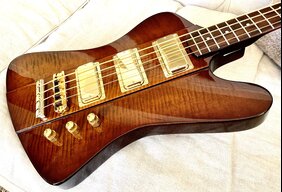
Looking at this lovely photo makes me wonder why Epiphone didn't put the VP pickups in the same place as the 64...?
The VPs pickups are actually close to the original locations--more so than any other Gibson/Epi offering*. I'm sure there was a reason in moving them from the magic location that helped produce the sound that put them on the map, but it eludes me.

*The 2013s are in the almost historically correct location. (Someone please correct I'm I'm off on that.)

Some enterprising guy (GBassNorth), took the time to compile some great info. There may be an updated wiki.
Thunderbird Club
 
Amazing, and both '76s!
I recall those being one of the really cool basses and guitars at that time to the early 80s. I recall playing a bass, but and thought they were really nice. I don't recall which model. I guy I played with had a guitar for a while. Pink, no less. I'm not sure why they dropped in popularity. Similar to Kramers I suppose in some ways. Or, maybe nothing like that.
 
I recall those being one of the really cool basses and guitars at that time to the early 80s. I recall playing a bass, but and thought they were really nice. I don't recall which model. I guy I played with had a guitar for a while. Pink, no less. I'm not sure why they dropped in popularity. Similar to Kramers I suppose in some ways. Or, maybe nothing like that.
been in contact with a bassist in Sac who needs SVT advice/perhaps repair who may come to the GTG….says he owns a 66 burst II and a black 76….we’ll see..