
Definitely a place I wanna go, thought about moving there. Have friends in Fife. We don't have any booking contacts there yet. Working on a West coast booking agent.Let me know if you're out to Seattle Bryan!

TalkBass has been independent since 1998. Add your voice.
Create a free account to reply to discussions, view embedded media, and browse with fewer display ads.
Join free Log in
Want zero display ads or expanded classifieds tools? Compare plans.
Definitely a place I wanna go, thought about moving there. Have friends in Fife. We don't have any booking contacts there yet. Working on a West coast booking agent.Let me know if you're out to Seattle Bryan!

Definitely a place I wanna go, thought about moving there. Have friends in Fife. We don't have any booking contacts there yet. Working on a West coast booking agent.
 I'm in Tacoma now....Will drive through Fife on my way tonight! If you need an opener, let me know!
If we hook up something I'll let you know for sure.

Ahhh, I see.Nothing more than 1) no router and 2) even less time to learn. My band is national now so we're always playing and when we're not I'm building props or other band crap. Plus, don't have a junk bass to experiment on.
I can imagine! I've done it the hard way, drill multiple holes, connect them and dremmel out the middle. I've used my dremmel many times to widen pickup routes as well.Ahhh, I see.
I learned by routing out the space for a Rickenbacker pickup on my Peavey (started out as a P-bass copy).
Then I did the head cab for my D-180, and only after that did the routing for converting a Sunn 1200s 6x12 cab to the 2000S 2x15 design.
Though next time I use a router, I'm going to try my friend's router table setup rather than doing it freehand, as the latter can be pretty nerve wracking.
A router is basically the same concept. Just removes way more wood way faster (so larger consequences if you screw up, ha ha).I can imagine! I've done it the hard way, drill multiple holes, connect them and dremmel out the middle. I've used my dremmel many times to widen pickup routes as well.

Idk man, looks like a black finish sanded down to me. I always hand sand basses and they look like that sometimes if it was a solid color
IcIf the wood is maple or basswood it would probably be close to the beige look that this bass has. You could just sand it down to test it out.
Also, after you have sanded and or painted, maybe hit it with a satin clear coat. Would keep it dull looking but seal the finish up so it doesn't keep peeling.
I was thinking the same thing, a flat or satin. Have to figure out what type i want to use. But yeah, I'm definitely going to sand of see what happens. Now to find some uses EMGs.If the wood is maple or basswood it would probably be close to the beige look that this bass has. You could just sand it down to test it out.
Also, after you have sanded and or painted, maybe hit it with a satin clear coat. Would keep it dull looking but seal the finish up so it doesn't keep peeling.
Pretty sure it's basswoodIf the wood is maple or basswood it would probably be close to the beige look that this bass has. You could just sand it down to test it out.
Also, after you have sanded and or painted, maybe hit it with a satin clear coat. Would keep it dull looking but seal the finish up so it doesn't keep peeling.
Nikki's being a USA spector was definitely a maple body.If the wood is maple or basswood it would probably be close to the beige look that this bass has. You could just sand it down to test it out.
Also, after you have sanded and or painted, maybe hit it with a satin clear coat. Would keep it dull looking but seal the finish up so it doesn't keep peeling.
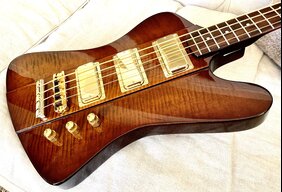
Maple is quite a bit different than basswood when it comes to woodworking and finishing. Basswood is very soft and usually has very little grain pattern, maple is the exact opposite. I don't know if you already have a Spector bass you're modifying but if you need to buy a used one check out the Spector RexPro. It's all maple and neck through, they run about $500 used.Nikki's being a USA spector was definitely a maple body.
Nope, this is going to be a Fernandes MV65NS I just got. It's basswood.Maple is quite a bit different than basswood when it comes to woodworking and finishing. Basswood is very soft and usually has very little grain pattern, maple is the exact opposite. I don't know if you already have a Spector bass you're modifying but if you need to buy a used one check out the Spector RexPro. It's all maple and neck through, they run about $500 used.
Well, it's definitely NOT Maple! So we'll see what happens. Either way I am redoing at least the top so if it works it'll be raw, of not I'll paint it polka dot or something.I think I've seen the bodies listed as alder and basswood, but not in any "official" info. Just in for sale listings on Ebay.

That's black on top, I think. Definitely seal the finish. Use a flat clear on it.Misunderstood your previous comment. That’s the same magazine lol
If you’re going to do that finish I’d recommend a clear coat on top.
But it actually looks like cream/beige over black and just “worn out”, or vise versa.


I'm probably the quantifiably worst bassist on all of TB and certainly in the TBC. It took me all of 30 seconds to adjust to fanned frets, and it only took that long because I spent almost 17 seconds expecting it to be harder than it is. I was in my own way at first, thinking it was complicated when it isn't.

" Wet Blanket" Perfect. It's exactly my take on them as well. The 360 smokes it in terms of transient response and damping factor. I've heard SVTs sound ok with Ricks or Fenders but not usually with any type of Gibson bass..
Not a fan of Hartke amps.Anyone have any experience with Hartke Transient Attack amplifiers and their XL cabs?
There seem to a few 2nd hand on my side of the pond...


