• TalkBass has been independent since 1998. Add your voice.
    Create a free account to reply to discussions, view embedded media, and browse with fewer display ads.
    Join freeLog in
    Want zero display ads or expanded classifieds tools? Compare plans.

Thunderbird Club

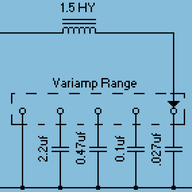
102 is .001 uF or 1 nF -- the K is the tolerance of the cap. A 0.1 uF cap would be 105K.

The reason the mids get accentuated is that the inductance of the pickup(s) interacts with the capacitor to form a LC resonant circuit. This kind of circuit gives a peak response at a frequency that goes up as the capacitance is lowered (skipping over the math). An interesting thing that happens with this circuit is that the peak effect increases as you turn the tone knob down.
Excellent, made the mistake of asking a friend vs looking it up myself at the orange cap site. All the raw data collected still stands but the cap value will be revised to .001uf.
Again, peer review is a good thing. Thanks for the correction. I'll run through the other caps just to make sure I didn't make the same mistake there.
 
Excellent, made the mistake of asking a friend vs looking it up myself at the orange cap site. All the raw data collected still stands but the cap value will be revised to .001uf.
Again, peer review is a good thing. Thanks for the correction. I'll run through the other caps just to make sure I didn't make the same mistake there.
Alright, I'm curious now -- going to run some tests on my Goth tonight to see if I can estimate the inductance of the stock pickups. Usually bass pickups are around 5-6 H.
 
102 is .001 uF or 1 nF -- the K is the tolerance of the cap. A 0.1 uF cap would be 105K.

The reason the mids get accentuated is that the inductance of the pickup(s) interacts with the capacitor to form a LC resonant circuit. This kind of circuit gives a peak response at a frequency that goes up as the capacitance is lowered (skipping over the math). An interesting thing that happens with this circuit is that the peak effect increases as you turn the tone knob down.
Excellent, made the mistake of asking a friend vs looking it up myself at the orange cap site. All the raw data collected still stands but the cap value will be revised to .001uf.
Again, peer review is a good thing. Thanks for the correction. I'll run through the other caps just to make sure I didn't make the same mistake there.

Just went back and looked up the marked value of each cap. Of the ones tested, the only incorrect value was the originally claimed .1uf cap, which in fact as you pointed out is actually a .001uf cap.

There was one other value error but it wasn't included in this experiment. I had a .1uf cap incorrectly noted as a .001uf cap. Which now has me thinking I might have inadvertently mixed the two orange drop caps up when I was assembling the test rig. Again, this cap was not included in the testing, so nothing to change there.
 
Excellent, made the mistake of asking a friend vs looking it up myself at the orange cap site. All the raw data collected still stands but the cap value will be revised to .001uf.
Again, peer review is a good thing. Thanks for the correction. I'll run through the other caps just to make sure I didn't make the same mistake there.

102k is .1uFd. K has not been used to denote tolerance for some time now since production processes have vastly improved.
102 = 10 plus two 0s. K equals 1000pF hence 1000 + 1000pF = 1000000pF = .000001Fd = .1uFd...
I would invest in one of these for a project like this...
upload_2020-9-29_10-22-11.png


Sound clips would be nice too!:thumbsup::thumbsup:
 
Great stuff!

A meter for capacitance, inductance and "Q" is not too expensive. I have the DE-5000, but last time I looked there was a new model.
Also the magnetic field strength meter WT10A not too expensive last time I looked.

With those you can do some serious pickup analysis! They were recommended by credible posters at another forum for exactly this, but I haven't even tried it yet.

EDIT: Oh, "great minds think alike" I see! (I was writing this while you posted that.)
 
102k is .1uFd. K has not been used to denote tolerance for some time now since production processes have vastly improved.
102 = 10 plus two 0s. K equals 1000pF hence 1000 + 1000pF = 1000000pF = .000001Fd = .1uFd...
I would invest in one of these for a project like this...
View attachment 4001098

Sound clips would be nice too!:thumbsup::thumbsup:
It's an orange drop cap, according to the orange drop value calculator the code of 102K100v 1645 is a .001uf cap made the 45th week of 2016.
Invalid Link Removed

You're spot on about sound clips. I intend to record some but still trying to figure out how to post them. Probably won't happen for a couple of weeks at best. And yes I have looked into getting a cap meter but felt it wasn't necessary for this particular job.
 
Great stuff!

A meter for capacitance, inductance and "Q" is not too expensive. I have the DE-5000, but last time I looked there was a new model.
Also the magnetic field strength meter WT10A not too expensive last time I looked.

With those you can do some serious pickup analysis! They were recommended by credible posters at another forum for exactly this, but I haven't even tried it yet.

EDIT: Oh, "great minds think alike" I see! (I was writing this while you posted that.)
A magnetic field strength meter would have been good to have when I was working through setup issues on my 2015 bird.
 
Great stuff!

A meter for capacitance, inductance and "Q" is not too expensive. I have the DE-5000, but last time I looked there was a new model.
Also the magnetic field strength meter WT10A not too expensive last time I looked.

With those you can do some serious pickup analysis! They were recommended by credible posters at another forum for exactly this, but I haven't even tried it yet.

EDIT: Oh, "great minds think alike" I see! (I was writing this while you posted that.)
Can’t wait for him to get his new meter. I’ll bet he probably just ordered it.
 
estimate the inductance of the stock pickups
With just that $18.99 capacitance meter linked above, and a little free software (FFT, for example the one built into Audacity), one could calculate inductance and Q from that.

EDIT:
Oh, for estimating inductance you don't even need the capacitance meter, just some good capacitors.
-For the pickup in the circuit, set tone=0, and use the software to find the frequency of the resonance.
-For the pickup alone, connect a suitable capacitor in parallel, feed it with a signal and again look for the frequency of the resonance peak. And with the resistance of the pickup you could then calculate the Q.

For a Fender single coil and a .047u, the resonance at tone=0 is at around 300Hz.
 
Last edited:
With just that $18.99 capacitance meter linked above, and a little free software (FFT, for example the one built into Audacity), one could calculate inductance and Q from that.

Oh, for estimating inductance you don't even need the capacitance meter, just some good capacitors.
(For the pickup in the circuit, set tone=0, and use the software to find the frequency of the resonance.)
That's pretty much what I do -- I use Audacity to generate a sweep signal -- play that back through a magnetic driver to drive the pickup while recording the output of the bass with Audacity.

I describe what I do in this post
20190716_050905-jpg.jpg
 
It's an orange drop cap, according to the orange drop value calculator the code of 102K100v 1645 is a .001uf cap made the 45th week of 2016.
Invalid Link Removed

You're spot on about sound clips. I intend to record some but still trying to figure out how to post them. Probably won't happen for a couple of weeks at best. And yes I have looked into getting a cap meter but felt it wasn't necessary for this particular job.
It would appear that orange-drops still use the "K" notation for tolerance.
View attachment 4001160

Dang! I stand corrected (it's been so long...:rollno:)....apologies for any confusion caused..
104k as below = .1uFd = 100nFd...meter reads 98.8 nano...20 dollars to avoid all of this? where do I sing up?;):thumbsup:
upload_2020-9-29_11-20-32.png
 
That's pretty much what I do -- I use Audacity to generate a sweep signal -- play that back through a magnetic driver to drive the pickup while recording the output of the bass with Audacity.

I describe what I do in this post
View attachment 4001184
Interesting thread, I'll have to go through it in more detail when I get more spare time.
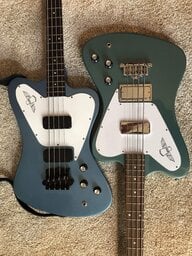
FWIW - I think the consistency of components from Goth to Goth may be questionable. I have two Goth birds, both made in China, both made at the same plant and both made within a couple of years of each other. They are two completely different beasts both sound wise and in construction. One has 14.6/14.7k ohm pups the other has 13.8/14.4k ohm pups.