• TalkBass has been independent since 1998. Add your voice.
    Create a free account to reply to discussions, view embedded media, and browse with fewer display ads.
    Join freeLog in
    Want zero display ads or expanded classifieds tools? Compare plans.

Thunderbird Club

Amplifiers do have a volume knob. You don't always have to turn up to eleven. Although it is always better if you do.
Yep, but to retain upmost testing integrity the amp controls were completely off limits once the testing started. The trippy part was that the amp volume was only set at two. I seriously think I could have easily damaged a speaker with that .1 cap if I had the amp volume up around 4. Keep in mind the Goth pups are 14.7K ohms, very hot.
 
yeah definitely...people kept their distance, actually doable if the venue is large enough..to answer your question the short cutie is this gal (Darby)..
View attachment 3999744

the big ugly "cutie" is this guy (John)..


My two first sports heroes (not sure which came first) were Micky Mantle and a roller derby queen- the Blonde Bomber, Joanie Weston.
 
Just wrapped up the first leg of the Goth tone cap and pot test where the 500K pots were in the control circuit.
...
Findings:

.1uf cap - tone on zero gives super loud deep lows even at volume settings as low as 4, thunderous at a volume of 6, destructive at 8, then at a volume of 9 the upper mids mix in and you better have hearing protection and a spare set of speakers for your cab. Increasing the tone cap setting drastically increases mids. On this bass this is the cap to use if all you want is lows and low mids and don't mind leaving the tone pot on zero and the volume at 5 or less. Truly makes a one trick pony (or wrecking ball) out of the Goth. Bottom line - "nuke em from orbit"

.082uf cap - smooth, deep and dark, nice low mids BUT very little adjustability. A tone knob setting of zero requires a volume knob setting of 8 to get any useable level of sound, and at a volume setting of 9 or higher it sounds very harsh and unpleasant (my notes actually say "yuck"). This is the cap that I thought would sound best, so much for confirmation bias. Kick the tone knob up to 5 and you have nice smooth useable lows starting at a volume setting of 4 to 6. At a volume of 8 the high mids start to kick in and quickly ruin the party. Bottom line - not ready for prime time.
...

This is very strange, because there's very little difference in those cap values. They should react almost identically.And .082 to .06[89] shouldn't be all that different. I smell an Infinity Stone influence.
 
Never heard that before. Intense. Did you read the story behind it?

Yes, that's part of the reasons the song still gives me goosebumps. Very touching.
 
This is very strange, because there's very little difference in those cap values. They should react almost identically.And .082 to .06[89] shouldn't be all that different. I smell an Infinity Stone influence.
I was a bit surprised also. The caps were night and day difference physically as well. The .082 was a tiny little ceramic thing smaller than a match head, the .069 was two orange drop capacitors wound together in parallel, by comparison massive in size.
IMG_4326.JPG

...maybe size does matter after all. :whistle:
 
I was a bit surprised also. The caps were night and day difference physically as well. The .082 was a tiny little ceramic thing smaller than a match head, the .069 was two orange drop capacitors wound together in parallel, by comparison massive in size.
View attachment 4000596
...maybe size does matter after all. :whistle:

Looks like you have a 1uF and either a .082nF or .082pF, rather than a .082uF. What exactly does it say on that tiny cap?
 
Looks like you have a 1uF and either a .082nF or .082pF, rather than a .082uF. What exactly does it say on that tiny cap?
.082uf is what I ordered from Stewmac. The packing slip says it's .082uf and the writing on the sealed plastic bag of five caps says .082uf. I don't have a multi meter to measure capacitance so I assume I got what I ordered, but you raise a valid point. I'll get out a magnifier and see if I can read any of the writing on one of the little buggers.
 
Looks like you have a 1uF and either a .082nF or .082pF, rather than a .082uF. What exactly does it say on that tiny cap?
.082uf is what I ordered from Stewmac. The packing slip says it's .082uf and the writing on the sealed plastic bag of five caps says .082uf. I don't have a multi meter to measure capacitance so I assume I got what I ordered, but you raise a valid point. I'll get out a magnifier and see if I can read any of the writing on one of the little buggers.

Here's a pic zoomed in as best I can. It's stamped 823, which I assume follows the normal coding convention for caps, thus a .082uf cap. A multi meter would make it a certainty, alas none to be found in this household.
IMG_4330.PNG
 
Here's a pic zoomed in as best I can. It's stamped 823, which I assume follows the normal coding convention for caps, thus a .082uf cap. A multi meter would make it a certainty, alas none to be found in this household.
View attachment 4000642

According to what I could find, from multiple sources:

82000 pF / 82 nF / 0.082 uF = 823

So your assumption should be correct! :thumbsup:
 
Looks like you have a 1uF and either a .082nF or .082pF, rather than a .082uF. What exactly does it say on that tiny cap?
.082uf is what I ordered from Stewmac. The packing slip says it's .082uf and the writing on the sealed plastic bag of five caps says .082uf. I don't have a multi meter to measure capacitance so I assume I got what I ordered, but you raise a valid point. I'll get out a magnifier and see if I can read any of the writing on one of the little buggers.
Here's a pic zoomed in as best I can. It's stamped 823, which I assume follows the normal coding convention for caps, thus a .082uf cap. A multi meter would make it a certainty, alas none to be found in this household.
View attachment 4000642

Reviewing the raw data again to make sure I didn't transpose anything wrong.
Data collected for the .082 cap is as follows:

Tone at zero, neck pup volume stepped at 2,4,6,8,10
2 - smooth, too quiet, not useable
4 - smooth, quiet, barely useable
6 - very slightly louder, still barely useable
8 - useable, smooth a bit louder
10 - high mids kick in strong at 9, unpleasant tone

Tone at three, neck pup volume indexed same as above
2 - smooth, uneven, low volume on open G string
4 - good volume across strings, mid focused
6 - same
8 - volume jump in low mids
10 - yuck

Tone at five, neck pup volume indexed same as above
2 - low volume
4 - sounds good, nice low mids
6 - nice smooth low mids
8 - loud, high mids kicking in
10 - yuck

Sorry about the non scientific "yuck" notation but the sound at that setting was a mess and just unuseable for anything I'd ever want to play.

Edit
@Miles_ONeal maybe the better question is - is the .1uf cap truly .1uf? It behaved completely different from the other caps (the raw data is actually comical). I'll check it next to see if there's an error there. As you correctly noted, there's just not a lot of value difference between the two caps, so one would expect similar results.
 
Last edited:
@Miles_ONeal
Just checked the .1uf orange drop cap and confirmed it's marked 102K. That should be .1uf if I've translated the naming convention correctly.

Data collected for the .1uf tone cap is as follows:

Tone at zero, volume at 2,4,6,8,10
2 - plenty of volume, deep, low mids
4 - very loud low mids
6 - thunderous loud (loud underlined two times) low mids
8 - shaking the room apart loud (loud underlined three times)
10 - high mids rolled in, loud, loud, loud (each loud underlined twice)

Tone at 3, volume settings same as above
2 - smooth very useable volume
4 - very loud mids kicking in
6 - same but much louder
8 - much too loud, shaking everything in the room
10 - high mids added, too too too loud, painful, must stop

Tone at 5, volume settings same as above
2 - mid lows very loud
4 - same but much louder
6 - no huge change in volume or tone (blown ear drum?) but still very loud
8 - high mids kicked in, too loud for comfort
10 - brighter, louder, more painful, cutting test off while I still have ear drums!

The killer cap! As best I can tell all looks correct
 
Last edited:
It has been awhile since we've seen posts from some of our most prolific posters here in Thunderbird world.

@JJR58 comes to mind and I hope all is well with you, Jeff. 6 weeks since his last visit.
I PM’d him last week or so. No reply. I’m confident he’ll resurface. He always does. Miss Kat too. A few others reply when hailed, so it is just a sign of the strange times I suppose.
 
@Miles_ONeal
Just checked the .1uf orange drop cap and confirmed it's marked 102K. That should be .1uf if I've translated the naming convention correctly.

Data collected for the .1uf tone cap is as follows:

Tone at zero, volume at 2,4,6,8,10
2 - plenty of volume, deep, low mids
4 - very loud low mids
6 - thunderous loud (loud underlined two times) low mids
8 - shaking the room apart loud (loud underlined three times)
10 - high mids rolled in, loud, loud, loud (each loud underlined twice)

Tone at 3, volume settings same as above
2 - smooth very useable volume
4 - very loud mids kicking in
6 - same but much louder
8 - much too loud, shaking everything in the room
10 - high mids added, too too too loud, painful, must stop

Tone at 5, volume settings same as above
2 - mid lows very loud
4 - same but much louder
6 - no huge change in volume or tone (blown ear drum?) but still very loud
8 - high mids kicked in, too loud for comfort
10 - brighter, louder, more painful, cutting test off while I still have ear drums!

The killer cap! As best I can tell all looks correct

102 is .001 uF or 1 nF -- the K is the tolerance of the cap. A 0.1 uF cap would be 105K.

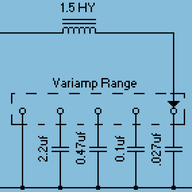
The reason the mids get accentuated is that the inductance of the pickup(s) interacts with the capacitor to form a LC resonant circuit. This kind of circuit gives a peak response at a frequency that goes up as the capacitance is lowered (skipping over the math). An interesting thing that happens with this circuit is that the peak effect increases as you turn the tone knob down.