• TalkBass has been independent since 1998. Add your voice.
    Create a free account to reply to discussions, view embedded media, and browse with fewer display ads.
    Join freeLog in
    Want zero display ads or expanded classifieds tools? Compare plans.

Thunderbird Club

I still don't understand. All you need to do is reverse the hot and ground wires. Even if the hunbucker had 4 conductors, you would only use one hot and one ground (unless you wanted to split the coils) and connect the remaining two wires to each other (this is done internally w/ with a 2 conductor humbucker). Reversing the hot and ground wires would put a humbucker in/out of phase with the other pickup just as it does with single-coil pickups.

I was thinking that as well. For the pickup @Dadagoboi showed, the braid would become the hot and the non-braid would go to ground. That should still produce a signal, the same signal, with the phase reversed. The only disadvantage I can see is that the shield is now no longer connected to ground, which I guess would increase noise/hum.

Oh, and you would also need to insulate the braid to prevent it from inadvertently contacting another ground in the cavity.

Did I get that right? I'm no expert...
 
I still don't understand. All you need to do is reverse the hot and ground wires. Even if the hunbucker had 4 conductors, you would only use one hot and one ground (unless you wanted to split the coils) and connect the remaining two wires to each other (this is done internally w/ with a 2 conductor humbucker). Reversing the hot and ground wires would put a humbucker in/out of phase with the other pickup just as it does with single-coil pickups.

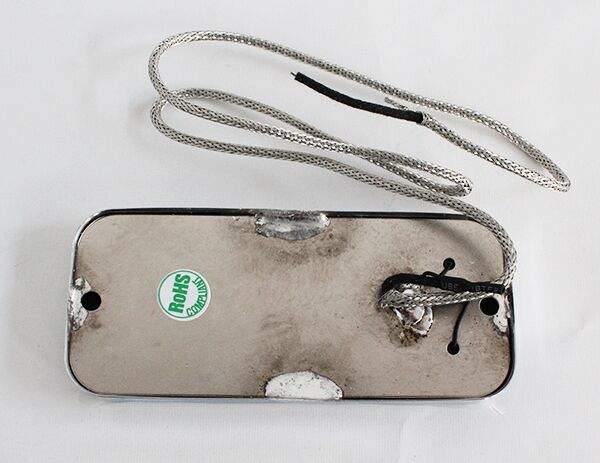
Reversing the ground and hot wires at the pot results in the coil wire grounded to the pup base going to the circuit hot side.

baseplate66.jpg


I think it would work if you changed the coil to output wire connections on the base.

ThunderBuckers are phased correctly and checked before they're sent out so it's something I've never encountered.
 
I was thinking that as well. For the pickup @Dadagoboi showed, the braid would become the hot and the non-braid would go to ground. That should still produce a signal, the same signal, with the phase reversed. The only disadvantage I can see is that the shield is now no longer connected to ground, which I guess would increase noise/hum.

Oh, and you would also need to insulate the braid to prevent it from inadvertently contacting another ground in the cavity.

Did I get that right? I'm no expert...
I think so. Hum isn't a problem since vintage TBird pups are completely encased in metal.
 
  • Like
Reactions: kat888
I still don't understand. All you need to do is reverse the hot and ground wires. Even if the hunbucker had 4 conductors, you would only use one hot and one ground (unless you wanted to split the coils) and connect the remaining two wires to each other (this is done internally w/ with a 2 conductor humbucker). Reversing the hot and ground wires would put a humbucker in/out of phase with the other pickup just as it does with single-coil pickups.

With the blend pot in the centre, the Bird sounds quite a lot like a J*zz which wasn't the plan. Seeing as the braid is soldered to the casing, if the conductors are reversed the case is no longer earthed right? ...unlike the strings, bridge and other pup case. Are there any potential problems with this?
 
With the blend pot in the centre, the Bird sounds quite a lot like a J*zz which wasn't the plan. Seeing as the braid is soldered to the casing, if the conductors are reversed the case is no longer earthed right? ...unlike the strings, bridge and other pup case. Are there any potential problems with this?

The cover would have to be grounded, but all you have to do is solder a wire to the casing and the other end to the back of a pot.
 
The cover would have to be grounded, but all you have to do is solder a wire to the casing and the other end to the back of a pot.

Wrong. That's what I was saying earlier. For a single-hot-plus-braided-shield setup, if you reverse the leads your braided shield (which is already soldered to the casing) becomes hot. If you do that, and then solder a ground wire to the casing, you will silence the pickup completely, as both leads will then go to ground.
 
Wrong. That's what I was saying earlier. For a single-hot-plus-braided-shield setup, if you reverse the leads your braided shield (which is already soldered to the casing) becomes hot. If you do that, and then solder a ground wire to the casing, you will silence the pickup completely, as both leads will then go to ground.

That's why I included the pic of the baseplate wiring...twice.:) What the hell, maybe the third time's the charm.
baseplate66.jpg
 
With the blend pot in the centre, the Bird sounds quite a lot like a J*zz which wasn't the plan. Seeing as the braid is soldered to the casing, if the conductors are reversed the case is no longer earthed right? ...unlike the strings, bridge and other pup case. Are there any potential problems with this?

Yeah, you're canceling out a lot of the signal because the middle position of the blend pot is both pups wide open. There's a little cancellation even if they were in phase but it sounds like you're getting a drastic reduction.

Take it to someone who understands what (s)he's doing and switch the wiring at ONE PUP ONLY. You don't need to buy another pup. The braid gets left alone. The two wires coming out of the base plate get switched. Then the pups will be in phase. The pots don't need to be touched.
 
Last edited:
Well there's the problem.

Sent an email to EY Guitar Parts, hopefully fixing this won't cost me any more.
It just takes a soldering iron and some shrink tube. Nobody in Sydney works on electronics or computers? Where did you find the person who had the bright idea to use a blend pot?
 
Wrong. That's what I was saying earlier. For a single-hot-plus-braided-shield setup, if you reverse the leads your braided shield (which is already soldered to the casing) becomes hot. If you do that, and then solder a ground wire to the casing, you will silence the pickup completely, as both leads will then go to ground.

I'm sorry, I dont know what I was thinking (I don't usually deal with pickups w/ metal covers). The cover needs only be connected to the base plate (if no connection is already present) for ground. But my main point was that the cover does need to be grounded.
 
It just takes a soldering iron and some shrink tube. Nobody in Sydney works on electronics or computers? Where did you find the person who had the bright idea to use a blend pot?

Don't think he sees a lot of Gibson/Epi basses - he reused the blend pot from the ProIV guts. I suppose some people think 'sounds like a J' is a good thing ... maybe like if you have a J bass.
 
A certain amount of mid-scoop cancellation will occur when any two of the same pickups - jazz or otherwise - are combined at equal levels. Even if they're in phase. What you will hear if the two pickups truly are out of phase is a very thin tone, devoid of any bottom. It's truly a tone that nearly all bassists will find unpleasant, at least for a musically foundational role. If you have a nice low frequency tone with both pickups on, then your pickups are most likely in phase.

The above advice is still worthwhile though - if you've never actually experienced the out-of-phase tone, it's easy to temporarily switch the leads on one pickup to check it out. I think it's pretty lousy myself...

Edit: this also can be an issue when mixing pickups from different manufacturers. They don't all use the same wiring color codes, and they don't all orient their magnets and coils the same way. If you do this (as I have) and a very thin tone results, the proper remedy is to swap the hot and ground leads on one of the pickups, ignoring any preconceptions surrounding wire colors.
 
Last edited:
That's why I included the pic of the baseplate wiring...twice.:) What the hell, maybe the third time's the charm.
baseplate66.jpg
Call me crazy, but I'm sure I've seen that picture somewhere before!;)

Just to be clear, to cure the phase issue simply unsolder the black wire connected to the braided lead and unsolder the black wire that's currently soldered to the back of the pup. Then solder the black wire that was connected to the pup to the core of the braided lead wire and solder the black wire that was connected to the lead to the back of the pup. Also make sure the braided portion of the lead wire remains soldered to the back of the pup and be sure to insulate (shrink wrap or tape) the black wire that connects to the core of the lead wire so that it doesn't ground out as it touches the back of the pup.

Is that correct?