• TalkBass has been independent since 1998. Add your voice.
    Create a free account to reply to discussions, view embedded media, and browse with fewer display ads.
    Join freeLog in
    Want zero display ads or expanded classifieds tools? Compare plans.

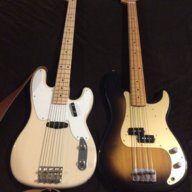
Two almost identical precisions, different tone.

"A lie told once remains a lie, but a lie told a thousand times becomes the truth."

Joseph Goebbels (1897-1945)

Your statement may or may not be true for all the instruments that you've played. Having not played any of your past and/or present basses, I can't be the judge of that.

It most certainly doesn't qualify as truth for the thousands of pieces that I've played over the past 39 years.

+1
I knew this thread was going to get ugly fast. After 30 yrs of playing, If I am checking a bass I just try it unplugged first. I am not necessarily set on a particular type of wood but I can tell right away if the bass is a dud before even plugging it.
I bet that even with a very similar set up and same strings, the OP's basses already sound quite different when played unplugged.
 
Last edited:
+1
I knew this thread was going to get ugly fast but after 30 yrs of playing, If I am checking a bass I just try it unplugged first. I am not usually set on a particular type of wood but I can tell right away if the bass is a dud before even pluging it.
I bet the OP's basses, even with a very similar set up and same strings, already sound quite different played unplugged.
I always do the ear up against the upper horn trick as my first sonic evaluation after first checking for any construction/setup problems. The really good ones make me involuntarily flinch away from the power of the sound/vibrations.
 
I mean, it doesn't make me mad... that's just a logical fallacy!

It's a pavlov thing... people play a really cool bass they like, not knowing jack about electronics or anything... they see the bass, the wood it is made out of... see it being advertised for the wood, and become conditioned to believe that it must be the wood. The way people organize and categorize 'tonewood' looks like pseudoscience, or astrology to me. It also contributes to the whole misconception about things like cheaper instruments that are outsourced and made out of "inferior materials". Cheaper instruments made in other countries may be of lower quality, but it is not because they are cheap... it's because of the free market and cost of labor... so in return, the instrument may or may not be of lower quality, but in most cases, it can be fixed, and to make it sound REALLY GOOD, you just add some 3rd party pickups and electronics. But the average first world citizen does not put that effort or thought into it; when they make an instrument purchase, they look to these kinds of threads for information and learn that "basswood is that crappy wood" that you should never build an instrument with, and therefore, should not purchase an instrument based solely on that. AND THAT is what I see is the problem, and THAT is what makes me mad. But feel free to believe in whatever you want to believe. :)

A realistic and practical analysis of amplification and electronics would lead someone to the same conclusion every time... that electronics in amplified instruments is what determines tone. It's just sad that people refuse to see the truth, but it's definitely a great excuse to go out and buy another bass. But that very excuse would crumble if somebody began to question it.. I mean, if I suddenly realized that I wasted most of my life's fortune and savings on music gear for reasons that were self-validating, I'd probably become nihilistic and lose all hope.

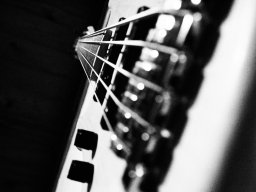
It may be worth mentioning that the reason I swapped the pickups in the Franklin to Quarter Pounders and set it up to be as identical as possible to the '83 was because I thought it would let me get the same tone as the '83. I don't have a strong 'tonewood' opinion either way, I just wanted to have a lighter and more playable version of the '83, but the inherent tone has remained pretty different.

Ya gotta love how all I want to do is assert a seemingly logical idea for the benefit of those who are uninformed consumers, and people who think this is insufferable due to their own personal views and experiences (that I don't really care about or am concerned about) resort to personal attacks and undermining my posts through employing various logical fallacies and other tactics. To OP: I am sorry I have oversaturated the thread with my posts...


I watched this guy a while ago and thought he had some valid things to say, but then on another video he talks about his 'life' views and it's some of the most confused and bizarre nonsense you'll ever hear, it made me sceptical about the rest of his opinions, I found it hard to take him seriously after that.
 
  • Like
Reactions: pjbassist
I actually had this conversation with a very reputable guitar tech guy who specializes in vintage guitar and this is what he said.

A vintage guitar that played so well till yesterday all of a sudden turn sour and sounds dead the next day. This happens for a variety of reasons but an element that most people will not even think about is the head stock angle.

The head stock angle, will rise just a bit and that will change everything in a guitar. This is especially true to guitars that are vintage or have been played a lot. (I could explain more about being played a lot but think of A.R.E. of Yamaha, disagree all you want but Yamaha is a Toyota group and they have money and did the research, go talk to them if you want more facts).

According to the guy, the head stock angle will eventually rise in most guitars so eventually many guitars will sound like crap later on in their life. Not all but many will. This is why buying anything that says "vintage" needs to be done carefully and you can't expect that vintage to stay good for the next 50 years. It's a gamble. It might, it might not.

This isn't to say that all vintages sound good or all vintages will eventually sound bad. Some guitars just sound better for all sorts of reasons but if you take two guitars made roughly the same and you can't figure out why one is better than the other, you might want to check the head stock angle if you have the means or ability to do so.

All that said, you're probably hearing correctly. It's not your imagination.
 
It's the sum of the parts that makes the difference IMO/IME.
I've built a few basses from the same parts and the tone was different and this was raw wood before any finish.

But really, what does better mean: One guys passion is another guys poison.

Never heard the head stock angle idea; wouldn't this be the same as comparing pressure on the nut?
If it move more that say .030" (the thickness of a matchbook cover), the action would change considerably.
I'd have to see some sort of research or tech paper before I could understand or believe this would be audible.
 
I always do the ear up against the upper horn trick as my first sonic evaluation after first checking for any construction/setup problems. The really good ones make me involuntarily flinch away from the power of the sound/vibrations.
Yes, I have always done this too. The unplugged wood sound has to be great. You have to get the sound you want there. If it is not there, it will never be there. It is what will get translated out to speakers eventually. The wood of a guitar is like the soil of a vineyard. It is ultimately the lasting quality that persists over the decades.
 
Yes, I have always done this too. The unplugged wood sound has to be great. You have to get the sound you want there. If it is not there, it will never be there. It is what will get translated out to speakers eventually. The wood of a guitar is like the soil of a vineyard. It is ultimately the lasting quality that persists over the decades.
Sounds like you and I, and for that matter most of the respondents in this thread, are on the same page about this. The pickups cannot sense string information, and the overall timbre of that information that is not already there in the first place.
 
  • Like
Reactions: ajkula66
It's the sum of the parts that makes the difference IMO/IME.
I've built a few basses from the same parts and the tone was different and this was raw wood before any finish.

But really, what does better mean: One guys passion is another guys poison.

Never heard the head stock angle idea; wouldn't this be the same as comparing pressure on the nut?
If it move more that say .030" (the thickness of a matchbook cover), the action would change considerably.
I'd have to see some sort of research or tech paper before I could understand or believe this would be audible.

I asked the same thing, but apparently it's not the same as the pressure on the nut. They guy said that after seeing, testing, fixing all sorts of vintage guitars, the common traits in a crap sounding vintage was this head stock angle. He's seen the before and after the shift in the same guitar and this was most likely the reason. He tried solving the problem with some result but it's always temporary.

Anyway it happens all of a sudden without any warning, which is why it's really problematic when buying a vintage equipment.
 
Interesting info, Whippet. If the headstock angle/nut down pressure can make such a difference, then on an electric bass, you could minimize this by installing string trees or a bar closer to the nut making a greater angle and pressure. I try to always install string trees on my builds that it is feasible, usually for the top 4 strings on one sided 6 stringers. I think at least it DOES help even out volume and tone across the strings some. I have seen quite a few basses that are made this way(with bars behind the nut). The higher string tension of basses and the growing difficulty of accessing high quality wood for necks makes it more of a concern.


Minus the poor compression and audio quality of this video, I think this is a good demonstration of the basic points I made.


Of course it still sounds like an electric guitar.
I'll bet if that cinder block was 50% styrofoam it would have sounded differently.
and it would've been lighter :smug:

Foam concrete - Wikipedia
 
Last edited:
A vintage guitar that played so well till yesterday all of a sudden turn sour and sounds dead the next day. This happens for a variety of reasons but an element that most people will not even think about is the head stock angle.

I must say that I've never ran into a quality vintage instrument that would fit this description and it sure hasn't been for a lack of exposure to such instruments.

Different old guitars and basses sometimes develop various bugs, some of which are more common and/or better known than the others. My old '64 Jazz had a vicious "ski jump" as did my '73 Precision. I've encountered Guilds (probably the most notorious brand for this particular flaw), Gibsons and Hagstroms that needed a neck reset. And so forth and so on. But TBT, none of them sounded sickly, it was just a part of their playability aspect that was affected in varying degrees. My experience is that if the instrument sounded dull to begin with, aging process by itself will do next to nothing to make it better. I've owned an all-original '63 Strat that was an absolute yawn sound-wise. There was nothing physically wrong with it - otherwise the good people at one of Europe's most prestigious guitar shops wouldn't have accepted it in a trade - it was just utterly unremarkable. But I've never come across a guitar or bass that had woken up one morning and decided to start sounding like a bad copy of itself.

My $0.02 only...
 
I must say that I've never ran into a quality vintage instrument that would fit this description and it sure hasn't been for a lack of exposure to such instruments.

Different old guitars and basses sometimes develop various bugs, some of which are more common and/or better known than the others. My old '64 Jazz had a vicious "ski jump" as did my '73 Precision. I've encountered Guilds (probably the most notorious brand for this particular flaw), Gibsons and Hagstroms that needed a neck reset. And so forth and so on. But TBT, none of them sounded sickly, it was just a part of their playability aspect that was affected in varying degrees. My experience is that if the instrument sounded dull to begin with, aging process by itself will do next to nothing to make it better. I've owned an all-original '63 Strat that was an absolute yawn sound-wise. There was nothing physically wrong with it - otherwise the good people at one of Europe's most prestigious guitar shops wouldn't have accepted it in a trade - it was just utterly unremarkable. But I've never come across a guitar or bass that had woken up one morning and decided to start sounding like a bad copy of itself.

My $0.02 only...

I was thinking the same thing - particularly the part about the headstock angle changing...
 
Interesting info, Whippet. If the headstock angle/nut down pressure can make such a difference, then on an electric bass, you could minimize this by installing string trees or a bar closer to the nut making a greater angle and pressure. I try to always install string trees on my builds that it is feasible, usually for the top 4 strings on one sided 6 stringers. I think at least it DOES help even out volume and tone across the strings some. I have seen quite a few basses that are made this way(with bars behind the nut). The higher string tension of basses and the growing difficulty of accessing high quality wood for necks makes it more of a concern.

I would have dismissed what the guy said, but when you have a store that specializes in vintage stuff and he sees all sorts of guitars , maintains this stuff, and sets them up, you take what he says seriously.

I didn't understand his technical talk but I do remember him saying that the head angle starts to rise and it's not just the tension that's affected. He said that you could say that the wood fiber was deteriorating in the neck.

His ears are much better than mine and a lot of peoples'. He makes a living doing maintenance on vintage stuff, collects them, appraises them and hooks people up with the desired stuff. This guys has seen it all.

I don't want to jack the thread but the last time I saw him, he told me something really interesting. A 17mm, 18mm, 19mm, string spacing bass, an 18mm and 19 mm string spacing with a wider neck is going to sound much better than a 16.5 or 17mm. The key is to develop a 5 string bass guitar with a 17mm spacing, 34 inch neck and sustain of a 35-37.5 inch neck and tone of an 18-19mm neck with even tone across all strings. And the guy had 2 proto type model jazz bass with this spec. The thing was incredible.

I have a lot of really nice guitars (5000+ dollar) but this thing was just better than anything I have. One was maple / ash the other was alder / rosewood. I was never much into thinking about tone wood but all what you read about tone wood was right there in front of me. Bright maple ash, Softer alder rose. I could go on about these proto types but I don't want to jack the thread so I'll just keep it simple, every BIT of the bass makes a difference. I mean everything till the kind of metal you use on the tree and pegs. That proto type was backed up by science. It wasn't art. It's science. Words don't do justice. I was in awe.

When I heard him speak and he showed me that proto type, I was convinced that the guy knows his stuff. There was no way he was bsing his knowledge and be able to supervise building one of those proto types. You just can't put a neck, body, pickups, etc into a bag and shake it and come up with something like that.

Back to the topic, there are a lot of things that could affect the difference in the tone. Everything counts but one of the many suspects overlooked could be that head stock angle and deterioration of the wood.
 
I must say that I've never ran into a quality vintage instrument that would fit this description and it sure hasn't been for a lack of exposure to such instruments.

Different old guitars and basses sometimes develop various bugs, some of which are more common and/or better known than the others. My old '64 Jazz had a vicious "ski jump" as did my '73 Precision. I've encountered Guilds (probably the most notorious brand for this particular flaw), Gibsons and Hagstroms that needed a neck reset. And so forth and so on. But TBT, none of them sounded sickly, it was just a part of their playability aspect that was affected in varying degrees. My experience is that if the instrument sounded dull to begin with, aging process by itself will do next to nothing to make it better. I've owned an all-original '63 Strat that was an absolute yawn sound-wise. There was nothing physically wrong with it - otherwise the good people at one of Europe's most prestigious guitar shops wouldn't have accepted it in a trade - it was just utterly unremarkable. But I've never come across a guitar or bass that had woken up one morning and decided to start sounding like a bad copy of itself.

My $0.02 only...
My experience has been the same.
I've bought and sold some vintage instruments that were dogs.
Back in the day I had an untouched 58' burst that sounds like crap.
This was in the early 80's when they went for under $10K.
There was absolutely nothing wrong with it but it just didn't sound that good.

I have seen a bunch of 70's P & J's with ski jumps.
I own 5 (all 72 or 7 2 J's and 3 P's;) that are reasonably straight but none are perfect.


Interesting idea Whippet, I have not encountered this but it certainly is possible.
Next time I have some time I will check with a dial indicator and/or a vernier caliper to see how close they are.
This may be worthless info on my part though as these all sound very nice (to me).

Am I the only one leery about buying a parts guitar or bass?
I'm thinking that Fender, Lakland, etc. wouldn't let their higher end instruments go out the door if they were dogs; or, I'm completely wrong about modern QC!
 
And all you have to do to empirically verify it, just take a bass guitar string and stretch it between two points (a board and a couple of nails if you want) ... and pluck it and then place a magnet close to the vibrating string and watch how the vibrations change. This experiment has been done many times by many people, magnets absolutely affect the way a string vibrates. Of course, the closer they are to the strings and the stronger the magnet the more affect you see. This is one of EMGs claims of superiority that they can use weaker magnetic fields due to being active.